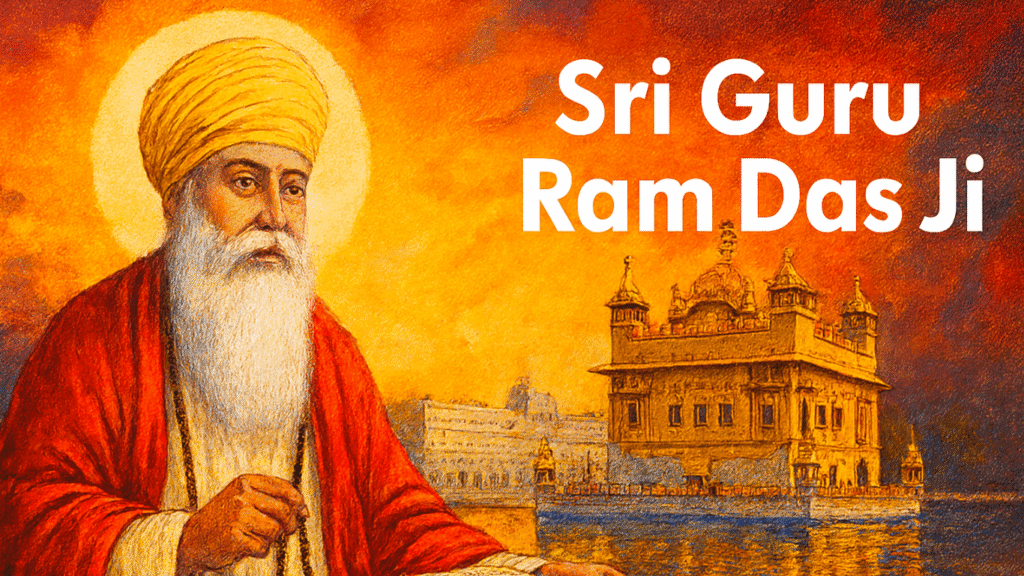
Sri Guru Angad Dev Ji, the second Guru of Sikhism, assumed Guruship in 1539 A.D. after Sri Guru Nanak Dev Ji and led the Sikh community until 1552 A.D. His tenure was a turning point in Sikh history. At a time when Sikhism was still in its formative phase and faced threats from dominant religious traditions and emerging sects, Guru Angad Dev Ji laid a strong foundation for its distinct identity.
His contributions were not just spiritual but also social, linguistic, and organizational. From popularising the Gurmukhi script to expanding the Langar system, preserving sacred hymns, and promoting physical fitness, Guru Ji’s legacy is a blend of wisdom, foresight, and action. This article explores his life and achievements in detail, tailored for aspirants preparing for competitive exams and those seeking deeper understanding of Sikh heritage.
Sikhism in Crisis: The Challenges of 1539
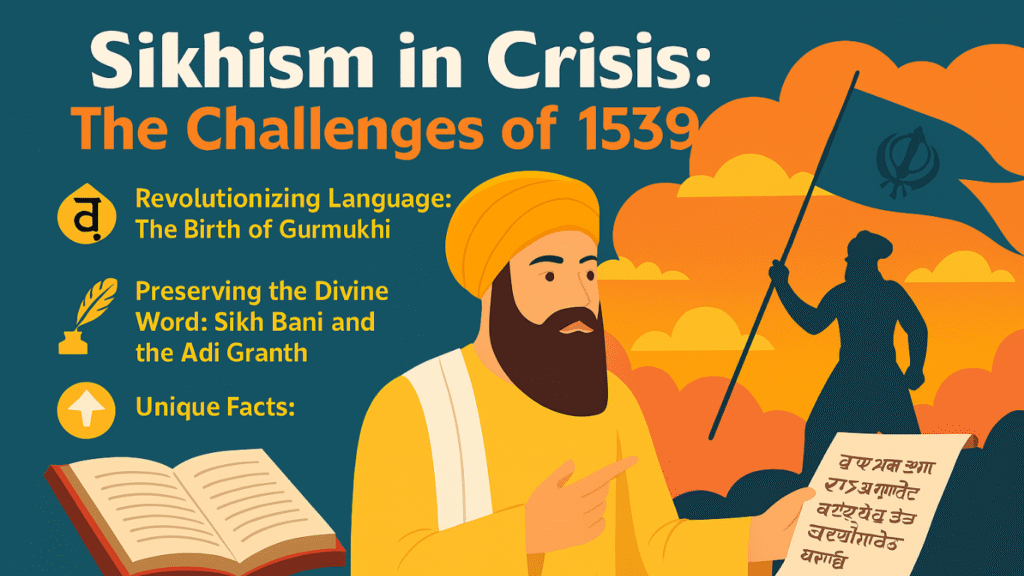
When Guru Angad Dev Ji took over the mantle of Sikh leadership, Sikhism was at a crossroads. Though Guru Nanak Dev Ji had spread his teachings far and wide, the number of followers was still small compared to Hinduism. The rituals of Sikhs and Hindus were so similar that there was a real fear of Sikhism being absorbed into Hinduism.
Adding to this challenge was the rise of the Udasi sect, founded by Baba Sri Chand Ji, the elder son of Guru Nanak Dev Ji. The Udasis emphasized renunciation and asceticism, which attracted many Sikhs. This was in direct contrast to Guru Nanak Dev Ji’s teachings that promoted family life and social responsibility. Guru Angad Dev Ji had to act decisively to preserve the purity and uniqueness of Sikhism.
Revolutionizing Language: The Birth of Gurmukhi
One of Guru Angad Dev Ji’s most transformative contributions was the development and popularisation of the Gurmukhi script. At that time, Sanskrit was the dominant religious language, controlled by Brahmins. It was inaccessible to the common people, creating a divide between religious knowledge and the masses.
Guru Angad Dev Ji refined and standardized the Gurmukhi script, making it easier to learn and use. This script became the medium for writing Sikh scriptures and teachings. The word “Gurmukhi” literally means “from the mouth of the Guru,” symbolizing divine wisdom and accessibility.
By promoting Gurmukhi, Guru Ji empowered ordinary people to read and understand spiritual texts. It also helped distinguish Sikhism from Hinduism and challenged the monopoly of Sanskrit, striking a blow to caste-based religious control.
Unique Fact:
Guru Angad Dev Ji personally taught Gurmukhi to children and encouraged its use in daily life. This grassroots approach made literacy a spiritual duty and laid the foundation for Sikh educational traditions.
Preserving the Divine Word: Sikh Bani and the Adi Granth
Guru Angad Dev Ji understood the importance of preserving the original teachings of Guru Nanak Dev Ji. He carefully collected and safeguarded Guru Nanak’s hymns (Bani), ensuring they remained authentic and free from distortion. This was a monumental task, as oral transmission could easily lead to changes or misinterpretations.
In addition to preserving existing hymns, Guru Angad Dev Ji composed 62 Sabads under the name ‘Nanak,’ continuing the poetic and spiritual tradition. These compositions later became part of the Adi Granth Sahib Ji, the central scripture of Sikhism.
Unique Fact:
Guru Angad Dev Ji’s efforts in preserving Bani were so meticulous that he rejected any hymn that did not match Guru Nanak’s style or message, ensuring doctrinal purity.
Langar: The Kitchen of Equality
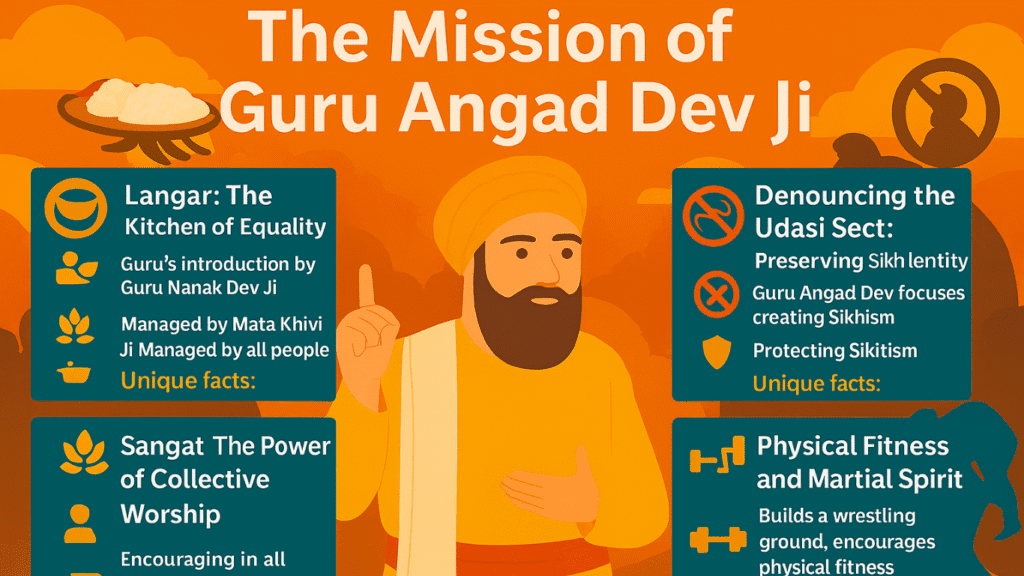
The Langar system, introduced by Guru Nanak Dev Ji, was expanded and institutionalized by Guru Angad Dev Ji. Langar is a community kitchen where free meals are served to all, regardless of caste, religion, gender, or social status.
During Guru Angad Dev Ji’s time, Langar was managed by Mata Khivi Ji, his wife. She played a crucial role in organizing and maintaining the kitchen, setting an example of service and leadership.
People sat together in rows (Pangat) and ate the same food, symbolizing equality and unity. This practice shattered caste barriers and promoted social harmony.
Unique Fact:
Mata Khivi Ji is the only woman mentioned by name in the Guru Granth Sahib Ji, honored for her role in Langar—a testament to Sikhism’s respect for women and service.
Sangat: The Power of Collective Worship
Guru Angad Dev Ji strengthened the institution of Sangat, which means “holy congregation.” Sangat was open to all—men and women, rich and poor. People gathered every morning and evening to listen to hymns and share spiritual experiences.
This collective worship created a sense of belonging and unity among Sikhs. It also served as a platform for spreading the Guru’s teachings and organizing community efforts.
Unique Fact:
Guru Angad Dev Ji encouraged Sangat gatherings in villages, making spirituality a part of daily life and not confined to temples or elite circles.
Denouncing the Udasi Sect: Preserving Sikh Identity
The Udasi sect, founded by Baba Sri Chand Ji, emphasized renunciation and asceticism. While it retained some teachings of Guru Nanak Dev Ji, its focus on sanyas conflicted with Sikhism’s core belief in family life and social responsibility.
Guru Angad Dev Ji made it clear that Sikhism was a religion of householders. He publicly denounced the Udasi sect and emphasized that true Sikhs must live in society, fulfill their duties, and serve humanity.
This bold move protected Sikhism from dilution and preserved its original values.
Unique Fact:
Guru Angad Dev Ji’s rejection of Udasi practices was not just verbal—he refused to meet Baba Sri Chand Ji, sending a strong message about doctrinal integrity.
Physical Fitness and Martial Spirit
Guru Angad Dev Ji believed that a healthy body was essential for a healthy mind and soul. He built a wrestling ground at Khadur Sahib and encouraged physical training among Sikhs.
This emphasis on fitness laid the foundation for the martial spirit that later evolved into the Khalsa under Guru Hargobind Ji and Guru Gobind Singh Ji.
Unique Fact:
Guru Ji personally participated in wrestling matches and used them as metaphors for spiritual struggle, teaching that discipline and strength were vital for both body and soul.
Meeting with Humayun: A Lesson in Courage
In 1540 A.D., after losing a battle to Sher Shah Suri, Mughal Emperor Humayun visited Guru Angad Dev Ji at Khadur Sahib. Guru Ji was in deep meditation and did not respond immediately. Feeling insulted, Humayun drew his sword.
Guru Angad Dev Ji calmly opened his eyes and said, “Where was this sword during your battle with Sher Shah Suri?” Humayun was ashamed and asked for forgiveness.
This encounter highlighted Guru Ji’s courage and wisdom. It also established friendly relations between Sikhs and the Mughals, which proved beneficial in later years.
Unique Fact:
This meeting is one of the earliest recorded interactions between Sikh Gurus and Mughal rulers, setting the tone for future diplomacy and resistance.
Nomination of Guru Amar Das Ji: Ensuring Continuity
One of Guru Angad Dev Ji’s greatest services was the nomination of his successor. After careful consideration, he chose Bhai Amar Das Ji, a devoted disciple known for his humility and service.
Guru Ji placed a coconut and five paise before him and bowed his head, symbolizing the transfer of spiritual authority. This ensured the continuity of Sikh leadership and values.
Guru Angad Dev Ji merged with the Divine on 29 March 1552 A.D., leaving behind a legacy of strength, clarity, and devotion.
Unique Fact:
Guru Amar Das Ji was 73 years old when he became Guru, proving that spiritual leadership is based on merit and devotion, not age or lineage.
The Legacy of Sri Guru Angad Dev Ji
Sri Guru Angad Dev Ji’s contributions to Sikhism were profound and far-reaching. He:
- Popularised the Gurmukhi script, making spiritual knowledge accessible.
- Preserved the hymns of Guru Nanak Dev Ji with utmost care.
- Expanded the Langar system, promoting equality and charity.
- Strengthened the Sangat, fostering unity and collective worship.
- Denounced the Udasi sect, preserving Sikhism’s core values.
- Promoted physical fitness, laying the foundation for martial spirit.
- Handled political challenges with courage and wisdom.
- Ensured smooth succession by nominating Guru Amar Das Ji.
His leadership transformed Sikhism from a budding movement into a distinct and organized faith. For aspirants preparing for competitive exams, understanding Guru Angad Dev Ji’s life is essential—not just for historical knowledge but for appreciating the values of equality, service, and resilience.