In the golden pages of Punjab’s spiritual history, few figures shine as brightly as Sri Guru Amar Das Ji, the third Guru of Sikhism. Born in 1479, his life was a testament to humility, service, and revolutionary reform. From a devout Vaishnavite to a transformative Sikh leader, Guru Amar Das Ji’s journey is not just a biography—it’s a blueprint for aspirants seeking purpose, leadership, and legacy.
Birth and Early Life: A Seed of Devotion
Sri Guru Amar Das Ji was born on 5th May 1479 in Basarke village, located in the Amritsar district of Punjab. His father, Tej Bhan Ji, was a well-to-do farmer and trader. Though historical records differ on his mother’s name—some mention Lakhmi Ji, Rup Kaur Ji, Sulakhni Ji, and others—her spiritual influence was evident in his early religious leanings.
From childhood, Amar Das Ji was drawn to spirituality. Influenced by his Vaishnavite parents, he became a follower of Vaishnavism, a sect devoted to Lord Vishnu. He regularly undertook pilgrimages to Haridwar, believing that bathing in the Ganges would cleanse his sins.
At the age of 24, he married Mansa Devi Ji, daughter of Devi Chand. Together, they had two sons—Baba Mohan Ji and Baba Mohri Ji—and two daughters—Bibi Dani Ji and Bibi Bhani Ji. His family life was simple, yet deeply rooted in spiritual values.
The Turning Point: Meeting Guru Angad Dev Ji
One day, returning from Haridwar, Amar Das Ji met a Sadhu who asked, “Who is your Guru?” Amar Das Ji replied, “I have none.” The Sadhu rebuked him, saying that without a Guru, all his spiritual efforts were in vain. This moment shook Amar Das Ji to his core.
Soon after, he visited Khadur Sahib, where he met Sri Guru Angad Dev Ji, the second Sikh Guru. Introduced by Bibi Amro Ji (Guru Angad Dev Ji’s daughter and Amar Das Ji’s niece-in-law), he was deeply moved by the Guru’s teachings. At age 62, Amar Das Ji became a devoted disciple.
Years of Service: The Humble Path to Guruship
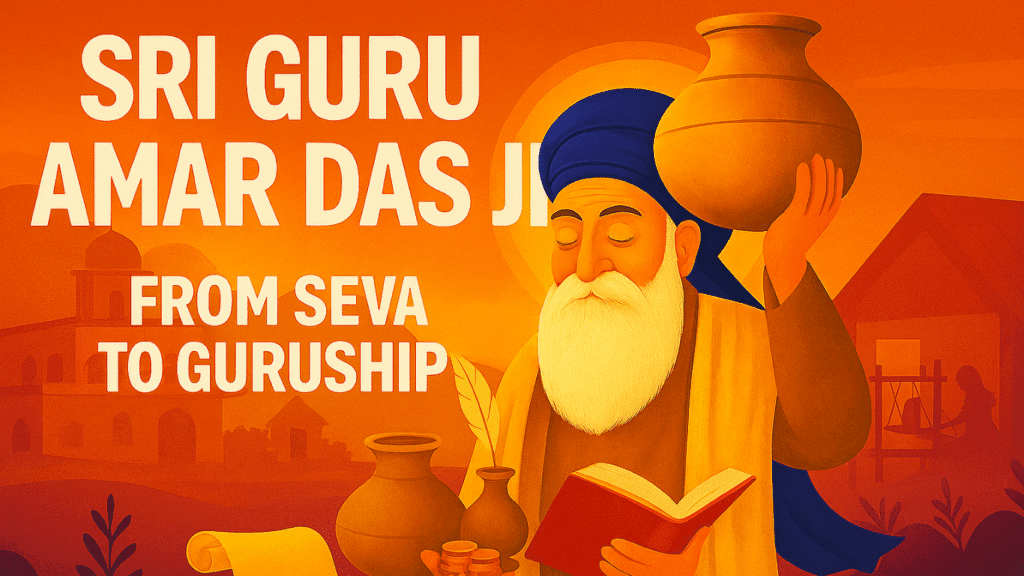
For 11 years, Amar Das Ji served Guru Angad Dev Ji with unmatched devotion. Every morning, he walked three miles to fetch water from the Beas River for the Guru’s bath. He also managed the Langar (community kitchen) and welcomed the Sangat (devotees) with love and respect.
One night, while carrying water, he stumbled and fell. A nearby weaver’s wife remarked, “It must be Amru Nithawan”—meaning “Amar Das, the shelterless.” When Guru Angad Dev Ji heard this, he declared that Amar Das Ji would now be the shelter for the shelterless.
On 16th March 1552, Guru Angad Dev Ji placed five paisas and a coconut before Amar Das Ji and bowed to him, officially appointing him as the third Guru of Sikhism at the age of 73.
Establishing Goindwal Sahib: A Spiritual Capital
After becoming Guru, Amar Das Ji moved to Goindwal Sahib, transforming it into a spiritual hub. He constructed a Baoli Sahib (stepwell) with 84 steps, symbolizing liberation from the cycle of birth and death. Devotees were encouraged to recite Japji Sahib on each step.
Goindwal became the first official Sikh pilgrimage center, breaking the monopoly of Hindu sacred sites and offering a place of worship rooted in equality and devotion.
Challenges and Opposition
1. Resistance from Guru Angad Dev Ji’s Sons
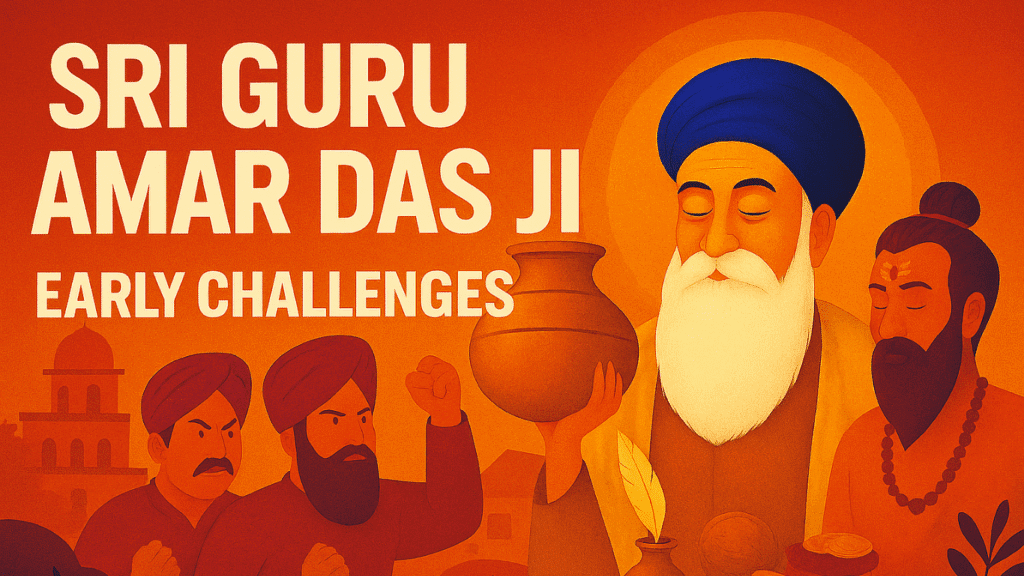
Dasu and Datu, sons of Guru Angad Dev Ji, opposed Amar Das Ji’s Guruship. They believed that Guruship should pass by lineage. While Dasu later accepted Guru Ji’s leadership, Datu remained hostile, even attempting to physically harm Guru Ji. Despite this, Guru Ji responded with forgiveness and grace.
2. Conflict with Baba Sri Chand Ji
Baba Sri Chand Ji, son of Guru Nanak Dev Ji and founder of the Udasi sect, believed in renunciation and asceticism. Guru Amar Das Ji clarified that Sikhism emphasized householder life, service, and social responsibility. His reasoning convinced the Sikhs to distance themselves from Udasi ideology.
3. Opposition from Upper-Caste Hindus
Guru Ji’s reforms—like Langar for all, abolition of caste, and equality for women—angered upper-caste Hindus. They complained to Emperor Akbar, accusing Guru Ji of anti-Hindu activities. Guru Ji sent Bhai Jetha Ji (later Guru Ram Das Ji) to represent him. Akbar was impressed and dismissed all charges.
Social Reforms: A New Dawn for Sikhism
Guru Amar Das Ji’s legacy lies in his bold reforms and spiritual contributions:
Langar System
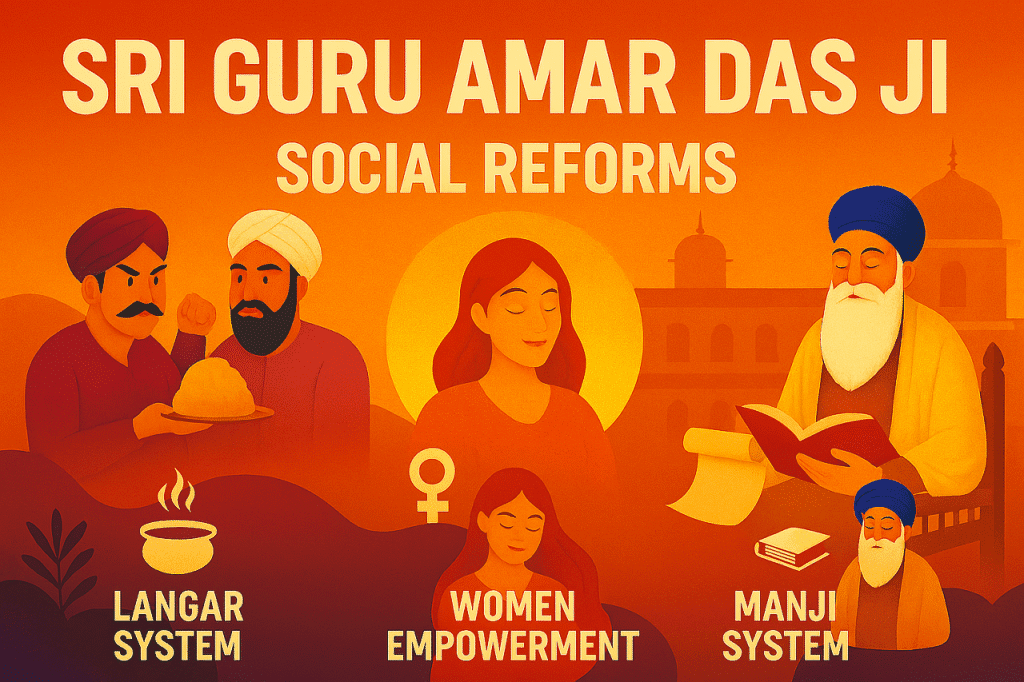
He made it compulsory for everyone—rich or poor, Hindu or Muslim—to eat together in the Langar before meeting him. This practice broke caste barriers and promoted equality.
Women Empowerment
Guru Ji uplifted women by:
- Prohibiting Sati Pratha (widow burning)
- Opposing Purdah system (veil)
- Encouraging widow remarriage
- Promoting inter-caste marriages
Manji System
To manage the growing Sikh community, Guru Ji introduced the Manji system—appointing 22 missionaries to spread Sikh teachings across Punjab. Each missionary was responsible for a region and reported directly to the Guru.
Unique Fact: Guru Ji’s Silent Revolution
Unlike political leaders, Guru Amar Das Ji led a silent revolution. He didn’t use force or power—he used service, logic, and love. His reforms were so impactful that even Emperor Akbar adopted the Langar tradition in his court.
Literary Contributions: The Voice of Wisdom
Guru Amar Das Ji composed 907 hymns, including the Anand Sahib, which is recited daily by devout Sikhs. His writings emphasized:
- Devotion to one God
- Rejection of rituals
- Importance of honest living
- Equality of all human beings
His verses are included in the Guru Granth Sahib, the holy scripture of Sikhism. They reflect deep spiritual insight and practical wisdom.
Succession and Legacy
Before his passing on 1st September, 1574, Guru Amar Das Ji appointed his son-in-law Bhai Jetha Ji (later Guru Ram Das Ji) as the fourth Guru. His decision was based on merit, not lineage—reinforcing the Sikh principle of equality and capability.
He passed away at Goindwal Sahib, leaving behind a legacy of compassion, courage, and reform.
A Legacy Rooted in Equality and Empowerment
Guru Amar Das Ji’s contributions weren’t just spiritual—they were social revolutions. His reforms challenged centuries-old caste hierarchies, gender discrimination, and ritualistic practices. He didn’t preach from a throne—he served from the ground. His teachings were lived, not just spoken.
He taught that:
- Service (Seva) is the highest form of worship.
- Equality is not optional—it’s divine.
- Spirituality must be practical and inclusive.
His legacy laid the foundation for Sikhism’s core values: Naam Japna (meditating on God’s name), Kirat Karni (honest living), and Vand Chakna (sharing with others).
Relevance for Today’s Aspirants
For students preparing for competitive exams, Guru Amar Das Ji’s life offers:
- Historical depth for Punjab GK and Indian history sections.
- Grammar and comprehension examples in both Punjabi and English.
- Vocabulary enrichment through spiritual and reformist terminology.
- Essay and article inspiration for ethics, leadership, and social justice topics.
- Practice material for previous year papers and mock tests.
Whether you’re preparing for Punjab PCS, SSC, UPSC, Teaching Exams, or Banking, Guru Ji’s story is a goldmine of values, facts, and inspiration.
Unique Facts to Remember
Here are some lesser-known but powerful facts about Guru Amar Das Ji that can help aspirants stand out:
- He became Guru at age 73, after decades of spiritual search.
- He built Baoli Sahib with 84 steps, symbolizing liberation from rebirth.
- He introduced Anand Sahib, a hymn of bliss and spiritual joy.
- He made Langar compulsory before meeting the Guru—breaking caste barriers.
- He appointed 22 Manjis to spread Sikh teachings across regions.
- He empowered women by opposing Sati, Purdah, and promoting widow remarriage.
- He sent Bhai Jetha Ji to Emperor Akbar’s court, who cleared all false charges.
- He established Sikh festivals like Baisakhi and Diwali as spiritual gatherings.
- He emphasized householder life, rejecting asceticism and ritualism.
- He separated Sikhism from the Udasi sect, preserving Guru Nanak’s original teachings.
A Guru for All Generations
Sri Guru Amar Das Ji’s life is not just a chapter in history—it’s a living guide for every aspirant, educator, and seeker. His message of equality, service, and spiritual wisdom transcends time and speaks directly to the heart.
In today’s world, where divisions still exist, Guru Ji’s teachings remind us:
- To serve without pride.
- To lead without ego.
- To live without fear.
He was the shelter for the shelterless, the voice for the voiceless, and the light for the lost. His legacy continues to inspire millions—and now, it’s your turn to carry it forward.