Imagine a time when the Sikh community was still finding its shape—its scripture unwritten, its sacred center unbuilt, its voice scattered across regions. Then came a divine soul who didn’t just guide the Sikhs—he sculpted their spiritual identity, brick by brick, verse by verse, heart by heart.
That soul was Sri Guru Arjan Dev Ji, the fifth Guru of Sikhism. From 1581 to 1606 A.D., his leadership marked a golden chapter in Sikh history—a chapter every aspirant must know, not just for exams, but for understanding the roots of resilience, unity, and spiritual brilliance.
Whether you’re preparing for UPSC, PCS, SSC, or any other competitive exam, this journey through Guru Arjan Dev Ji’s contributions will not only help you score marks—it will inspire you. Because this isn’t just history. It’s heritage. It’s the story of how one Guru transformed a growing faith into a powerful, organized, and inclusive movement.
From the shimmering waters of Harmandir Sahib to the divine verses of Adi Granth Sahib Ji, from the founding of cities to the creation of the Masand system, Guru Arjan Dev Ji’s legacy is a roadmap of spiritual and social evolution. His vision laid the foundation for Sikhism’s future—strong, compassionate, and fearless.
Let’s walk together through this transformative era. Let’s decode each milestone, each sacrifice, and each act of brilliance. Because when you understand Guru Arjan Dev Ji—not just as a historical figure, but as a visionary—you don’t just prepare for an exam. You prepare to carry forward a legacy.
Harmandir Sahib: The Eternal Beacon of Humility, Equality, and Sikh Identity

In the heart of Amritsar, surrounded by the sacred waters of Amrit Sarovar, stands a monument that is not just a temple—it is the soul of Sikhism. Harmandir Sahib, also known as the Golden Temple, is the most revered spiritual site for Sikhs worldwide. But its story is not merely architectural—it is a tale of humility, inclusivity, and divine vision, brought to life by Sri Guru Arjan Dev Ji, the fifth Guru of Sikhism.
Vision and Foundation: A Temple for All Humanity
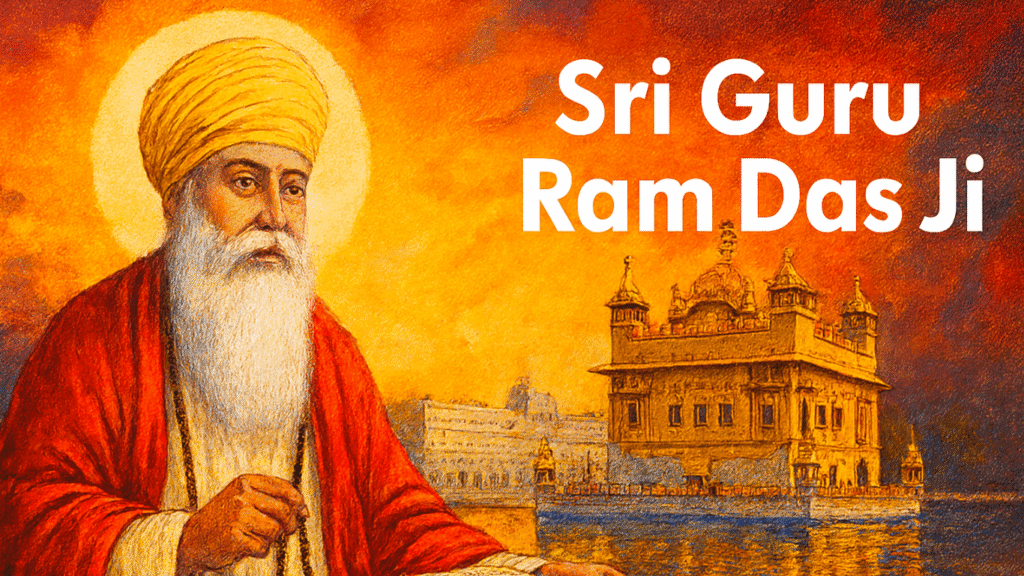
The journey of Harmandir Sahib began with Guru Ram Das Ji, who initiated the excavation of Amrit Sarovar—a sacred pool meant to purify the soul. But it was Guru Arjan Dev Ji who envisioned something far greater: a temple at the center of this pool, open to all, regardless of caste, creed, or background.
In 1588 A.D., Guru Ji invited the renowned Sufi saint Mian Mir of Lahore to lay the foundation stone. This act was revolutionary—it symbolized interfaith harmony and the Guru’s deep respect for spiritual wisdom beyond religious boundaries. For aspirants, this moment is a key example of Sikhism’s inclusive ethos and Guru Arjan Dev Ji’s diplomatic foresight.
Architectural Symbolism: Humility Over Grandeur
Unlike traditional temples built on elevated platforms, Guru Arjan Dev Ji instructed that Harmandir Sahib be constructed lower than surrounding buildings. When questioned, he replied, “He who is humble shall be exalted.” This wasn’t just a design choice—it was a spiritual declaration. The temple’s architecture itself became a living sermon, teaching that true greatness lies in humility.
This principle is vital for competitive exam aspirants studying Sikh philosophy, as it reflects the core Sikh value of egolessness (Nimrata)—a recurring theme in Sikh scripture and ethics.
Four Doors, One Humanity
Another groundbreaking feature was the temple’s four entrances, each facing a cardinal direction—North, South, East, and West. This design was deliberate and deeply symbolic. It proclaimed that people from all directions and walks of life were welcome in the house of God. In a society fractured by caste and religious divisions, Guru Ji’s temple stood as a sanctuary of unity.
Completion and Consecration: A Spiritual Milestone
The construction of Harmandir Sahib was completed in 1601 A.D., and it quickly became the spiritual nucleus of Sikhism. It wasn’t just a place of worship—it was a center of learning, community service, and divine music (Kirtan). Guru Arjan Dev Ji himself composed many hymns that were sung here, creating an atmosphere of peace and devotion.
Later, in 1604 A.D., Guru Ji installed the Adi Granth Sahib Ji—the first compilation of Sikh scripture—inside Harmandir Sahib. This act elevated the temple’s sanctity and made it the repository of Sikh spiritual wisdom.
Exam-Relevant Facts and Insights
Here are some key points aspirants should remember for competitive exams:
| Feature | Detail | Relevance |
|---|---|---|
| Foundation Year | 1588 A.D. | Laid by Mian Mir, symbolizing interfaith harmony |
| Completion Year | 1601 A.D. | Became the central shrine of Sikhism |
| Architectural Symbolism | Built lower than surroundings | Reflects humility, a core Sikh value |
| Four Entrances | North, South, East, West | Signifies openness to all communities |
| Installation of Adi Granth | 1604 A.D. | Made Harmandir Sahib the spiritual and literary center of Sikhism |
Tarn Taran: Where Waters Whisper Liberation and Faith Finds a Home

In the fertile plains of Majha, where the spirit of Punjab pulses through every grain of soil, Sri Guru Arjan Dev Ji planted not just a city—but a sanctuary. In 1590 A.D., just 24 kilometers south of Amritsar, he founded Tarn Taran, a place destined to become a spiritual lighthouse for generations of Sikhs.
But Tarn Taran was more than geography. It was Guru Ji’s answer to the soul’s yearning for freedom. It was his gift to the people of Majha—a region rich in valor, yet longing for spiritual direction.
The Sacred Tank: A Mirror of Moksha
At the heart of Tarn Taran lies its most divine feature—a sacred tank, dug under Guru Ji’s guidance. Its name, Tarn Taran, means “Liberator of Transmigration”. Guru Ji proclaimed that those who bathe in its waters with devotion would be freed from the endless cycle of birth and death (Sansar da Chakra).
This holy tank is also the world’s largest sarovar, making Tarn Taran a place of great spiritual and historical significance.
Embracing the Jats of Majha: A Social Revolution
Guru Arjan Dev Ji’s message resonated deeply with the Jat community of Majha—farmers, warriors, and seekers of justice. Thousands embraced Sikhism, drawn by Guru Ji’s teachings of equality and divine grace. Their conversion wasn’t just spiritual—it was transformative. These Jats became the backbone of the Sikh Panth, offering their strength, service, and unwavering faith.
Tarn Taran as a Spiritual Hub
Under Guru Ji’s guidance, Tarn Taran blossomed into a center of devotion, learning, and community service. It became a place where Kirtan echoed through the air, where Langar fed the hungry, and where the teachings of the Gurus were lived—not just preached.
Even today, Tarn Taran remains one of the most sacred pilgrimage sites for Sikhs. Its annual gatherings, its historical Gurdwaras, and its tranquil waters continue to draw seekers from across the world.
Exam-Relevant Insights
| Feature | Detail | Relevance |
|---|---|---|
| Founded | 1590 A.D. | By Guru Arjan Dev Ji to spread Sikhism in Majha |
| Location | 24 km south of Amritsar | Strategic placement for regional outreach |
| Sacred Tank | Tarn Taran | Believed to offer liberation from transmigration |
| Social Impact | Conversion of Jats | Strengthened Sikhism’s rural and martial base |
| Spiritual Role | Pilgrimage site | Continues to be a center of Sikh devotion |
Kartarpur and Hargobindpur: Cities Born of Vision, Devotion, and Legacy
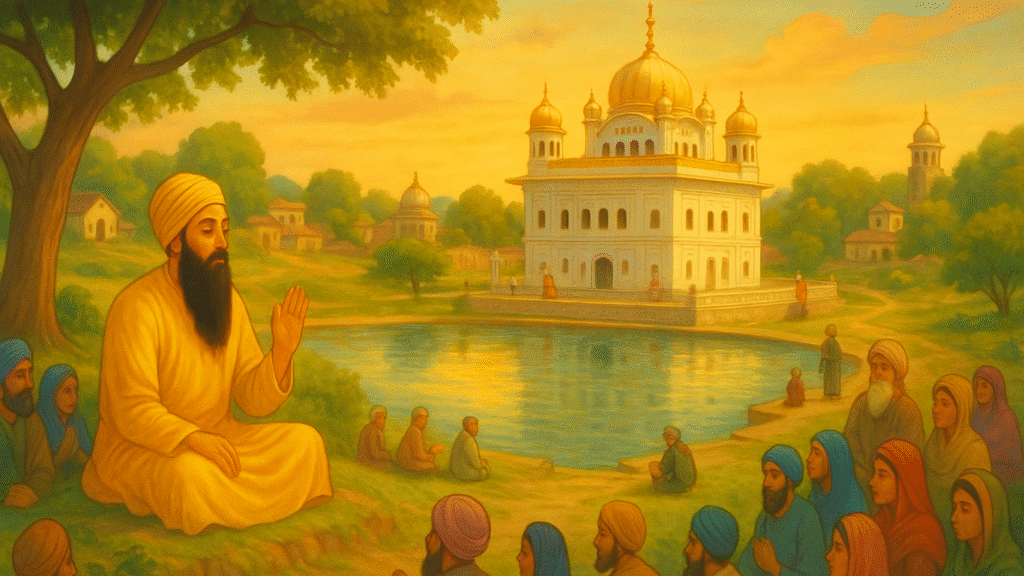
In the sacred geography of Punjab, where rivers whisper ancient truths and soil carries the footsteps of saints, Sri Guru Arjan Dev Ji sowed the seeds of two divine cities—Kartarpur and Hargobindpur. These were not mere settlements. They were spiritual sanctuaries, built with purpose, love, and foresight.
Kartarpur: The City of God
In 1593 A.D., Guru Arjan Dev Ji founded Kartarpur, meaning “The City of the Creator”, in the fertile Jalandhar Doab, nestled between the Beas and Sutlej rivers. This location was chosen not just for its strategic value, but for its spiritual resonance. Here, Guru Ji constructed the sacred Gangsar tank, and with divine authority, proclaimed its waters as holy as the Ganges.
This declaration was revolutionary. It challenged the monopoly of traditional Hindu pilgrimage sites and offered spiritual equality to all. For aspirants, Kartarpur represents Sikhism’s assertion of independent identity—a theme often tested in competitive exams.
Kartarpur quickly became a center of Sikh learning, devotion, and community service. Pilgrims gathered to hear Kirtan, scholars came to study Gurbani, and the spirit of Seva (selfless service) flowed through its streets.
Hargobindpur: A City of Celebration and Strength
Two years later, in 1595 A.D., Guru Ji celebrated the birth of his son Hargobind Ji by founding another town—Hargobindpur—on the banks of the Beas. This wasn’t just a gesture of joy; it was a strategic and spiritual move. Guru Ji foresaw the changing tides of history and began preparing the Sikh community for a more assertive future.
Hargobindpur became a symbol of continuity and transformation. It honored the birth of the future sixth Guru, who would later introduce the concept of Miri-Piri—the balance of spiritual and temporal power.
Exam-Relevant Insights
| Feature | Detail | Relevance |
|---|---|---|
| Kartarpur Founded | 1593 A.D. | Located in Jalandhar Doab between Beas and Sutlej |
| Gangsar Tank | Declared as sacred as the Ganges | Symbol of Sikh spiritual independence |
| Hargobindpur Founded | 1595 A.D. | Celebrated birth of Guru Hargobind Ji |
| Strategic Role | Both towns became spiritual hubs | Strengthened Sikh presence in Punjab |
| Cultural Impact | Promoted learning, devotion, and community | Key centers for Sikh propagation |
Kartarpur and Hargobindpur are not just dots on a map—they are living legacies of Guru Arjan Dev Ji’s divine vision. They remind us that cities can be built not just with bricks, but with Bani, Seva, and Sangat. They show us that every act of creation by a Guru carries layers of meaning—spiritual, social, and historical.
Boli at Lahore: A Well of Devotion, A Testament of Love
In the bustling lanes of Dhabbi Bazaar, Lahore—where merchants traded goods and voices echoed with everyday life—Sri Guru Arjan Dev Ji gifted the Sikh Sangat something far more precious than wealth or wares. He gave them a well, a Boli, carved not just into the earth, but into the hearts of the faithful.
This wasn’t a grand monument. It wasn’t a political statement. It was a humble act of love, born from the Guru’s deep connection with his Sangat.
A Guru Who Listened
The Sikh Sangat of Lahore, yearning for a tangible symbol of Guru Ji’s presence, requested him to visit their city. Guru Arjan Dev Ji, ever compassionate, responded not with sermons, but with service. He personally oversaw the construction of a Boli (well)—a source of water, yes, but more importantly, a source of spiritual nourishment.
A Sacred Site Born of Simplicity
The Boli in Dhabbi Bazaar became more than a well—it became a sacred site, a place where Sikhs gathered to remember the Guru’s kindness, humility, and accessibility. It symbolized that divine grace doesn’t always arrive in grandeur—it often flows through the simplest acts of care.
Even today, this well is revered by devotees, reminding them that Guru Arjan Dev Ji’s legacy lives not only in scriptures and shrines, but in every drop of water drawn with faith.
Exam-Relevant Insights
| Feature | Detail | Relevance |
|---|---|---|
| Location | Dhabbi Bazaar, Lahore | Strengthened Sikh presence in urban Punjab |
| Constructed | By Guru Arjan Dev Ji | On request of local Sikh Sangat |
| Type | Boli (Well) | Symbol of Guru’s humility and service |
| Spiritual Role | Sacred gathering site | Reinforced Guru-Sangat bond |
| Cultural Impact | Urban outreach | Demonstrates Sikhism’s inclusive expansion |
The Boli at Lahore is a reminder that true leadership flows from listening, serving, and loving. Guru Arjan Dev Ji didn’t just build a well—he built a bridge between the divine and the daily, between the Guru and the people.
Masand System: The Lifeline of Sikh Unity, Service, and Spiritual Expansion
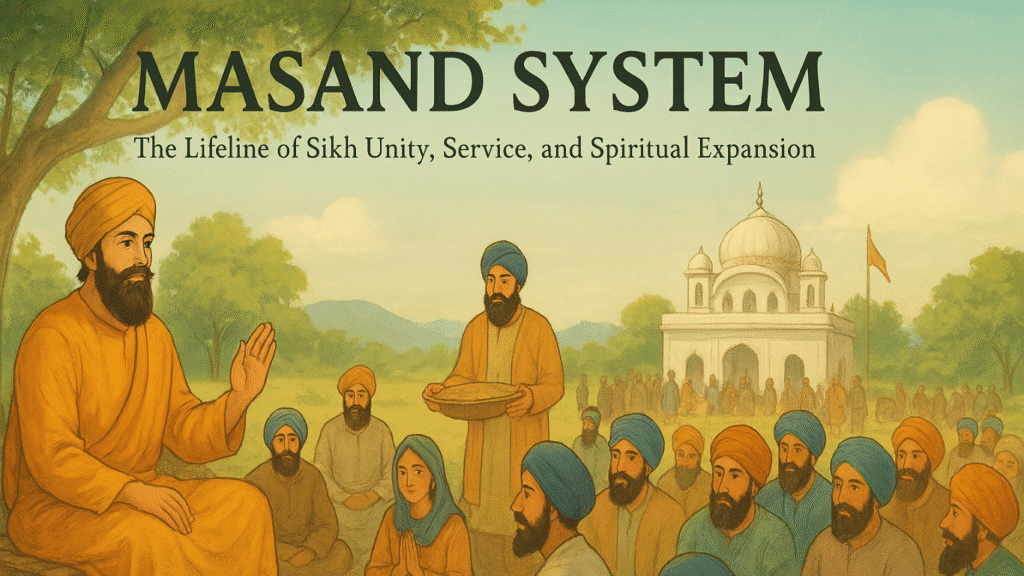
As the Sikh community grew in strength and numbers under the divine guidance of Sri Guru Arjan Dev Ji, so did the need for a structured system to nurture its spiritual flame and sustain its social mission. In response, Guru Ji didn’t just build temples—he built a network of trust, devotion, and responsibility. This was the Masand System—a visionary framework that transformed Sikhism from a regional faith into a pan-Indian spiritual movement.
Origins and Evolution: From Guru Ram Das Ji to Guru Arjan Dev Ji
The seeds of the Masand system were first sown by Guru Ram Das Ji, the fourth Guru, who appointed trusted disciples to represent him in distant regions. But it was Guru Arjan Dev Ji who expanded and institutionalized this system, turning it into a spiritual and administrative backbone of the Sikh Panth.
The word Masand comes from the Persian “masan”, meaning “raised platform”—a reference to the elevated seat from which these representatives addressed the Sangat. But their role was far more than symbolic.
Who Were the Masands?
Masands were handpicked emissaries of the Guru, chosen for their integrity, devotion, and leadership. They were tasked with:
- Spreading Sikh teachings in far-off regions
- Organizing local Sangats (congregations)
- Collecting Daswandh—the sacred offering of one-tenth of a Sikh’s income
- Maintaining Langar and community welfare programs
- Reporting back to the Guru during major gatherings like Baisakhi and Diwali
This system allowed Guru Arjan Dev Ji to stay spiritually connected with Sikhs across India, from Kabul to Bengal, without the need for physical travel.
Sustaining Langar and Seva
One of the most beautiful aspects of Sikhism is the Langar—the free community kitchen that feeds all, regardless of religion, caste, or status. But feeding thousands daily required resources. Through the Masand system, Guru Ji ensured a steady flow of Daswandh, which funded Langar, construction of Gurdwaras, and support for the poor.
A Spiritual Network Across India
Under Guru Arjan Dev Ji, the Masand system became a spiritual web that connected Sikhs from Punjab to the Deccan, from Sindh to Assam. It created a sense of belonging, discipline, and shared purpose. Masands became the voice of the Guru in every village and town, ensuring that no Sikh felt distant from the divine.
This decentralized yet unified structure is often cited in exams as a model of religious organization and community mobilization.
Exam-Relevant Insights
| Feature | Detail | Relevance |
|---|---|---|
| Origin | Initiated by Guru Ram Das Ji | Expanded by Guru Arjan Dev Ji |
| Meaning of “Masand” | Persian: “High platform” | Symbolic of their elevated role |
| Duties | Preaching, collecting Daswandh, managing Langar | Strengthened Sikh administration |
| Financial Role | Collected 1/10th income (Daswandh) | Funded community services and Gurdwaras |
| Spiritual Role | Represented Guru in distant regions | Ensured unity and doctrinal consistency |
| Reporting | Returned to Amritsar on Baisakhi & Diwali | Strengthened central authority |
The Masand system was more than a management tool—it was a sacred trust. It reflected Guru Arjan Dev Ji’s deep understanding of human nature and community dynamics. He knew that faith must be nourished not just with words, but with structure, service, and shared responsibility.
Compilation of Adi Granth Sahib Ji: The Eternal Light That Illuminates Sikhism
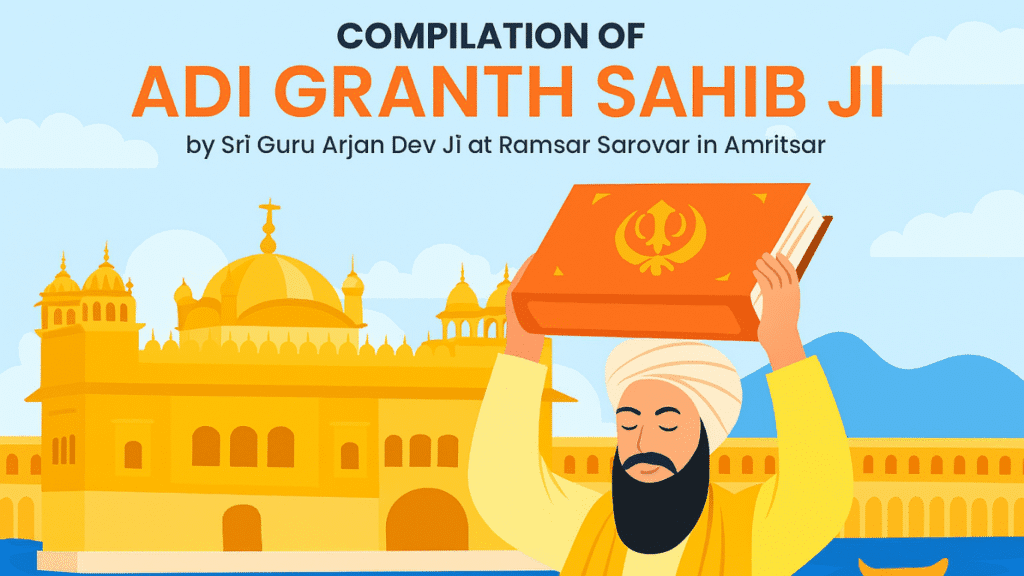
In the quiet sanctity of Ramsar Sarovar, where the waters reflect the sky and the soul finds peace, Sri Guru Arjan Dev Ji undertook a divine mission that would forever shape the destiny of Sikhism. It was here, in 1604 A.D., that the Guru began compiling the Adi Granth Sahib Ji—a scripture not just of verses, but of vision, unity, and divine truth.
This wasn’t merely a literary endeavor. It was a spiritual revolution. Guru Ji knew that the Sikh Panth needed a central, uncorrupted source of divine wisdom—a scripture that would preserve the teachings of the Gurus and protect the community from distortion and division.
The Sacred Process: From Voice to Verse
Guru Arjan Dev Ji dictated the hymns to Bhai Gurdas Ji, a scholar of unmatched intellect and devotion. Messages were sent across the Sikh world, requesting disciples to share authentic compositions of the previous Gurus. Despite initial resistance, Baba Mohan, son of Guru Amar Das Ji, eventually handed over two volumes of sacred hymns—an act of grace that enriched the compilation.
This process was meticulous, reverent, and inclusive. Guru Ji didn’t just collect verses—he curated a spiritual symphony, ensuring every hymn aligned with the gospel of Guru Nanak Dev Ji.
Contents of Adi Granth Sahib Ji
The Adi Granth included:
- Hymns of Guru Nanak Dev Ji, Guru Angad Dev Ji, Guru Amar Das Ji, Guru Ram Das Ji, and Guru Arjan Dev Ji himself—who contributed the most hymns (2216).
- Verses from 15 Bhagats, including Kabir, Shaikh Farid, and Ravidas, representing diverse spiritual traditions.
- Compositions of 11 Bhatts (court poets) and 4 Gursikhs, whose devotion echoed the Guru’s teachings.
- Exclusion of writings by Kanha, Shah Hussain, Pillo, and Chaju, as they did not align with Sikh doctrine.
This inclusivity was revolutionary. It showed that truth transcends caste, creed, and religion—a principle aspirants must remember when studying Sikh philosophy and interfaith harmony.
Installation in Harmandir Sahib
Once completed, the Adi Granth was ceremoniously installed in Harmandir Sahib, the spiritual heart of Sikhism. Baba Buddha Ji, a revered Sikh elder, was appointed the first Granthi, carrying the scripture on his head in a divine procession from Ramsar to the temple.
This act wasn’t just ceremonial—it was symbolic of the Guru’s humility and reverence for Gurbani. It marked the beginning of a tradition where scripture became the Guru, guiding the community with eternal wisdom.
From Adi Granth to Sri Guru Granth Sahib Ji
Later, Guru Gobind Singh Ji, the tenth Guru, added the hymns of Guru Tegh Bahadur Ji (116 in total) and declared the scripture as the eternal Guru of the Sikhs—Sri Guru Granth Sahib Ji. With this, the lineage of human Gurus ended, and the spiritual authority was vested in the divine word.
For aspirants, this transition is a critical milestone in Sikh history, often asked in exams as the moment when Guru Granth Sahib Ji became the final Guru.
Exam-Relevant Insights
| Feature | Detail | Relevance |
|---|---|---|
| Compilation Year | 1604 A.D. | At Ramsar Sarovar, Amritsar |
| Compiler | Guru Arjan Dev Ji | Dictated to Bhai Gurdas Ji |
| Contributors | 5 Gurus, 15 Bhagats, 11 Bhatts, 4 Gursikhs | Reflects interfaith inclusivity |
| Most Hymns | Guru Arjan Dev Ji (2216) | Shows his literary and spiritual depth |
| First Installation | Harmandir Sahib | Baba Buddha Ji as first Granthi |
| Final Form | Sri Guru Granth Sahib Ji | Declared by Guru Gobind Singh Ji |
The Adi Granth Sahib Ji is not just a book—it is the heartbeat of Sikhism, the voice of the Gurus, and the light that guides every seeker. It speaks of love, justice, humility, and divine unity. It embraces saints from all walks of life and teaches that God resides in every heart that seeks truth.
Horse Trade: Breaking Barriers, Building Prosperity and Pride

In the era of Sri Guru Arjan Dev Ji, Sikhism was not just a spiritual path—it was a movement of empowerment. Guru Ji understood that faith must walk hand in hand with dignity, and dignity often comes from economic independence. That’s why, in a bold and visionary move, Guru Arjan Dev Ji encouraged Sikhs to engage in horse trade beyond the Indus, especially with Arab countries.
This wasn’t just commerce—it was courage in motion.
Economic Empowerment: Trade as a Tool of Upliftment
Horses were a prized commodity in medieval India, essential for transport, agriculture, and warfare. By entering the horse trade, Sikhs tapped into a high-value market, increasing their wealth and status. Guru Ji’s encouragement helped many Sikhs become successful traders and skilled horsemen, transforming their livelihoods and strengthening the community’s economic base.
For aspirants, this initiative is a key example of Guru-led economic reform—a topic often explored in questions on medieval Indian society and Sikh history.
Skill and Strength: Preparing for the Future
Horse trading wasn’t just about profit—it was about preparation. Guru Arjan Dev Ji foresaw the need for Sikhs to be physically capable and strategically aware. By mastering horse riding and trade logistics, Sikhs became agile, mobile, and resilient—qualities that would later prove vital under Guru Hargobind Ji’s martial leadership.
This transition from peaceful devotion to martial readiness is a recurring theme in Sikh history.
Social Reform: Shattering Caste Boundaries
Perhaps the most revolutionary aspect of this initiative was its challenge to caste restrictions and Hindu superstitions. Traditional Hindu beliefs discouraged crossing the Indus River, fearing ritual impurity. Guru Arjan Dev Ji shattered this barrier, declaring that spiritual purity lies in intention, not geography.
By encouraging Sikhs to trade beyond borders, Guru Ji promoted social mobility, inter-cultural engagement, and fearless living. This act was a direct blow to caste orthodoxy, reinforcing Sikhism’s core values of equality and liberation.
Exam-Relevant Insights
| Feature | Detail | Relevance |
|---|---|---|
| Trade Encouraged | Horse trade beyond Indus | Boosted Sikh economic prosperity |
| Key Markets | Arab countries | Expanded Sikh commercial reach |
| Skills Developed | Horse riding, trade logistics | Prepared Sikhs for future martial roles |
| Social Impact | Challenged caste restrictions | Promoted equality and courage |
| Strategic Role | Economic and physical empowerment | Strengthened Sikh community resilience |
Guru Arjan Dev Ji didn’t just teach through hymns—he taught through action. His encouragement of horse trade was a message to every Sikh: “You are not bound by superstition. You are born to rise.” It was a call to break barriers, build prosperity, and ride with pride.
Relations with Emperor Akbar: A Bond of Reverence, Resilience, and Respect

In an age when religious intolerance often cast shadows over spiritual movements, Sri Guru Arjan Dev Ji stood as a beacon of peace and dialogue. His relationship with Mughal Emperor Akbar, one of the most enlightened rulers of medieval India, was not just diplomatic—it was deeply respectful, rooted in mutual admiration and shared values.
This bond became a shield for Sikhism, protecting it during its formative years and allowing it to flourish under Guru Ji’s visionary leadership.
Akbar’s Legacy of Tolerance
Emperor Akbar, known for his policy of Sulh-e-Kul (universal peace), had long admired the Sikh Gurus. His respect for Guru Amar Das Ji laid the foundation for his cordial ties with Guru Arjan Dev Ji. Akbar’s court was a melting pot of ideas, and he welcomed voices that spoke of unity, humility, and divine love—values that resonated deeply with Sikh teachings.
Deflecting Detractors: Truth Over Falsehood
Despite this harmony, Guru Ji faced relentless opposition from detractors like Prithia (his jealous elder brother), Chandu Shah (a powerful Mughal official), and orthodox factions who feared the growing influence of Sikhism. They tried to poison Akbar’s mind with false accusations, claiming that the Adi Granth Sahib Ji contained verses offensive to Islam.
But Akbar, true to his character, personally reviewed the scripture. Upon reading its divine hymns, he declared it worthy of reverence, silencing the critics and reaffirming his trust in Guru Ji.
This moment is a powerful example of interfaith respect and intellectual integrity, and a key milestone in Sikh-Mughal relations.
Reduction in Land Revenue: A Gesture of Grace
At Guru Ji’s humble request, Akbar reduced land revenue by 10%, easing the burden on farmers and strengthening the Sikh community’s economic foundation. This act wasn’t just administrative—it was a gesture of goodwill, reflecting Akbar’s recognition of Guru Ji’s leadership and compassion.
Exam-Relevant Insights
| Feature | Detail | Relevance |
|---|---|---|
| Relationship | Cordial ties with Akbar | Protected Sikhism during formative years |
| Accusations | False claims about Adi Granth | Reviewed and dismissed by Akbar |
| Akbar’s Verdict | Scripture is worthy of reverence | Reinforced Sikh legitimacy |
| Revenue Reduction | 10% cut in land tax | Strengthened Sikh economic base |
| Political Impact | Shielded Guru Ji from detractors | Enabled peaceful propagation of Sikhism |
Guru Arjan Dev Ji’s relationship with Akbar is a testament to the power of truth, humility, and divine wisdom. It shows that even in turbulent times, respect can transcend religion, and dialogue can defeat division.
Nomination of Guru Hargobind Ji: From Devotion to Defense, A New Dawn for Sikhism
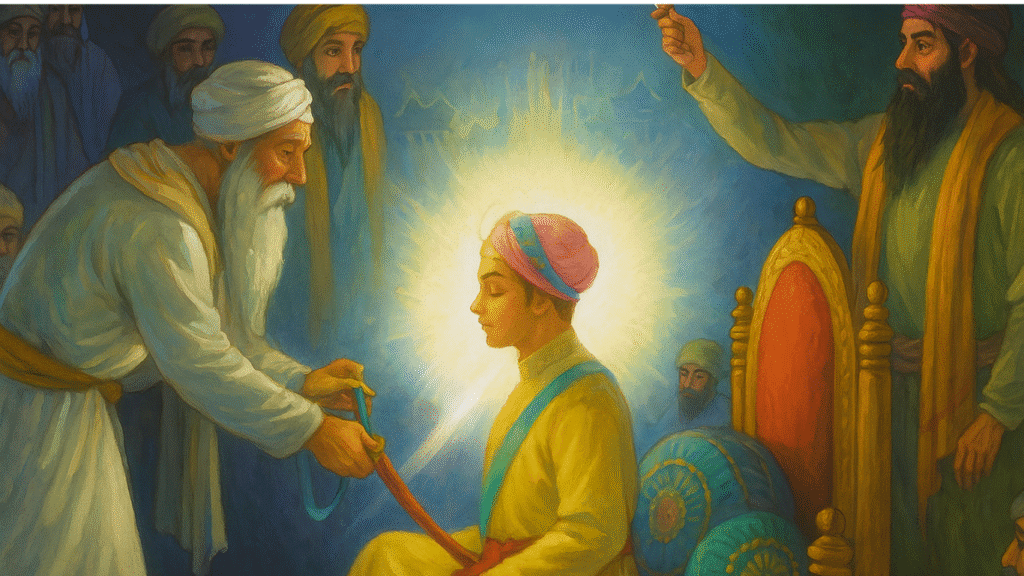
In the sacred year of 1606 A.D., as the sun of Guru Arjan Dev Ji’s earthly journey prepared to set, he lit a new flame—one that would burn with both spiritual radiance and martial resolve. That flame was Guru Hargobind Ji, his beloved son and chosen successor.
This wasn’t just a passing of leadership. It was a strategic shift, a prophetic response to the changing tides of history. Guru Arjan Dev Ji, with divine foresight, knew that the Sikh Panth would soon face trials that required not just prayer—but protection.
A Guru Armed with Grace
Before his martyrdom, Guru Arjan Dev Ji gave a powerful instruction: “Let my son sit fully armed on the throne and maintain an army to the best of his ability.” These words marked a turning point in Sikh history—the transition from peaceful consolidation to martial preparedness.
Guru Hargobind Ji was not just a spiritual guide—he became a warrior saint, embodying the dual principles of Miri (temporal authority) and Piri (spiritual authority). This doctrine, later formalized, became the cornerstone of Sikh sovereignty and self-defense.
Preparing the Panth for Resistance
Guru Arjan Dev Ji’s martyrdom was a signal that oppression was rising, and the Sikh community needed to be ready—not with vengeance, but with valor. By nominating Guru Hargobind Ji and instructing him to wear two swords—Miri and Piri, Guru Ji ensured that the Panth would remain spiritually rooted and politically resilient.
This shift laid the foundation for future Gurus, especially Guru Gobind Singh Ji, who would later establish the Khalsa—a community of saint-soldiers.
Exam-Relevant Insights
| Feature | Detail | Relevance |
|---|---|---|
| Year of Nomination | 1606 A.D. | Guru Arjan Dev Ji’s final act of leadership |
| Successor | Guru Hargobind Ji | Sixth Guru of Sikhism |
| Instruction | Sit armed, maintain an army | Marked shift to martial preparedness |
| Doctrine Introduced | Miri-Piri | Dual authority: spiritual and temporal |
| Strategic Impact | Prepared Sikhs for future resistance | Foundation for Khalsa and Sikh militarization |
Guru Arjan Dev Ji’s nomination of Guru Hargobind Ji was not just a succession—it was a sacred strategy, a father’s final gift to his people. It showed that true spirituality does not shy away from justice, and that defense of the righteous is itself a divine duty.
Legacy of Guru Arjan Dev Ji: A Beacon That Illuminates Sikhism Across Centuries

Some lives are lived quietly. Others blaze like divine comets across the sky of history—illuminating paths, transforming destinies, and inspiring generations. Sri Guru Arjan Dev Ji, the fifth Guru of Sikhism, was one such radiant soul. His legacy is not confined to the pages of history—it lives in every Gurdwara, every Shabad, and every aspirant’s heart that seeks truth, justice, and divine love.
A Vision That Shaped a Faith
Guru Arjan Dev Ji didn’t just lead—he architected Sikhism’s spiritual infrastructure. He gave the Sikhs their sacred scripture, the Adi Granth Sahib Ji, preserving the divine wisdom of the Gurus and saints across traditions. He gave them their central shrine, the Harmandir Sahib, a temple of humility and unity that welcomes all. He gave them an organized structure, through the Masand system, ensuring that faith was not just preached but practiced across regions.
Cities That Carried His Light
Through the founding of Tarn Taran, Kartarpur, and Hargobindpur, Guru Ji expanded the Sikh footprint across Punjab. These weren’t just towns—they were spiritual sanctuaries, built to nurture devotion, learning, and community. They became living centers of Sikh propagation, where the Guru’s message flowed like the rivers that surrounded them.
A Network of Faith and Service
The Masand system, refined under Guru Arjan Dev Ji, became a lifeline of unity and support. It connected Sikhs across distant lands, sustained the Langar, and ensured that every Sikh, no matter how far, remained close to the Guru’s teachings. It was a model of spiritual decentralization with centralized devotion—a concept aspirants must grasp when studying Sikh administration and community building.
A Scripture That Speaks to All
The Adi Granth Sahib Ji, compiled with divine care, became the eternal compass of Sikhism. It embraced voices from all walks of life—Bhagats, Bhatts, and Gursikhs—proclaiming that truth knows no boundaries. Later, Guru Gobind Singh Ji gave it the status of Sri Guru Granth Sahib Ji, making it the eternal Guru of the Sikhs.
This act marked a spiritual revolution, where the word became the guide, and the community became the custodian of divine wisdom.
A Martyrdom That Lit the Flame of Resistance
Guru Arjan Dev Ji’s martyrdom in 1606 A.D. was not a defeat—it was a declaration. A declaration that truth cannot be silenced, that faith cannot be crushed, and that sacrifice is the highest form of devotion. His final act of courage laid the foundation for Guru Hargobind Ji’s martial leadership, and eventually, the rise of the Khalsa.
For aspirants, this moment is a turning point in Sikh history, often asked in exams as the beginning of Sikh resistance and the shift from spiritual consolidation to martial assertion.
Emotional Legacy: A Symphony of Humility, Courage, and Divine Love
Guru Arjan Dev Ji’s life was a symphony—each note resonating with humility, each verse echoing courage, and each act radiating divine love. His teachings continue to guide seekers, his hymns continue to heal hearts, and his legacy continues to inspire movements.
He taught us that leadership is service, that scripture is sanctuary, and that sacrifice is strength. topic-wise analysis for better exam strategy.