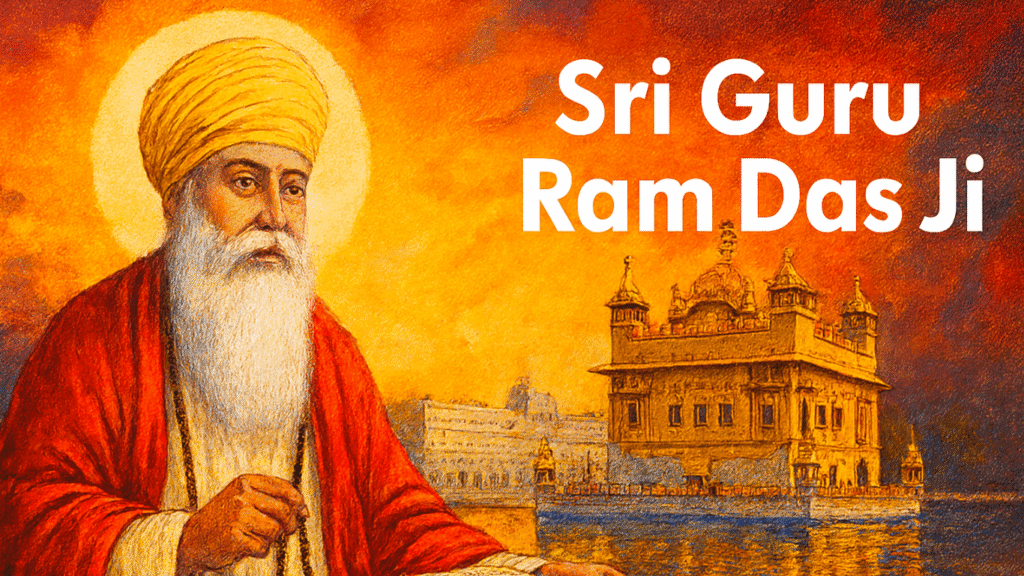
In the pages of Punjab’s proud history, there stands a figure who did not just guide his followers with words of wisdom, but reshaped their destiny with courage and vision. Imagine a child of barely eleven years, suddenly entrusted with the immense responsibility of leading a community shaken by the martyrdom of his father. Would he falter? Would he retreat? No—Sri Guru Hargobind Singh Ji rose like a flame in the darkness, carrying two swords upon his shoulders, one for the spirit and one for the world.
This was the dawn of a new chapter in Sikhism—the moment when devotion met defense, when prayer walked hand in hand with valor. For aspirants preparing for Punjab’s competitive exams, understanding this transformation is not just about memorizing dates and battles; it is about grasping the heartbeat of a community that learned to stand tall against oppression.
Guru Hargobind Singh Ji’s story is not a distant tale—it is a living reminder that strength and spirituality can coexist, that resilience is born when faith refuses to bow. As you read further, you will discover how the founding of the Akal Takht, the battles fought against mighty Mughal forces, and the creation of Kiratpur Sahib were not mere events, but milestones that shaped the Sikh Panth forever.
Early Life and Education of Sri Guru Hargobind Singh Ji
Birth and Parentage
Sri Guru Hargobind Singh Ji, the sixth Guru of Sikhism, was born on 14 June 1595 A.D. in the village of Wadali, Amritsar district, Punjab. His birth was not ordinary—it came after 16 years of marriage between Guru Arjan Dev Ji and Mata Ganga Ji, who longed for a child.
According to tradition, Mata Ganga Ji once visited the revered saint Baba Buddha Ji in the forest of Chherta Sahib. She humbly prepared food with her own hands and offered it with devotion. Pleased by her sincerity, Baba Buddha Ji blessed her, saying that she would be gifted with a son who would grow into a mighty leader. Soon after, with his grace, Guru Hargobind Singh Ji was born. This event was celebrated as a divine blessing, marking the arrival of a child destined to transform Sikhism into a community of saint-soldiers.
Childhood and Education
From his earliest years, Guru Hargobind Singh Ji showed remarkable promise. He studied Punjabi, Sanskrit, and Prakrit literature, reflecting both intellectual brilliance and spiritual depth. His education was not confined to scriptures alone. Under the revered guidance of Baba Buddha Ji, he was trained in both religious teachings and martial skills. This included horse riding, swordsmanship, archery, and battlefield strategy—skills that would later define his leadership.
Spiritual and Martial Training
Guru Ji’s upbringing was unique because it combined saintly wisdom with warrior discipline. Baba Buddha Ji ensured that he understood the essence of Sikh philosophy while also becoming skilled in defending the faith. This dual training laid the foundation for the revolutionary concept of Miri-Piri, symbolizing the union of spiritual authority and temporal power.
Family Life
Guru Hargobind Singh Ji was married to Mata Damodari Ji, Mata Nanaki Ji, and Mata Marvahi Ji. He was blessed with five sons—Baba Gurditta Ji, Ani Rai Ji, Suraj Mal Ji, Baba Atal Rai Ji, and Guru Tegh Bahadur Ji, who later became the ninth Guru of Sikhism. He also had one daughter, Bibi Viro Ji, remembered for her devotion and strength. His family played a vital role in continuing the Sikh legacy, with Guru Tegh Bahadur Ji’s martyrdom becoming a cornerstone of Sikh history.
Anointment as the Sixth Guru (Age 11 Years)
When the tragic news of Guru Arjan Dev Ji’s martyrdom reached Amritsar in 1606, the Sikh community was shaken. The veterans of the Panth, led by Baba Buddha Ji, consulted Mata Ganga Ji, Bhai Gurdas Ji, and other respected members of the Guru’s household. Their decision was unanimous: the young Hargobind Ji, barely 11 years old, would be anointed as the sixth Guru of the Sikhs.
The Traditional Ceremony
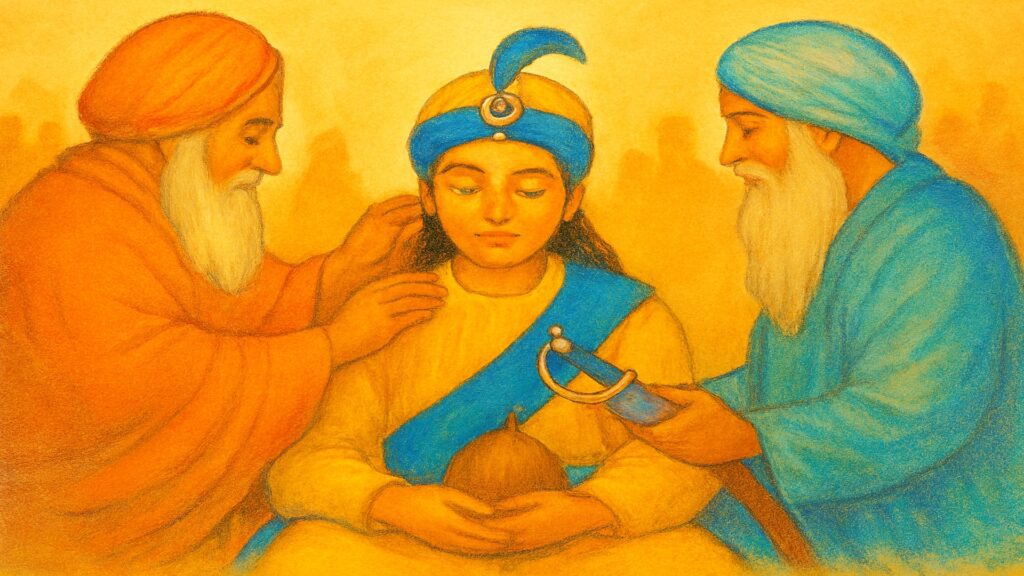
On 11 June 1606, the sacred ceremony was performed. Following the footsteps of earlier Gurus:
- A coconut and five paisa were placed in the lap of the young Guru.
- A tilak of saffron was applied to his forehead.
- The Seli, a black woolen cord traditionally tied around the waist of every Guru since Guru Nanak Dev Ji, was prepared to be placed.
But at this moment, Guru Hargobind Singh Ji made a historic choice. Instead of the Seli, he asked Baba Buddha Ji to adorn him with a sword. This marked the beginning of a new chapter in Sikh history.
The Two Swords – Miri and Piri
When Baba Buddha Ji inadvertently placed the sword on the right side of the young Guru, Guru Hargobind Singh Ji responded with a gentle smile and said, “Let this one remain as it is, but place another on the left side as well.” In this way, Guru Hargobind Singh Ji came to wear two swords—one on each side—symbolizing the dual ideals of Miri (temporal power) and Piri (spiritual authority).
He declared that these swords symbolized:
- Miri (Temporal Power): To resist tyranny and protect justice.
- Piri (Spiritual Power): To guide the faithful and protect the innocent.
This was the birth of the Miri-Piri doctrine, a revolutionary concept that combined spiritual authority with temporal sovereignty.
The True King – Sacha Patshah
Guru Hargobind Singh Ji announced to his followers with firm resolve, “In the Guru’s realm, the light of spiritual wisdom and the strength of temporal leadership shall stand as one.” My mala (rosary) will be my sword belt, and upon my turban, I shall adorn a Kalgi.” The Kalgi—a regal ornament traditionally worn by sovereigns—represented honor, majesty, and royal authority. From that moment on, the Sikhs reverently addressed him as ‘Sacha Patshah,’ meaning the True Emperor.
Legacy of Courage and Faith
Guru Hargobind Singh Ji carried the same divine light of Guru Nanak Dev Ji, but he added to it the gleam of the sword—strength, courage, and bravery. His anointment was not just a ceremony; it was a turning point in Sikh history, preparing the Panth to face oppression with resilience and faith.
Founding of the Akal Takhat Sahib
A Monumental Task by Guru Hargobind Singh Ji
In 1606 A.D., Sri Guru Hargobind Singh Ji undertook a visionary task that would forever transform the Sikh Panth. He began the construction of a new institution opposite the Harimandir Sahib, initially called “Akal Bunga” – the House of God. This structure would later be known as the Akal Takhat Sahib, meaning “Throne of the Timeless One.”
The construction was completed in 1609 A.D., and it became the seat of Sikh temporal authority, where the Guru would guide the political and military affairs of the community. Guru Ji himself laid the keystone, and Baba Buddha Ji and Bhai Gurdas Ji built the structure with their own hands—no outside builder was allowed to help, emphasizing the sacredness and sovereignty of the task.
The First Hukamnama and Jathedar
Upon completion, Guru Hargobind Singh Ji issued the first Hukamnama to the Sikh Sangat from the Akal Takhat, marking the beginning of its role as the supreme court of the Sikhs. He also appointed Bhai Gurdas Ji as the first Jathedar, establishing a tradition of leadership and governance rooted in spiritual discipline and community service.
Symbolism of Location and Design
The Akal Takhat was deliberately built slightly lower than the Harimandir Sahib, symbolizing that while temporal authority is essential, spiritual wisdom must always lead. The site chosen was deeply personal—it was the very plot of land where Guru Hargobind Ji had played as a child.
The initial design was simple yet powerful: a 10-foot-high platform where Guru Ji would sit like a king. A devotee would wave a parasol (fly whisk) above him, and the Guru would receive petitions, settle disputes, and administer justice. This marked the beginning of Sikh sovereignty, where the Guru was both a spiritual guide and a temporal leader.
Military Training and Heroic Spirit
At the Akal Takhat, Guru Ji would train Sikhs in martial arts, oversee wrestling matches, and infuse a spirit of bravery and discipline. Professional bards sang ballads of unrivalled heroism, inspiring the community to rise against oppression and uphold righteousness. The Akal Takhat became a center of courage, justice, and unity.
Evolution of the Structure
Originally, the Akal Takhat was a two-storey building. Later, Maharaja Ranjit Singh added three more storeys, making it a five-storey structure. Recent restoration work has uncovered lime plaster with painted decoration, believed to be part of the original Takhat.
The structure’s marble pillars and semi-circular platform with an open view to the courtyard are reminiscent of Guru Hargobind Singh Ji’s Durbar Hall—a public assembly room where justice and governance were carried out with dignity and transparency.
Guru Hargobind’s Royal Living and Private Army
The Saint-Soldier Ideal
Sri Guru Hargobind Singh Ji was the first Sikh Guru to live as a Saint-Soldier, embodying both spiritual devotion and martial strength. Soon after his Guruship, he employed 52 young Sikhs as his personal bodyguards. His private army initially grew to about 500 men, with recruits coming from across Punjab. This marked a decisive shift in Sikh identity—from a purely spiritual community to one prepared for defense and justice.
Construction of Lohgarh Fort
To strengthen Sikh sovereignty, Guru Ji constructed a small fort called Lohgarh, now known as Gurdwara Qila Lohgarh Sahib Amritsar. It is important not to confuse this fort with the Lohgarh Fort near Sadaura, built later by Bhai Lakhi Rai Wanjara under Guru Ji’s instructions. That fort was completed in 1710 and became the capital of the Khalsa Kingdom under Banda Singh Bahadur. Another fort of similar name exists in Rajasthan, built by the Bharatpur Jat rulers.
Unprecedented Decisions
Guru Hargobind Singh Ji’s actions surprised both his followers and the Mughal rulers of the time. His decisions included:
- Wearing two swords (Miri and Piri)
- Employing bodyguards
- Maintaining a private army
- Sitting on a throne
- Hearing petitions and administering justice
- Constructing a fort
These steps gave the Guru a majestic presence, further enhanced by his royal attire and the aigret (Kalgi) on his turban. People began to call him ‘Sacha Patshah’ – the True King, a title that reflected his dual authority.
Call to Arms for the Sikh Community
Guru Ji asked Sikhs to bring arms and horses as offerings instead of traditional gifts. Young followers were encouraged to take military training and join his private army. While some historians misinterpreted these acts as signs of militancy, in reality, they were a wake‑up call to prepare the community for the difficult times ahead. It was a call for religious and righteous people to unite against injustice and tyranny.
Tensions with the Mughal Empire
These exceptional acts soon reached the ears of the Mughal rulers. In 1611, the appointment of Shaikh Farid Bukhari Murtaza Khan, a zealot Muslim, worsened relations. His adverse reports about Guru Hargobind Singh Ji alarmed Emperor Jahangir, who summoned the Guru to meet him. This marked the beginning of a tense relationship between the Sikh Panth and the Mughal Empire.
Summon from Delhi
Soon after Guru Hargobind Singh Ji’s rise as the sixth Guru, his growing influence and martial preparations caught the attention of the Mughal court. By the Emperor’s order, Guru Ji was summoned to Delhi. Some historians note that he was actually called to meet Emperor Jahangir in Agra, but the accounts agree that this was a turning point in Sikh-Mughal relations.
March to Delhi and Stay at Majnu Da Tilla
Before leaving, Guru Ji delegated his administrative duties to Baba Buddha Ji and religious responsibilities to Bhai Gurdas Ji. On reaching Delhi, he stayed at Majnu Da Tilla, a place of historical significance where Guru Nanak Dev Ji had once stayed with the Muslim saint Majnu during the reign of Sikandar Lodhi. This connection symbolized the continuity of Sikh tradition and interfaith respect.
Meetings with Emperor Jahangir (1611)
At the time of their meetings, Guru Hargobind Singh Ji was just 16 years old, while Jahangir was 26 years older. The Emperor questioned Guru Ji about his court gatherings, bodyguards, and private army. Guru Ji explained calmly that these were meant for self-defense and protection of the Sikh community, not as a challenge to the Emperor or Islam. Jahangir was impressed by the Guru’s sincerity and spirituality.
During a hunting expedition arranged by Jahangir’s men, a tiger attacked the Emperor. Guru Hargobind Singh Ji displayed extraordinary bravery by slaying the beast, leaving Jahangir astonished at the young Guru’s courage. Until this point, relations between the two remained cordial.
Confinement at Gwalior Fort

However, upon reaching Agra, Jahangir suddenly fell ill. Astrologers blamed his sickness on “evil stars” and advised that detaining Guru Hargobind Singh would remove their effect. Acting on this advice, Jahangir ordered Guru Ji’s confinement at Gwalior Fort, a prison for royal captives.
Different historians record varying durations of confinement:
- Md Latif – 12 years
- Teja Singh, Ganda Singh – 2 years
- Khushwant Singh – 2 years
- Sangat Singh – 6 years
- Mcauliffe – 3 years
- Hari Ram Gupta – 2 years
- Surjit Singh Gandhi – 3 years
- Satbir Singh – 3 years
Most modern accounts, however, agree that Guru Ji was confined for about 18 months.
Intervention of Nur Jahan and Mian Mir
Queen Nur Jahan, who wielded significant power during Jahangir’s illness, admired Guru Hargobind Singh Ji’s divinity. Along with the Sufi saint Mian Mir, she persuaded Jahangir to release the Guru. Condemning the astrologers’ advice, Nur Jahan praised Guru Ji’s spiritual greatness and ordered his freedom.
On Guru Ji’s recommendation, 52 imprisoned Rajas (princes of different kingdoms) were also released from Gwalior Fort. This compassionate act earned Guru Hargobind Singh Ji the revered title of ‘Bandi Chhor’—literally meaning the Liberator of Prisoners.
Period of Post-Confinement Until the Death of Jahangir
Emperor’s Apology and Justice Delivered
Following Guru Hargobind Singh Ji’s release from Gwalior Fort, Emperor Jahangir, in a rare gesture of remorse, handed over Chandu Shah—the man behind the conspiracies against both Guru Arjan Dev Ji and Guru Hargobind—to the Sikh Sangat. Chandu had first orchestrated Guru Arjan’s martyrdom and later manipulated astrologers to justify Guru Hargobind’s arrest. The Sangat, outraged by his treachery, tied a rope around his neck and dragged him through the streets until he died. This act symbolized justice and closure for the Sikh community.
Journey from Gwalior to Amritsar and Kartarpur (1612–1613)
After his release, Guru Ji returned to Amritsar to reunite with his family. Making Amritsar his headquarters, he embarked on a seven-month tour across Punjab, visiting Kartarpur, Mukerian, Hargobindpur, and nearby villages. This journey was not just a return—it was a spiritual reconnection with the sangat who had long awaited his presence.
Sulakhni’s Miracle: The Blessing of Seven Sons
During this tour, a deeply moving incident occurred in village Chabbae (Majha). A childless woman named Sulakhni approached Guru Ji with a pen, inkpot, and flat stone, pleading for a son. She had visited saints of every faith, but all had told her that motherhood was not written in her destiny.
Guru Hargobind Singh Ji gently confirmed the same, but Sulakhni, with unwavering faith, said, “You are the one who writes destinies—if you forgot to write mine, please write it now.” Touched by her devotion, Guru Ji took the pen and began to write the number 1 on the stone. At that moment, his horse shook its leg, and the digit turned into 7.
Sulakhni was overjoyed. In time, she gave birth to seven sons, all of whom served the Guru’s household with loyalty and love. This story became a cherished Sikh sakhi, symbolizing the power of faith, divine grace, and the Guru’s role as the writer of destinies.
Activities Between 1614–1617
Restoration of Nanakmata (Visit to Pilibhit, Uttar Pradesh)
While residing in Amritsar, Guru Hargobind Singh Ji received troubling news from Nanakmata, a sacred site in Pilibhit (U.P.). The place, originally known as Gorakhmata, had been renamed Nanakmata after Guru Nanak Dev Ji’s spiritual discourse with yogis under a sacred peepal tree.
The Guru learned that local yogis were planning to destroy the peepal tree and had ousted the Udasi Sikh caretaker, replacing sacred elements with idols. Guru Ji immediately set out with a small group of soldiers. Upon arrival, the yogis fled in fear. The Udasi Sikh showed Guru Ji the damage done to the tree and shrine.
Guru Hargobind Singh Ji recited Japji Sahib and sprinkled water on the tree’s branches. Miraculously, the tree regained its green glory, symbolizing the restoration of truth and reverence. This act reaffirmed the sanctity of Nanakmata and Guru Ji’s role as protector of Sikh heritage.
Meeting Saint Ramdas in Srinagar (Garhwal)
From Nanakmata, Guru Ji toured the hilly villages of Garhwal, reaching Srinagar, where he met Saint Ramdas, a Maratha holy man. Ramdas was puzzled by Guru Ji’s princely attire, two swords, and martial presence. He questioned, “You claim to sit on Guru Nanak’s spiritual seat, yet you carry weapons and ride horses—what kind of holy ascetic are you?”
Guru Ji replied with grace: “At heart I am a saint, though externally a prince. Arms ensure the protection of the poor and the destruction of tyrants. Guru Nanak renounced ego—not the world.”
Saint Ramdas was deeply moved. He gifted Guru Ji an ochre-colored robe and a rosary, honoring his divine mission.
Journey to Kashmir and Miracles Along the Way
Guru Hargobind Singh Ji then journeyed through Rawalpindi, Jhelum, Gujrat, Sheikhupura, and Lahore, reaching Kashmir. In Gujrat, he met Shah Daula and shared Sikh philosophy: “A wife is man’s conscience, children perpetuate memory, wealth enables life, and arms extirpate tyrants.”
In Kashmir, Guru Ji visited Bhag Bhari, a blind devotee who had sewn a robe for him and prayed for his arrival. Upon meeting her, Guru Ji blessed her—and her eyesight was miraculously restored. This moment became a cherished sakhi of divine grace.
Miracle at Sialkot and Return to Amritsar
Continuing his journey, Guru Ji visited Sialkot, Wazirabad, Mirpur, Bimbar, and Behram. Near Sialkot, an arrogant Brahmin refused to offer water to Guru Ji and his men, saying, “There is no water for strangers.”
Guru Ji calmly thrust his spear into a rock, and a spring of water gushed out, silencing the Brahmin’s pride and quenching the thirst of the sangat.
On his return, Guru Ji visited Baramula, Uri, and Muzzafarabad, before finally returning to Amritsar—bringing with him stories of miracles, wisdom, and spiritual strength.
Diplomatic Grace and Spiritual Sovereignty (1617–1620)
Jahangir and Nur Jahan Visit Amritsar (1617)
In 1617, Governor Gyas Beg of Lahore invited Emperor Jahangir and Begum Nur Jahan to visit Lahore. On their way, they stopped at Amritsar, where Guru Hargobind Singh Ji received them with honour and humility. He instructed the Sikhs to serve the Mughal army through Guru-ka Langar, ensuring that even royal guests were treated with dignity and equality.
Jahangir and Nur Jahan visited the Harimandir Sahib, deeply moved by its spiritual aura. They offered financial help to complete the Akal Takhat Sahib, but Guru Ji politely declined, saying, “This sacred work is being carried out collectively by the Sangat.” This response reflected the Guru’s commitment to community-led service and sovereignty.
Lahore Celebrations and Divine Dialogues (1619)
In 1619, Lahore was adorned like a bride for a grand reception hosted by Governor Gyas Beg. On Jahangir’s instruction, Guru Hargobind Singh Ji was invited to attend. A special camp was set up next to the Emperor’s, symbolizing mutual respect.
During the celebrations, Nur Jahan visited Guru Ji to hear his divine teachings. Guru Ji told her, “Your beauty and high character are blessings of Allah. A monarch’s love and care for their subjects is the sure gate to heaven.” These words reflected Guru Ji’s deep understanding of spiritual leadership and moral governance, leaving a lasting impression on the royal court.
Founding of Hargobindpur (1620)
After the Lahore celebrations, Guru Ji toured the Doaba region, staying at Kartarpur for a few months. Passing through Mukerian and crossing the Beas River, he reached Gobindpur, a town originally founded by Guru Arjan Dev Ji.
A skirmish broke out with unlawful rulers occupying the town. Guru Ji and his followers repossessed it, and in a symbolic act of renewal, renamed it Hargobindpur. This marked the town as a center of spiritual strength and temporal justice, aligned with the Miri-Piri doctrine.
Visit to Kurukshetra During Solar Eclipse
Following the tradition of Guru Nanak Dev Ji, Guru Hargobind Singh Ji visited Kurukshetra during a solar eclipse, a time when thousands of devotees gathered for spiritual reflection. Guru Ji preached the doctrine of Guru Nanak, emphasizing that true renunciation lies in shedding ego, not worldly responsibilities. His presence attracted many seekers, reaffirming Sikhism’s inclusive and universal message.
Return to Punjab and Birth of Guru Tegh Bahadur Ji (1621)
Visit to Droli – A Land of Devotion
After visiting sacred places like Haridwar, Jagadhri, and Kaithal, Guru Hargobind Singh Ji reached Droli, a village remembered as the birthplace of Baba Gurditta Ji, Guru Ji’s eldest son. Here, Bhai Sai Dass awaited the Guru’s arrival to bless his housewarming ceremony. Guru Ji fulfilled his wish with grace and warmth.
In the same village, two devoted Sikhs—Bhai Sadhu and Bhai Rupa—were fasting in the scorching heat, waiting for the Guru’s darshan. Moved by their devotion, Guru Ji sat beside them, gently wiped their sweat, and lovingly asked them to drink water and break their fast. This moment of compassion became a cherished sakhi, symbolizing the Guru’s deep empathy for his followers.
Guru Ji met many more devotees in the region, each waiting with longing hearts for his presence. His visit to Droli rekindled the spirit of the sangat and strengthened the bond between Guru and disciple.
Visit to Baba Bakala and Mata Ganga Ji’s Final Moments
From Droli, Guru Ji journeyed to Baba Bakala, the ancestral village of Mata Nanaki Ji’s parents. Here, he blessed Bhai Mihra’s new house, continuing his tradition of uplifting the homes and hearts of his devotees.
While in Baba Bakala, Guru Ji’s beloved mother, Mata Ganga Ji, breathed her last. Her passing was a moment of deep sorrow, as she had been a pillar of strength and devotion in Guru Ji’s life. Her final moments in the sacred presence of her son added a layer of spiritual grace to her legacy.
Birth of Tyag Mal – The Future Guru Tegh Bahadur Ji
Upon returning to Amritsar, Guru Hargobind Singh Ji was blessed with the birth of his youngest son on 1st April 1621. He was named Tyag Mal, symbolizing renunciation and spiritual strength.
Later, after the Battle of Kartarpur, Tyag Mal earned the title Tegh Bahadur—meaning Brave of the Sword. His courage, wisdom, and sacrifice would eventually lead him to become the ninth Guru of Sikhism, known as Guru Tegh Bahadur Ji, the martyr who gave his life for religious freedom.
The Saint-Soldier’s Legacy
From the moment of his birth in 1595, Guru Hargobind Singh Ji’s life was destined to reshape Sikh history. At just 11 years old, he ascended the Guru Gaddi, and in a moment of divine clarity, chose the sword over the Seli, signaling the birth of the Miri-Piri doctrine—a union of spiritual wisdom and temporal strength.
His founding of the Akal Takhat Sahib was not just architectural—it was ideological. It became the seat of Sikh sovereignty, where justice was dispensed, warriors were trained, and the oppressed found hope. Guru Ji’s royal living, complete with court assemblies and martial discipline, was never about grandeur—it was about preparing the Panth to stand tall against tyranny.
Summoned to Delhi, Guru Ji’s grace and bravery won the admiration of Emperor Jahangir, yet fate led him to Gwalior Fort, where he endured confinement with dignity. His release, secured by Queen Nur Jahan and Sufi saint Mian Mir, became legendary—not just for his own freedom, but for the liberation of 52 imprisoned Rajas. Thus, he earned the eternal title of ‘Bandi Chhor’—the Liberator of Prisoners.
His return to Punjab was marked by compassionate encounters, miracles, and devotional reunions. From Sulakhni’s blessing of seven sons to the restoration of Nanakmata’s peepal tree, Guru Ji’s journey was a tapestry of spiritual radiance and human empathy.
The Journey Continues…
In the further chapters of this article, we explore:
- The battles fought by Guru Hargobind Sahib Ji against Mughal forces, where he led with courage and divine resolve.
- His retirement to the Shivalik hills, where he founded Kiratpur Sahib, a town of peace and spiritual reflection.
Guru Hargobind Singh Ji was not just a Guru—he was a shield for the weak, a voice for justice, and a beacon of divine sovereignty. His legacy lives on in every Sikh who walks the path of truth with courage, and in every aspirant who prepares to serve with wisdom and strength.