In the very land of Punjab, where the devotion of the people flowed through every village and the faith for justice echoed in every person’s prayer.
In the year 1606 A.D., the time was very hard for each Punjabi as the execution of Sri Guru Arjan Dev Ji by then emperor Jahangir took place. Sri Guru Arjan Dev Ji attained martyrdom for justice, which became the turning point in the relation between the Mughals and the Sikhs. After that, the battles with Mughals started, as the Mughals could not bear the Sikhs.
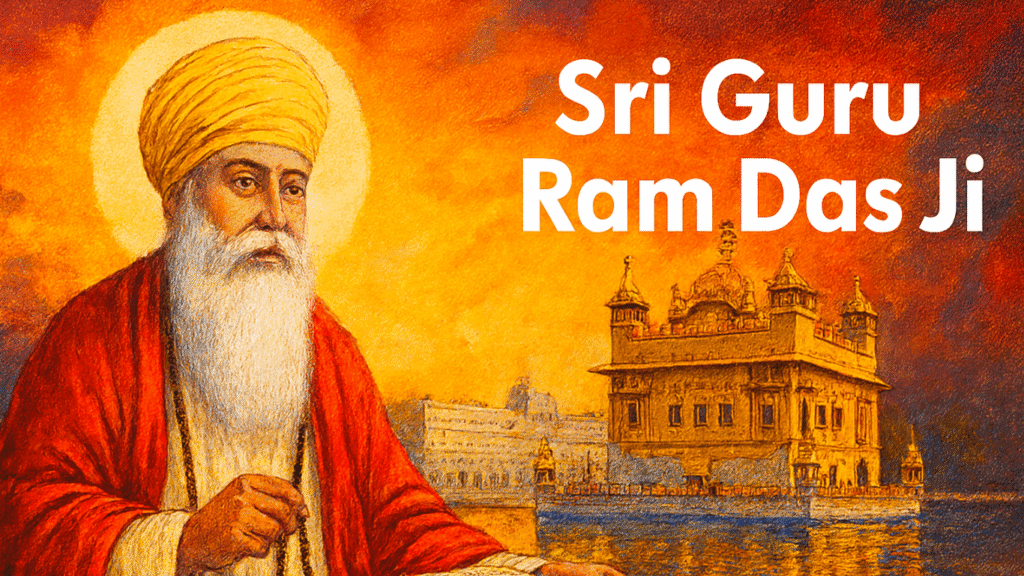
The Sikh community, which once lived peacefully and meditatively, had now received a serious wound. But from that wound was born a warrior of divine resolve — Sri Guru Hargobind Sahib Ji, the sixth Guru of the Sikhs and the only son of Sri Guru Arjan Dev Ji.
He was put on the throne at that time when everything was against the whole Sikh community, but he took all those challenges and, firstly, he did not seek revenge immediately; he chose righteous resistance. As Guru Ji understood that only spirituality could not protect the innocent from the tyranny of the Mughals, he decided to take two swords — Miri and Piri — which literally symbolize the union of temporal power and spiritual authority for his people. He also built many important buildings for the Sikhs, and one of them is Akal Takht, which was built for raising the Akal Sena and transformed the Sikh identity from Saintly to Warrior Saint, which could also act in the defence of Faith.
As Sri Guru Hargobind Singh Ji fought battles with the Mughals not for conquest of land and other worldly things, he fought for dharam (righteousness), for the people who wanted freedom to worship, and for the dignity of the people who were oppressed. Each battle with the Mughal empire was a message by Sri Guru Hargobind Singh Ji, i.e., Faith will not bow to fear.
Battle of Amritsar, 1634 A.D.
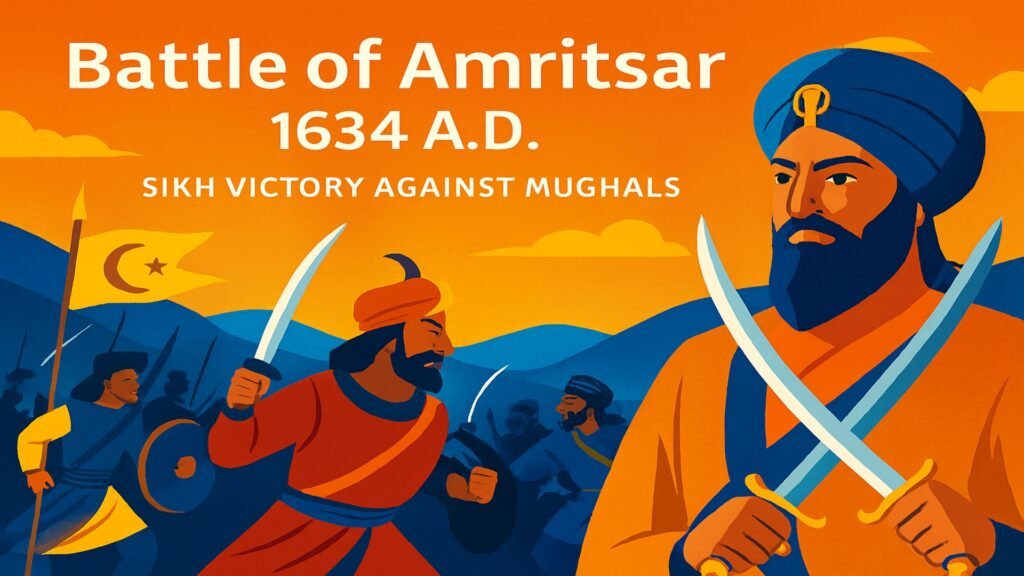
Imagine this with me. You and I are standing in the fields near Amritsar in 1634. The air is heavy with tension, yet life seems ordinary—farmers working, children playing, and the royal entourage of Emperor Shah Jahan hunting in his private reserve. Suddenly, a prized white baaz (hawk), gifted to Shah Jahan by the King of Persia, flies off course. It lands near a group of Sikhs, who catch it.
Now pause with me here. For you and me, this might seem like a small incident. But in those times, that hawk was more than a bird—it was a symbol of royal authority. When the Mughal soldiers demanded it back, the Sikhs refused. They said the hawk had come into the Guru’s sharan (protection) by its own will, and once under the Guru’s shelter, it could not be returned.
This refusal was not arrogance—it was a statement of dignity. And you and I can feel how such dignity often threatens tyrants. Reports reached Shah Jahan, twisted by local rivals of the Guru, painting the Sikhs as hostile. The Emperor’s pride was wounded. He ordered Mukhlis Khan with 7,000 soldiers to “teach a lesson” to Guru Hargobind Sahib Ji.
Mughal Response
At Gumtala, which is near Amritsar, the Mughal camp with a vast 7,000 soldiers, herd of elephants and horses lined up in formation to attack. But on the other side, there were only 700 Sikhs gathered around Guru Hargobind Sahib Ji. With simple weapons, their armor was also very light, but their spirit was unbreakable and ready to fight for the Panth.
As the Mughals began with their arrogance, as they had an edge over the Sikhs with the number of soldiers, elephants and horses, they stormed heavily at Lohgarh, plundering Guru Ji’s residence, desecrating sacred belongings, and mocking the Sikhs which could not be borne. For a moment, you and I might think the Sikhs would be crushed with this heavy plunder and vast soldiers, elephants and horses. But the calmness of Guru Ji steadied everyone with him. He reminded them all, “We fight not for land or wealth, but for dharam (righteousness).”
The Battle
On the second day, the Sikhs regroup and make plans for the counterattack. Imagine the roar of their war cries echoing across the fields and making them take revenge for what the Mughals have done to Guru Ji and the Sikhs. Although they are outnumbered, ten against one, they strike back with precision and proper planning. Their arrows find exact targets, their swords cut through Mughal ranks and show the unprecedented precision in war which the Mughals could not think of.
Twice, Mukhlis Khan, the Mughal general, is captured by the Sikhs. Twice, Guru Ji orders his release to show the gesture. You and I can feel the astonishment—why show mercy to such an enemy? But Guru Ji’s message is very clear for everyone: Sikh warfare is rooted in honor, not cruelty. So here the Sikhs fight for their dharma, not for the land or anything for which the Mughals are fighting.
The Duel
Finally, Mukhlis Khan, who was captured and released by Guru Ji with mercy, was humiliated and also faced repeated defeats against the Sikhs, and he challenged Guru Ji to single combat. Picture yourself standing beside Guru Ji as he accepts this challenge. Firstly, he tells Mukhlis Khan: “You strike first, so you will never regret that you didn’t have a chance for this fight.”
- The first swing comes—Guru Ji just steps aside as it passes.
- The second swing—Guru Ji again ducks effortlessly.
- And on the third swing—Guru Ji evades again with no harm.
Then, it’s Guru Ji’s turn, and with one decisive stroke, Guru Ji’s sword cleaves Mukhlis Khan in two parts. Silence grips the battlefield. The Mughal soldiers, stunned by the sight as they see their general falling down in two parts, lose their will to fight. Panic spreads across the Mughal army, and they retreat in chaos wherever they find a way to run away.
Sikh Heroes
Bhai Bidhi Chand – The Fearless Charger
Picture this great hero of Punjab: Bhai Bidhi Chand, one of Guru Hargobind Sahib Ji’s most trusted disciples. His reputation as a daring warrior was already legendary, as he was known for his courage and cleverness, even stealing horses from Mughal stables to prove Sikh resilience and courage, which shows his great abilities. In this battle, his fearless charge broke the enemy’s formation, which was known for fighting skills at that time. He also inspired fellow Sikhs to fight with double strength and courage. For you and me, his actions show that bravery is not about recklessness, but about leading from the front when others hesitate to challenge the authority at that time when they were formidable.
Bhai Jetha – The Skilled Fighter
Bhai Jetha’s swordsmanship was unmatched and he was skilled in an unprecedented way to fight with enemies. Imagine him weaving through Mughal soldiers with his skilful swordsmanship, striking with precision and agility on the mighty empire at that time. His skill was not just physical—it was also spiritual, guided by the Guru’s presence and the path shown to him. Each strike that he made was a reminder that the Sikh fight was just for dharam (righteousness), not to conquer any land or wealth. For aspirants like you, Bhai Jetha’s example teaches that mastery of skill, combined with courage and purpose, can overcome overwhelming odds for the people and community.
Painda Khan – From Ally to Devotee
Painda Khan’s story is one of transformation for many people. Once a fighter for the Mughals, he chose loyalty to the Sikh Guru Shri Guru Hargobind Sahib Ji over imperial power for justice and truth. In battle, he fought with unmatched devotion for Guru Ji against the Mughals who were outnumbers and more superior than the Sikhs, as a formidable soldier with full faith and dignity. For you and me, Painda Khan’s loyalty shows that a person who had even past alliances can be reshaped by conviction for the Panth and the teachings of Guru Hargobind Sahib Ji.
Outcome & Significance
Despite being outnumbered, with about just 700 Sikhs against huge numbers of 7,000 Mughal soldiers, the courage and discipline of Guru Hargobind Sahib Ji’s followers, with faith in the truth, turned the tide. The very victory at Gumtala, which is near Amritsar, was not just a military win against the Mughals, it was a big turning point for the Sikhs in Punjab. For the first time, the Sikhs had defeated the mighty Mughal army in open battle with a meager number of soldiers and simple armor. News spread quickly across Punjab and the whole Mughal empire: the Guru’s small band of 700 had humbled Emperor Shah Jahan’s 7,000 with courage and bravery.
- The Sikh Panth grew in confidence after this victory: This victory against the mighty Mughals at that point proved that the Sikhs were no longer a passive community and sect in Punjab. They had become a force capable, under Shri Guru Hargobind Sahib Ji, of defending their faith and people against imperial aggression and injustice with courage and bravery.
- Guru Ji’s reputation and belief increased: People began to believe him not only as a spiritual guide and saint but also as a sovereign leader of the Sikh community with high authority, which also call him a Sacha Padshah (True King). His courage and mercy—capturing Mukhlis Khan twice and releasing him to show mercy—added to his aura of justice and honor for many people.
Exam Pointers to Remember
- Year & Place: 1634 A.D., Gumtala near Amritsar.
- Cause: Dispute over Shah Jahan’s royal hawk.
- Mughal General: Mukhlis Khan (killed in duel with Shri Guru Hargobind Singh Ji).
- Sikh Strength: 700 vs. 7,000 Mughal soldiers, Elephants, Horses.
- Result: Sikh victory; first major battle victory under Guru Hargobind Sahib Ji against the Mughals.
Battle of Lahira, 1634 A.D.
You and I might expect battles to erupt over territory or treasure. But this one? It began with two horses—Dilbagh and Gulbagh. Not ordinary horses, but majestic, powerful steeds being brought directly from Kabul for Shri Guru Hargobind Sahib Ji’s stable by his two devoted Masands, Bakht Mal and Tara Chand.
Now imagine this the Masands who were traveling via Lahore from Kabul with horses for the Guru Ji, their hearts full of devotion for Guru Hargobind Sahib Ji, and when suddenly Mughal officials arrogantly stopped them. The horses which they carried for Guru Hargobind Sahib Ji were seized by the Mughal officials at Lahore and sent to the royal stables of Emperor Jahangir. You and I can feel the sting of this injustice, as it wasn’t just a theft in broad daylight, it was a challenge to the Guru’s dignity and faith.
Enter Bhai Bidhi Chand – The Master of Disguise
When the Masands reported this incident of horses stolen by the Mughal officials, Guru Hargobind Sahib Ji didn’t respond with rage. He responded with pure calmness. He called upon his trustworthy Bhai Bidhi Chand Ji, a warrior known not just for his bravery, but for his cleverness in critical situations, and for this, Guru Ji gave him the task of recovering the horses from the Mughals. And here’s where the story becomes cinematic and courageous.
First Mission – The Grass Cutter
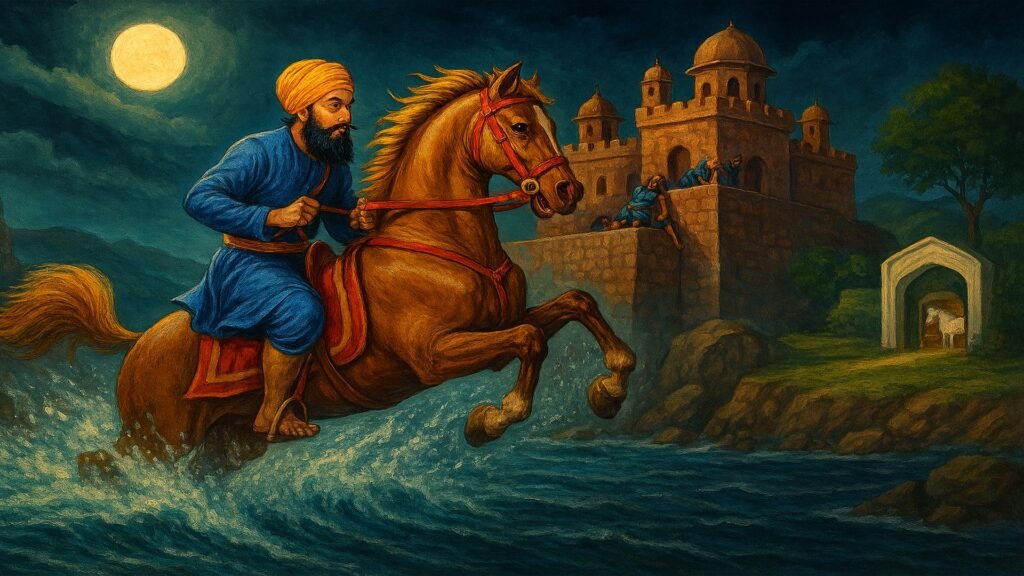
You and I are watching Bidhi Chand disguise himself as a humble grass cutter of the Mughals. He infiltrates the royal stables through the disguise, gains the trust of the officials, and waits for the perfect moment to get back the horse Dilbagh. One night, while the guards are drunk, he saddles the horse Dilbagh, leaps from the fort wall into the river, and rides the horse to safety back to Guru Hargobind Sahib Ji.
Can you feel the thrill? Dilbagh is now back where he belongs—in the Guru’s stable.
Second Mission – The Magician
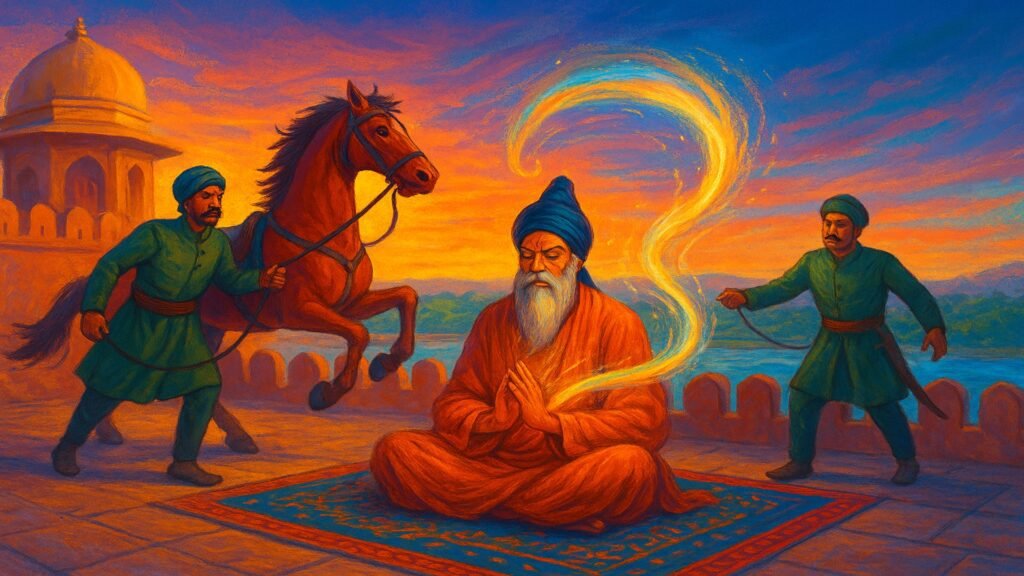
But Gulbagh is still in enemy hands. This time, Bidhi Chand becomes a magician. He claims he can locate the stolen horse using mystical powers—but only if the guards meet three conditions:
- Let him inspect the stable.
- Allow him to spend the night at the stable alone with Gulbagh.
- Give him half the reward amount in advance and the rest after the completion of work.
The guards agree to all his conditions. As Bidhi Chand sits on a clean platform, chanting mantras and other things to make sure the guards believe him. He asks the chief guard to recreate the theft scene. The guard saddles Gulbagh, leads him to the rooftop—and in a flash, Bidhi Chand kicks the horse into motion and leaps into the river.
Gulbagh joins Dilbagh. Mission complete.
The Mughal Response with full Rage and Retaliation
When Shah Jahan, then emperor of India, heard of this humiliation, he became furious at how a Sikh could challenge the Mughal authority by stealing the horses from the stable. He sent a large army under Lal Beg and Qamar Beg to crush the Sikhs. But Guru Ji was ready. He moved towards Lakhi Jungle, near Bathinda and Firozpur, and laid an ambush.
The Mughal army, though large, runs out of rations. Hunger weakens their morale. And then, the Sikhs strike.
At Gurusar near Nathana, the battle erupts. You and I can hear the war cries, see the dust rise, and feel the courage of the Sikhs. Though outnumbered, they fight with unmatched spirit.
- Bhai Bidhi Chand leads the charge.
- Bhai Jetha Ji attains martyrdom.
- Both Mughal commanders are slain.
Victory Beyond Numbers
The Sikhs emerged victorious in this war also. The Mughal army retreated again in defeat. And you and I know that this wasn’t just a win for the Sikhs on the battlefield against the mighty Mughals. It was a victory of honor, strategy, and faith of the Sikhs who believed in faith and truth for the people.
Exam Pointers to Remeber for Battle of Lahira, 1634 A.D.
- Year & Place: 1634 A.D., Lahira near Bathinda.
- Cause: Capture of Guru Ji’s horses Dilbagh and Gulbagh by Mughal officials from Masands in Lahore.
- Key Figure: Bhai Bidhi Chand – recovered both horses through daring disguises and his bravery from the stable of the Emperor (grass cutter, magician).
- Mughal Response: Emperor Shah Jahan sent a large army under Lal Beg and Qamar Beg.
- Battle Site: Gurusar near Nathana, close to Rampura Phul railway station.
- Outcome:
- Both Mughal commanders killed on the battlefield.
- Bhai Jetha Ji attained martyrdom by fighting against the Mughals.
Battle of Kartarpur, 1635 A.D.
Background
The third major battle between the Sikhs and the Mughals was fought at Kartarpur in 1635 A.D. Its cause lay in betrayal. Painda Khan, once a trusted commander of Guru Hargobind Sahib Ji’s Pathan troops, had shown bravery in earlier battles, but arrogance clouded his loyalty. He stole a hawk belonging to Guru Sahib and gifted it to his son‑in‑law without the permission of Shri Guru Hargobind Sahib Ji. When asked for the hawk, he lied, and upon discovery of the hawk, Guru Ji dismissed him from service for breaking the trust of Shri Guru Sahib Ji.
Humiliated, Painda Khan turned against Guru Sahib Ji. He allied with the arch‑rival of the Sikhs, Qutab Khan, Subedar of Jullundhur, and approached the Mughal court against the Sikhs. Emperor Shah Jahan immediately hoped that he would defeat the Sikhs with Painda Khan and dispatched a massive force of 50,000 soldiers under Kale Khan (brother of Mukhlis Khan), which was also supported by Painda Khan, Qutab Khan, Anwar Khan, and Asman Khan.
The Battle
Guru Ji’s generals—Bhai Bidhi Chand, Bhai Jati Mal, Bhai Lakhu, and Bhai Rai Jodh—sence the response of then Mughal Emperor and his generals they strategically positioned their Sikh troops around Kartarpur. However vastly outnumbered in soldiers, the Sikhs fought with unmatched courage and devotion, defending their faith and Guru for the trurth and there dignity.
- Bhai Bidhi Chand engaged with General Kale Khan.
- Baba Gurditta, Guru Hargobind Singh Ji’s eldest son, fought against Asman Khan.
- Tegh Mal(9th Guru), only then 14 years old, displayed extraordinary valor, earning the name Tegh Bahadur,from his father Shri Guru Hargobind Singh Ji.
The Duel with Painda Khan
Painda Khan, once a trusted commander of Shri Guru Hargobind Singh Ji, had turned against him. He came forward with angry words. Guru Ji stayed calm and just said:
“Painda Khan, why you speak like this when you have a sword in your hand? You may strike first. I have no anger towards you.”
Painda Khan attacked three times. Guru Ji blocked each blow. Then Guru Ji struck once, and Painda Khan fell, badly wounded.
Guru Ji felt pity. He covered Painda Khan’s face with his shield and prayed for his soul, even though he had betrayed him.
The Duel with Kale Khan
After the death of Painda Khan at the hands of Guru Hargobind Sahib Ji, Kale Khan came forward to fight with Guru Ji. He shot arrows—one missed, and one hit Guru Ji’s forehead and drew blood. Guru Ji said:
“Kale Khan, I have seen your skill. Now see mine.”
Guru Ji shot an arrow that killed Kale Khan’s horse. Then, to be fair, Guru Ji got off his own horse and offered a sword fight.
Their swords clashed. Sparks flew. Guru Ji blocked every attack. Then he struck with his sword and cut off Kale Khan’s head.
Victory
With their leaders dead, the Mughal army ran away. The Sikhs shouted “Sat Sri Akal!” across the battlefield. The brave Sikh soldiers had won, even though they were fewer in number.ollapsed. Sikh war cries—“Sat Sri Akal!”—echoed across the battlefield as imperial soldiers fled.
Outcome
- The Sikhs, though only 700 in number, defeated an imperial force of 50,000 soldiers.
- Several thousand Mughal soldiers were killed on the battleground.
- The Sikhs also suffered casualties, with Bhai Jetha Ji attaining martyrdom on the battlefield against the Mughals.
Exam Pointers to Remeber for Battle of Kartarpur, 1635 A.D. Battles with Mughals
- Year & Place of battle: 1635 A.D., at Kartarpur.
- Cause: Betrayal of Painda Khan, once Guru Ji’s commander, stole Guru Ji’s hawk and later joined the Mughals against the Sikhs.
- Mughal Force: 50,000 soldiers of the Mughals under the command of Kale Khan (brother of Mukhlis Khan), supported by Painda Khan, Qutab Khan, Anwar Khan, and Asman Khan.
- Sikh Generals: Bhai Bidhi Chand, Bhai Jati Mal, Bhai Lakhu, Bhai Rai Jodh.
- Key Events:
- Bhai Bidhi Chand fought Kale Khan.
- Baba Gurditta (Guru Ji’s eldest son) fought Asman Khan.
- Tegh Mal, only 14 years old, showed great bravery and earned the name Tegh Bahadur (later Ninth Guru).
- Painda Khan dueled Guru Ji, struck three times but failed; Guru Ji’s single blow mortally wounded him.
- Kale Khan fought Guru Ji; Guru Ji killed him in a sword duel after dismounting to fight fairly.
- Outcome: Sikh victory; Mughal army collapsed after losing commanders
Battle of Phagwara, 1635 A.D.
Background
After the fierce Battle of Kartarpur (1635 A.D.), Sri Guru Hargobind Sahib Ji stayed at Phagwara for some time. It was here that a small Mughal force under the command of Ahmed Khan launched a sudden attack.
Unlike earlier battles, Guru Ji was not prepared for this confrontation. However, the Mughal army this time was small in number, and the clash turned out to be more of a skirmish than a full‑scale battle, we can say.
The Skirmish
- The Mughal soldiers attempted to surprise Guru Ji’s camp at Phagwara.
- The Sikhs, though unprepaid, quickly organized themselves and resisted the attack of Mughals.
- The fight with the Mughals was very short, and the Mughal force was repelled by the Sikhs.
This skirmish is not considered as significant or very important as the earlier battles of Amritsar, Lahira, or Kartarpur, which are explained above with the Mughals, but this skirmish also holds importance as the last battle fought between the Mughals and the Sikhs during the pontificate of the Sixth Sikh Guru Sahib, Shri Guru Hargobind Sahib Ji.
For aspirants, from these battles with the Mughals the lesson is timeless: true leadership is not measured by huge numbers, but by courage and conviction for the dharma and for the people. Guru Ji’s vision of combining all the prayer with protection, spirituality with sovereignty of the people, reminds us that resilience is born when devotion meets duty.
So at the end, Guru Ji’s legacy is not just about history—it is a call to every learner preparing today for whatever they are preparing: face challenges with honor, and let truth be your shield against all odds.