From 1581 A.D. to 1606 A.D., Sri Guru Arjan Dev Ji guided the Sikh community with wisdom, courage, and deep spiritual vision. His accession to the Guruship marked a turning point in Sikh history—ushering in a powerful phase of growth, organization, and unity. During his leadership, Sikhism evolved from a growing faith into a well-structured spiritual movement with its own sacred scripture, places of worship, and guiding principles.
Guru Arjan Dev Ji’s contributions were not limited to one area—they touched every aspect of Sikh life: religious, social, economic, and cultural. His efforts gave Sikhism a strong foundation that continues to inspire millions today.
👉 If you haven’t read our previous article on the birth and martyrdom of Sri Guru Arjan Dev Ji, scroll down and explore that first—it will help you understand the full journey of this remarkable Guru.
Now, let’s explore the key achievements of Sri Guru Arjan Dev Ji that shaped the future of Sikhism.
Table of Contents
🛕 Construction of Harmandir Sahib: A Sacred Symbol of Sikh Unity
One of the most important achievements of Sri Guru Arjan Dev Ji was the construction of Harmandir Sahib, the spiritual center of Sikhism. The work began with the completion of Amrit Sarovar, a sacred pool first initiated by Sri Guru Ram Das Ji. Once the Sarovar was ready, Guru Arjan Dev Ji began building the temple at its heart.
In 1588 A.D., the foundation stone of Harmandir Sahib was laid by the respected Sufi saint Mian Mir, reflecting Guru Ji’s message of peace and interfaith harmony. When some Sikhs suggested that the temple should be taller than nearby buildings, Guru Ji humbly replied, “He who is humble shall be exalted.” As a result, the temple was built lower than its surroundings—symbolizing humility and spiritual depth.
Another unique feature of Harmandir Sahib is its four doorways, facing all directions. This design shows that people from every corner of the world—regardless of caste, color, or religion—are welcome in the house of God.
By 1601 A.D., the construction was complete, and Harmandir Sahib quickly became the most important pilgrimage site for Sikhs. It stood not just as a building, but as a living symbol of equality, devotion, and unity.
🌊 Foundation of Tarn Taran: A Sacred Step Toward Sikh Expansion
To spread the message of Sikhism in the Majha region of Punjab, Sri Guru Arjan Dev Ji founded the city of Tarn Taran in 1590 A.D., located just 24 kilometers south of Amritsar. At the heart of this city, Guru Ji had a large sarovar (tank) dug, which was named Tarn Taran, meaning “the place that frees one from the cycle of birth and death.”
This holy tank became a major pilgrimage site for Sikhs. Devotees believed that bathing in its waters could bring spiritual liberation. As Tarn Taran grew in importance, thousands of Jats from the Majha region embraced Sikhism, drawn by Guru Ji’s teachings and the sacred atmosphere of the city.
Their devotion and service added great strength to the Sikh community, helping it flourish both spiritually and socially. Tarn Taran remains a symbol of Guru Arjan Dev Ji’s vision to unite people through faith and compassion.
🏙️ Foundation of Kartarpur and Hargobindpur: Expanding Sikhism Through Sacred Towns
In 1593 A.D., Sri Guru Arjan Dev Ji founded Kartarpur, a new town in the Jalandhar Doab region, nestled between the rivers Beas and Sutlej. The name Kartarpur means “The City of God”, reflecting Guru Ji’s vision of a spiritually rich and inclusive community.
At Kartarpur, Guru Ji built a sacred tank called Gangsar, and declared its water as holy as the Ganges. This powerful message helped Kartarpur become a major center for spreading Sikh teachings across Punjab.
Two years later, in 1595 A.D., Guru Ji founded another town called Hargobindpur, named after his newborn son, Hargobind Ji. Located on the banks of the Beas River, this town also became a spiritual and cultural hub for the Sikh community.
Both towns played a key role in expanding Sikhism and creating spaces where faith, equality, and service could flourish.
💠 Development of the Masand System: Organizing Sikh Growth and Giving
One of the most impactful achievements of Sri Guru Arjan Dev Ji was the expansion of the Masand system, originally introduced by Sri Guru Ram Das Ji. The word Masand comes from the Persian term ‘Masan’, meaning “high place”. Since these representatives sat on elevated platforms during gatherings, they came to be known as Masands.
As the Sikh community grew rapidly, Guru Arjan Dev Ji needed a structured way to support Langar (community kitchen) and other development efforts. He encouraged every Sikh to contribute Daswandh—one-tenth of their income—for the welfare of the Panth.
To manage this, Guru Ji appointed trustworthy and devoted Masands. Their duties included:
- Collecting Daswandh from Sikhs across regions
- Depositing the funds in the Guru’s treasury at Amritsar, especially during Diwali and Baisakhi
- Actively spreading Sikh teachings with passion and dedication
This system not only ensured a steady income for community services but also helped expand Sikhism to distant places, making it a well-organized and spiritually strong movement.
📖 Compilation of Adi Granth Sahib Ji: The Eternal Light of Sikhism
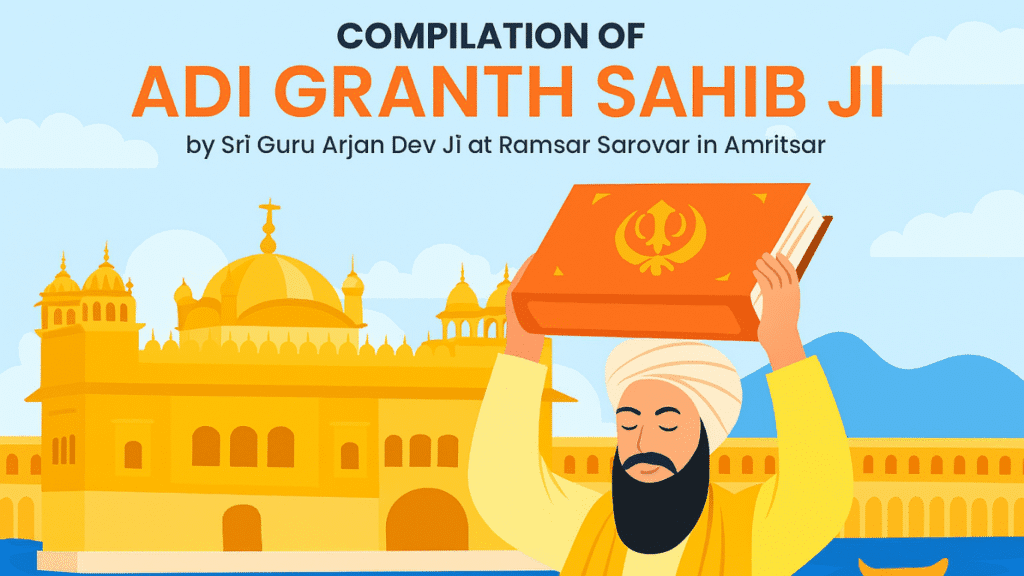
The crowning achievement of Sri Guru Arjan Dev Ji was the compilation of Adi Granth Sahib Ji, the sacred scripture of the Sikhs. His goal was clear: to preserve the Gurbani of the earlier Gurus and give the Sikh community a distinct religious text of their own.
Guru Ji began this historic work at Ramsar Sarovar near Amritsar, where he dictated the hymns to Bhai Gurdas Ji, his trusted scribe. He sent messages across the Sikh world to collect the verses of previous Gurus. When Baba Mohan, son of Guru Amar Das Ji, hesitated to share two important volumes, Guru Arjan Dev Ji personally visited him. Moved by Guru Ji’s humility, Baba Mohan handed over the sacred texts.
On 16 August 1604 A.D., the completed Adi Granth was ceremoniously installed in the newly built Harmandir Sahib. Baba Buddha Ji, the first Granthi, carried the scripture on his head in a grand procession from Ramsar to Harmandir Sahib.
At the time, the scripture was known as “Pothi Sahib”. It included:
- Hymns of Guru Nanak Dev Ji, Guru Angad Dev Ji, Guru Amar Das Ji, Guru Ram Das Ji, and Guru Arjan Dev Ji himself (with 2216 hymns—the highest contribution)
- Verses from 15 Bhagats and Sufi Saints, 11 Bhatts, and 4 Gursikhs like Shaikh Farid, Kabir, and Ravidas
- Guru Ji excluded compositions that did not align with Guru Nanak Dev Ji’s teachings
Later, Sri Guru Gobind Singh Ji added 116 hymns of Guru Tegh Bahadur Ji and gave the Adi Granth its final form and eternal status as Sri Guru Granth Sahib Ji, the living Guru of the Sikhs.
Guru Arjan Dev Ji also composed spiritual gems like:
- Sukhmani Sahib (The Psalm of Peace)
- Bara Maha, Barah Akharam Majh, and Gaudi
- He arranged all hymns into 30 ragas for musical recitation
This compilation became a spiritual lighthouse for Sikhs, offering guidance on the political, religious, social, and economic life of the 15th to 17th centuries. By including voices from different castes and faiths, Guru Ji set a timeless example of unity, equality, and divine wisdom.
🤝 Friendly Relations with Emperor Akbar: A Chapter of Respect and Support

During the leadership of Sri Guru Arjan Dev Ji, Sikhism enjoyed a period of peace and respect under the rule of Mughal Emperor Akbar. These friendly ties had begun earlier during the time of Sri Guru Amar Das Ji, and continued through Guru Arjan Dev Ji’s pontificate.
Despite efforts by rivals like Prithia, Chandu Shah, some Brahmins, and orthodox Muslims to turn Akbar against Guru Ji, the emperor remained fair and wise. They falsely claimed that the Adi Granth Sahib Ji contained verses against Islam. But when Akbar personally reviewed the scripture, he declared it worthy of reverence, recognizing its message of unity and devotion.
On Guru Ji’s request, Akbar even reduced land revenue by 10%, easing the burden on farmers and earning Guru Arjan Dev Ji great respect among the people. This act not only strengthened the bond between the Sikh community and the Mughal court but also helped Sikhism grow peacefully during that time.
⚔️ Nomination of Guru Hargobind Ji: A Shift Toward Strength and Defense
In 1606 A.D., just before his martyrdom, Sri Guru Arjan Dev Ji chose his son Hargobind Ji as the next Guru of the Sikhs. This moment was not only a continuation of the sacred tradition of Gurgaddi (spiritual succession), but also a turning point in Sikh history.
Guru Arjan Dev Ji gave a powerful instruction to his son: “Sit fully armed on the throne and maintain an army to the best of your ability.”
With these words, Guru Ji signaled a new direction for Sikhism—from peaceful devotion to preparedness and self-defense. This guidance laid the foundation for the martial spirit of the Sikh community, which would later be fully realized under Guru Hargobind Ji and future Gurus.
Guru Arjan Dev Ji’s foresight ensured that Sikhism would not only survive but stand strong against future challenges.
🌟 Legacy and Impact of Sri Guru Arjan Dev Ji’s Achievements
The contributions of Sri Guru Arjan Dev Ji to the development of Sikhism are truly remarkable and far-reaching. Through the construction of Harmandir Sahib, he gifted the Sikh community its most sacred and unifying place of worship—a symbol of humility, equality, and devotion that continues to inspire generations.
His founding of Tarn Taran, Kartarpur, and Hargobindpur created spiritual hubs that helped spread Sikh teachings across Punjab. The Masand system brought structure, financial support, and outreach, making Sikhism stronger and more organized.
Above all, the compilation of Adi Granth Sahib Ji stands as his greatest achievement. By preserving the divine hymns of Sikh Gurus and saints from various faiths, Guru Arjan Dev Ji gave the Sikhs a timeless spiritual guide—later enshrined as Sri Guru Granth Sahib Ji, the eternal Guru.
His vision, humility, and leadership laid the foundation for a vibrant, inclusive, and resilient Sikh community. For aspirants preparing for competitive exams, understanding Guru Arjan Dev Ji’s legacy is essential to grasp the spiritual and historical evolution of Sikhism.
🏁 Sri Guru Arjan Dev Ji’s Legacy & Your Path to Exam Success
Sri Guru Arjan Dev Ji’s visionary leadership transformed Sikhism into a well-structured, spiritually rich, and socially inclusive faith. From the construction of Harmandir Sahib to the compilation of Adi Granth Sahib Ji, his contributions laid the foundation for Sikh unity, resilience, and global reverence. For aspirants, understanding his legacy is not just about history—it’s about grasping the roots of equality, service, and spiritual strength.
🛕 Sri Guru Arjan Dev Ji Biography: Architect of Sikh Unity, Scripture & Sacrifice
👉 Click here to read the full article on Sri Guru Arjan Dev Ji’s Biography and Legacy Gain deep insights into the life, contributions, and spiritual impact of the fifth Sikh Guru—covering key milestones like the construction of Harmandir Sahib, compilation of Adi Granth Sahib Ji, and the development of the Masand system.
To deepen your preparation and connect this topic with broader exam themes, explore these valuable resources from RankersChoice:
🔗 Explore More for Competitive Exams
- 📅 Current Affairs & Articles Stay updated with weekly GK digests, international summits, awards, and historical insights like the Battle of Saragarhi.
- 📄 Previous Year Question Papers (PYQ) Practice real exam patterns and boost confidence with solved papers from PSSSB, UPSC, and more.
- 📘 Punjabi Grammar Master essential grammar rules for PPSC, Patwari, and Punjab Police exams with targeted lessons.
- 🏞️ Punjab History & Culture Dive into the rich legacy of Punjab—from early kingdoms to Guru biographies and cultural milestones.
- 📚 English Vocabulary & Grammar Learn vocabulary through stories of freedom fighters and sharpen grammar for SSC, CGL, and PCS exams.
- 💼 Jobs & Recruitment Updates Get the latest notifications, exam patterns, and preparation guides for Punjab government jobs.
Let Guru Arjan Dev Ji’s legacy inspire your journey—not just in exams, but in life. Keep learning, keep growing, and keep empowering others through knowledge.