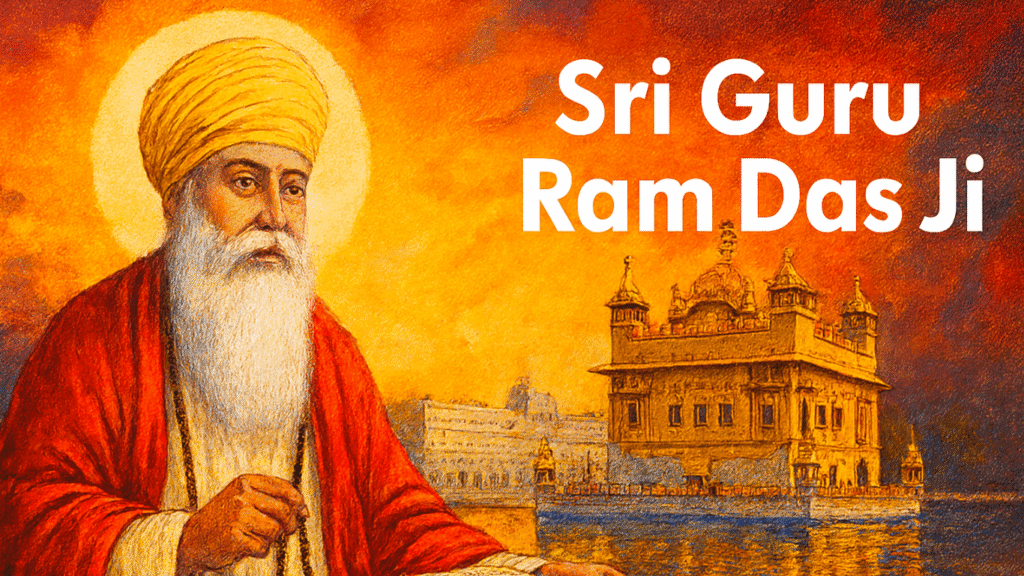
Sri Guru Ram Das Ji, the fourth Guru of Sikhism, stands as a towering figure in the spiritual and socio-cultural evolution of the Sikh faith. His life, though brief in terms of Guruship (1574–1581), was marked by profound humility, visionary leadership, and transformative contributions that continue to shape Sikh identity today. Born as Bhai Jetha Ji in Lahore, his journey from a humble child selling boiled grams to the founder of Amritsar and a spiritual beacon for millions is a testament to divine grace and human dedication.
Table of Contents
🌟 Early Life and Humble Beginnings
Birth and Parentage
Sri Guru Ram Das Ji was born on 24th September 1534 in a humble Sodhi family in Chuna Mandi, Lahore—a place now remembered as Gurdwara Janam Asthan, marking his sacred birthplace. Known as Bhai Jetha Ji in his childhood, he was the beloved son of Hari Das Ji and Daya Kaur Ji, who lived in simple circumstances. Despite the hardships of poverty, young Bhai Jetha Ji carried within him a spirit and strength that would one day inspire millions and shape the future of Sikhism. His early life reminds us how greatness often begins in the most unassuming ways.
Childhood Virtues
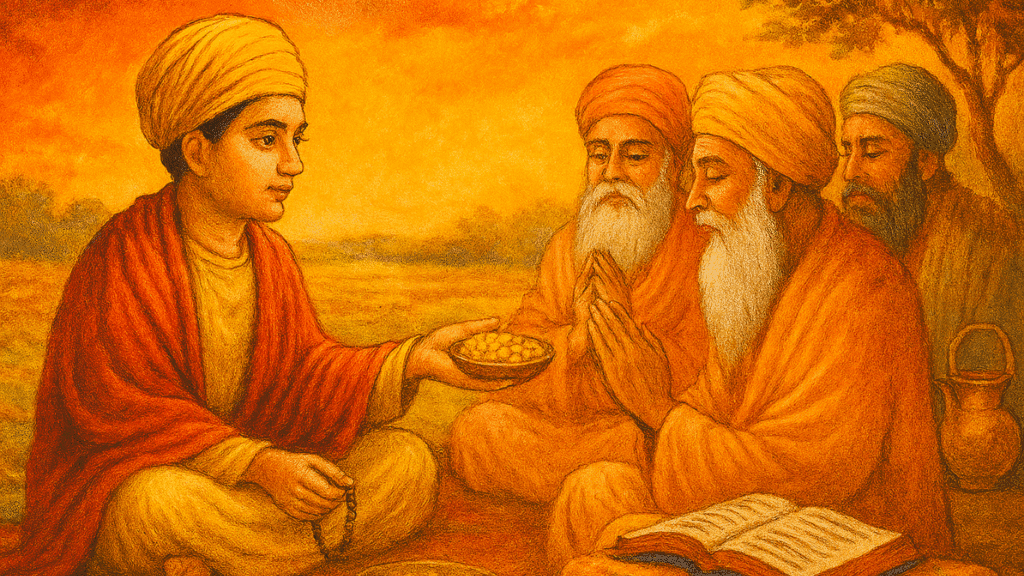
From a young age, Bhai Jetha Ji showed a deeply religious and kind-hearted nature. Once, when his mother sent him to the market to sell boiled grams, he met some hungry saints along the way. Without hesitation, he gave all the boiled grams to the saints, returning home empty-handed. Tragically, Bhai Jetha Ji lost both his parents when he was only seven years old. After this, his maternal grandmother took care of him in the village of Basarke, Amritsar where he continued to sell boiled grams to support himself.
💍 Marriage and Spiritual Ascent
Meeting Guru Amar Das Ji
His warm personality and willingness to help others made him well-loved throughout the village. At the age of twelve, Bhai Jetha Ji had the opportunity to visit Goindwal Sahib with a group of Sikhs. There, he became a devoted disciple of Sri Guru Amar Das Ji. Bhai Jetha Ji served the Guru and the Sikh congregation (Sangat) with dedication and humility.
Marriage to Bibi Bhani Ji
Impressed by his devotion and character, Sri Guru Amar Das Ji arranged the marriage of his younger daughter, Bibi Bhani Ji, to Bhai Jetha Ji in 1553 A.D., when he was 19 years old.
Together, they were blessed with three sons: Prithi Chand (Prithia), Mahadev, and Arjan Dev Ji. This union not only strengthened Bhai Jetha Ji’s spiritual journey but also laid the foundation for his future role as a revered Guru in Sikhism.
🕊️ Ascension to Guruship
Becoming the Fourth Guru
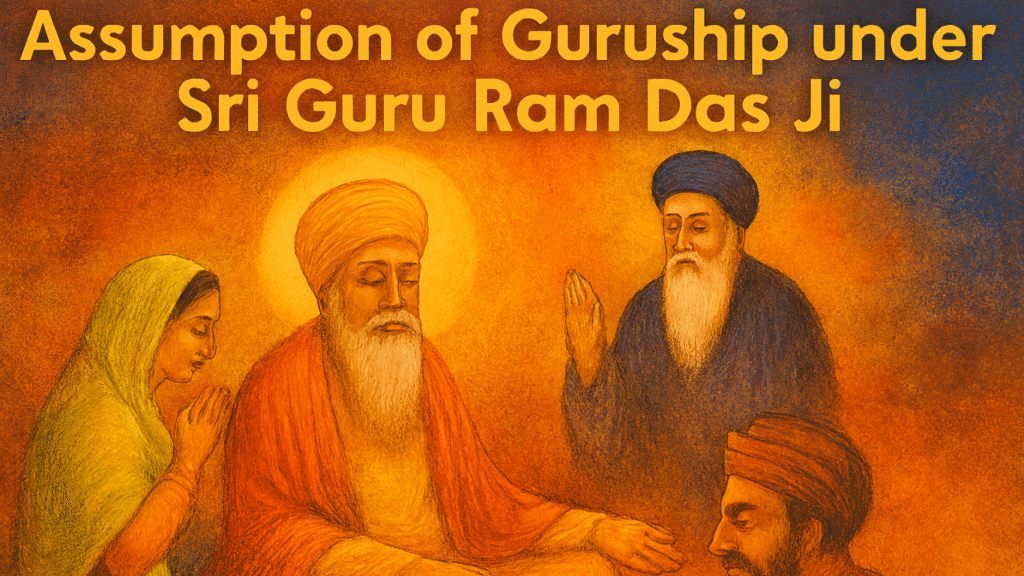
After his marriage, Bhai Jetha Ji continued to live at Goindwal Sahib, dedicating himself wholeheartedly to serving Sri Guru Amar Das Ji and the Sikh community. Bibi Bhani Ji, his devoted wife, also served the Guru with great love and commitment. Bhai Jetha Ji’s selfless service, humility, and gentle nature deeply touched Sri Guru Amar Das Ji.
Recognizing these qualities, on 1st September 1574 A.D., he appointed Bhai Jetha Ji as his successor to the Guruship. From that day forward, Bhai Jetha Ji was known as Sri Guru Ram Das Ji. Sri Guru Amar Das Ji blessed Bibi Bhani Ji with the promise that the Guruship would continue in her family. Thus, Sri Guru Ram Das Ji became the fourth Guru of the Sikhs, carrying forward the spiritual legacy with grace and devotion.
🏙️ Foundation of Ramdaspura (Amritsar)
Visionary Urban Planning
One of the greatest contributions of Sri Guru Ram Das Ji to the Sikh community was the establishment of Guru Ramdaspura, which later became known as Amritsar. After becoming the Sikh Guru, he chose to make this place his home. In 1577 A.D., he founded Ramdaspura with a vision to create a vibrant center for the Sikh faith and community.
To bring life and activity to Ramdaspura, Guru Ram Das Ji invited fifty-two traders from various professions to settle there. These traders set up shops and businesses, forming a bustling marketplace known as ‘Guru Ka Bazaar,’ which attracted people from near and far.
Construction of Sarovars
Understanding the spiritual importance of the place, Sri Guru Ram Das Ji planned the construction of two holy tanks, or sarovars, named Amritsar and Santokhsar. The work on the Amritsar sarovar began first, with the respected Baba Buddha Ji entrusted to oversee the project. Over time, Ramdaspura’s fame grew, and it became better known as Amritsar—the “Pool of Nectar”—a name symbolizing spiritual purity and blessings.
This foundation not only strengthened the Sikh faith but also established Amritsar as a spiritual and cultural hub that continues to inspire millions around the world today.
🧭 Institutional Innovations
Masand System
Sri Guru Ram Das Ji began the important work of digging two sacred sarovars (holy tanks), Amritsar and Santokhsar, at Ramdaspura. To complete this large project, he needed funds. To raise money and spread the message of Sikhism, he appointed trusted representatives to travel to different regions. These representatives, later known as Masands, played a vital role in collecting offerings from Sikhs and sharing the teachings of the faith.
The establishment of the Masand system was a breakthrough in Sikh history. It helped Sikhism grow far beyond its original centers, reaching even distant and remote areas. Thanks to the Masands, not only did the construction of the sarovars progress smoothly, but the Sikh community also became more connected and organized. This system laid a strong foundation for the expansion and unity of Sikhism, shaping its spread for generations to come.
Among the many missionaries sent by Sri Guru Ram Das Ji, the most distinguished was Bhai Gurdas. Recognizing his dedication and wisdom, Guru Ram Das Ji entrusted Bhai Gurdas with the important mission of traveling to Agra to preach the teachings of Guru Nanak. Through his tireless work, Bhai Gurdas played a vital role in spreading the message of Sikhism beyond Punjab, helping to strengthen and inspire Sikh communities in distant lands.
Manji and Piri Systems
He expanded the Manji system, assigning spiritual leaders to different zones, and introduced the Piri system for women, empowering them to lead and preach. These reforms democratized religious leadership and promoted gender inclusivity.
🤝 Reconciliation with Udasis
Meeting Baba Sri Chand Ji
During the Guruship of Sri Guru Ram Das Ji, a significant event was his peaceful reconciliation with the Udasi sect. Baba Sri Chand Ji, the founder of the Udasis and son of Guru Nanak Dev Ji, visited Amritsar specifically to meet Guru Ram Das Ji. Interestingly, Baba Sri Chand Ji had never met the earlier Gurus, Guru Angad Dev Ji or Guru Amar Das Ji, but sought an audience with Guru Ram Das Ji.
During their conversation, Baba Sri Chand Ji noticed the Guru’s long beard and remarked on it. With humility and grace, Guru Ram Das Ji replied, “Yes, I have grown a long beard so that I may wipe with it the feet of saintly men like you.” This expression of deep respect and modesty touched Baba Sri Chand Ji profoundly. He realized that his father’s spiritual legacy was entrusted to a worthy and humble successor.
Impressed by the Guru’s modesty, Baba Sri Chand Ji abandoned any opposition to Sikhism from that day onward. This reconciliation was highly beneficial for both the Sikhs and the Udasis. It ended conflicts and misunderstandings, and more importantly, inspired the Udasis to wholeheartedly support and work for the growth and spread of Sikhism. This unity strengthened the Sikh community and played a vital role in the faith’s expansion.
🎶 Literary and Spiritual Contributions
Compositions in Guru Granth Sahib
Sri Guru Ram Das Ji made many significant contributions to the growth and strengthening of Sikhism. He continued the sacred tradition of composing hymns, authoring 679 Sabads that enriched Sikh scripture with spiritual wisdom and guidance. One of his most enduring innovations was the introduction of a new Sikh marriage ceremony—where the couple circumambulates the Guru Granth Sahib Ji four times, a practice symbolizing unity and commitment. To accompany this, Sri Guru Ram Das Ji composed the four Lawans, the sacred hymns recited during the marriage ritual.
Beyond spiritual teachings, he strengthened key Sikh institutions like the Pangat (communal kitchen), Sangat (congregation), and Manji system (regional religious administration), which helped unify and organize the community. Sri Guru Ram Das Ji also firmly opposed social evils such as the caste system, sati (widow immolation), child marriage, and the prohibition on widow remarriage, condemning these practices in strong terms.
To spread Sikhism further, he sent dedicated preachers to various regions. Among them, Bhai Gurdas and Hindal stand out as prominent figures who played vital roles in carrying the Guru’s message far and wide. Through these combined efforts, Sri Guru Ram Das Ji not only nurtured spiritual growth but also worked towards social reform and community building, laying a strong foundation for Sikhism’s lasting impact.
Promotion of Pangat and Sangat
He reinforced the institutions of Pangat (eating together) and Sangat (congregational worship), promoting social equality and collective spirituality. These practices remain central to Sikh community life.
👑 Relations with Emperor Akbar
Diplomatic Grace
During his Guruship, Sri Guru Ram Das Ji maintained warm and respectful relations with the Mughal emperor Akbar. The two met in Lahore, where Emperor Akbar was deeply impressed by the Guru’s noble character and dignified presence.
Moved by this meeting, Akbar honored Guru Ram Das Ji’s recommendation by forgiving an entire year’s land revenue for the farmers of Punjab. This generous act not only relieved the farmers but also greatly enhanced the respect and reputation of Sri Guru Ram Das Ji among both his followers and the wider community.
Such friendly ties with the emperor helped strengthen Sikhism’s position and paved the way for its continued growth and acceptance in a complex political landscape.
👣 Succession and Final Years
Nomination of Guru Arjan Dev Ji
In 1581 A.D., Sri Guru Ram Das Ji chose his youngest son, Arjan Dev Ji, to be his successor as the Sikh Guru. This decision was made with careful thought. His eldest son, Prithi Chand, had caused trouble through his conspiracies, while his second son, Mahadev, showed little interest in worldly responsibilities. In contrast, Arjan Dev Ji was seen as the most capable and devoted among his brothers, making him the ideal choice to carry forward the Guruship.
Joti Jot (Merging with the Divine)
On 1st September 1581, Sri Guru Ram Das Ji left his mortal life and merged with the Divine, leaving behind a strong legacy and a worthy successor to lead the Sikh community into the future. This transition marked a significant moment in Sikh history, highlighting the importance of devotion, capability, and integrity in leadership.
🏆 Legacy and Impact
Architect of Sikh Identity
Although Sri Guru Ram Das Ji’s time as Guru lasted only seven years, his impact on Sikhism was profound and lasting. During his leadership, he gave new strength and direction to the faith, setting in motion important developments that shaped its future.
He laid the foundation of Ramdaspura, which became the spiritual and cultural heart of Sikhism. By establishing the Masand system, he created a network that helped spread Sikh teachings far and wide. His peaceful reconciliation with the Udasis helped unite different groups, strengthening the community’s bonds. Sri Guru Ram Das Ji also enriched Sikh scripture by composing many hymns, and courageously challenged social evils that divided society.
He continued to nurture essential Sikh institutions like the Sangat (congregation), Pangat (community kitchen), and the Manji system (regional religious leadership), ensuring they remained pillars of the faith. Additionally, his friendly relations with Emperor Akbar brought respect and support to the Sikh community.
Through all these efforts, Sri Guru Ram Das Ji played a key role in solidifying Sikhism’s foundation, inspiring generations to come with his vision, humility, and dedication.
🔗 Dive into Punjab’s rich history and cultural heritage to discover the powerful role folk music plays in shaping social movements and preserving the region’s unique languages.