National Press Day, observed every year on November 16, is not merely a date—it is a solemn tribute to those who dare to speak truth to power, who chase stories in the face of danger, and who believe that an informed citizen is the strongest pillar of a free nation.
In a world flooded with noise, where truth often drowns beneath waves of misinformation, there stands a quiet yet powerful force—the press. It is not just ink on paper or pixels on a screen; it is the heartbeat of democracy, the voice of the voiceless, the mirror that reflects both our triumphs and our failures.
For aspirants preparing for UPSC, SSC, PCS, and Patwari exams, understanding the essence of this day is more than syllabus—it’s a lesson in courage, ethics, and the relentless pursuit of truth.
Table of Contents
🗞️ What is National Press Day? | Full Explanation for Aspirants
National Press Day, observed annually on November 16, marks a defining moment in India’s democratic journey—the establishment of the Press Council of India (PCI) in 1966. This day is not just a ceremonial observance; it is a powerful reminder of the press’s role as the Fourth Pillar of Democracy, standing alongside the Legislature, Executive, and Judiciary.
🏛️ Birth of the Press Council of India
The Press Council of India (PCI) was set up on November 16, 1966 as a statutory, quasi-judicial body. Its primary mission: to preserve the freedom of the press while ensuring that journalism remains ethical, accountable, and responsible.
- Statutory: Created by an Act of Parliament.
- Quasi-judicial: Can investigate complaints and issue advisories, but cannot punish or enforce legal penalties.
Inspired by similar councils in democratic nations like the UK, the PCI was envisioned as a watchdog—not to control the press, but to guide it.
🛡️ Role & Powers of the PCI
Unlike courts or regulatory bodies, the PCI does not wield punitive powers. Instead, it functions through moral authority, public advisories, and investigative reports. Its responsibilities include:
- Investigating complaints against media outlets for unethical reporting.
- Protecting journalists from undue pressure or censorship.
- Promoting standards of fairness, accuracy, and public accountability.
- Encouraging responsible journalism in the face of sensationalism and misinformation.
The PCI’s strength lies in its ability to balance press freedom with public responsibility, especially in a diverse and vibrant democracy like India.
🧭 Why National Press Day Matters
In today’s digital age—where fake news, AI-generated misinformation, and social media manipulation threaten public trust—National Press Day becomes more relevant than ever. It reminds us that:
- Freedom of the press is not absolute; it must be exercised with integrity.
- Journalists are guardians of truth, not just content creators.
- Democracy thrives when the press is fearless, ethical, and transparent.
📜 Historical Background | National Press Day
The story of National Press Day begins not with celebration, but with a solemn commitment—to uphold the integrity of journalism in a democracy still finding its voice.
In 1966, the Government of India established the Press Council of India (PCI) as a statutory, quasi-judicial body to serve as a moral compass for the press. Its mission was clear: to regulate and elevate the standards of journalism, ensuring that the press remained free, fair, and responsible.
⚖️ The First Chairman: Justice J.R. Mudholkar
To lead this noble mission, the government appointed Justice J.R. Mudholkar as the first chairman of the PCI. A respected jurist, he laid the foundation for a council that would guide the press through principles, not punishments. Under his leadership, the PCI began shaping a culture of ethical journalism, where truth mattered more than headlines.
🛑 The Emergency & Rebirth
However, the journey wasn’t smooth. During the Emergency (1975–77), press freedom was severely curtailed, and the PCI was dissolved—a dark chapter in India’s democratic history. But like the press itself, the council refused to be silenced. In 1979, it was reconstituted, stronger and more resolute, reaffirming its role as the watchdog of press freedom.
📰 Incredible Stories of Indian Press
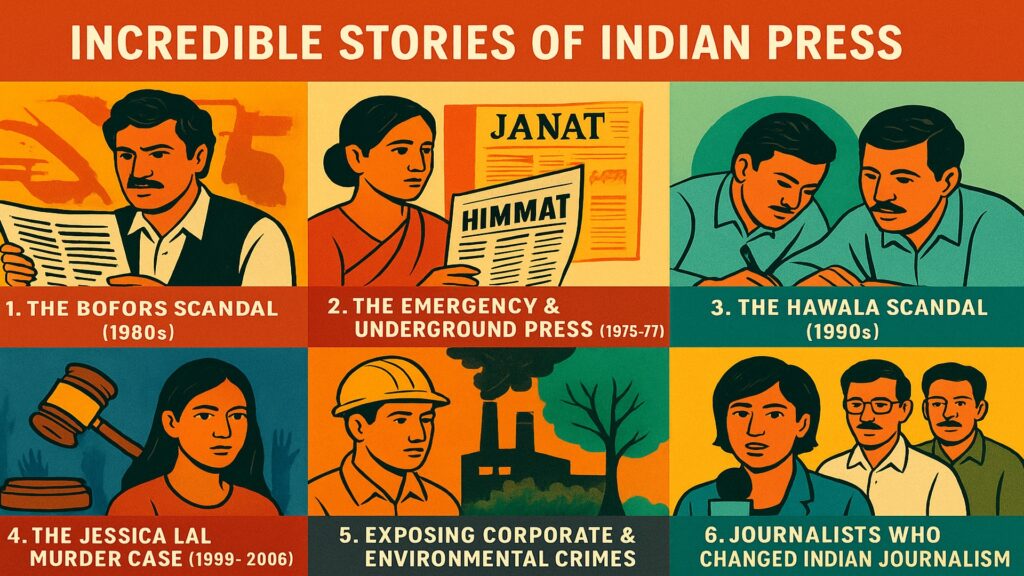
Incredible stories of the Indian press remind us that journalism is not just about reporting—it is about courage, accountability, and the relentless pursuit of truth.
🔎 1. The Bofors Scandal (1980s)
One of the most famous investigative stories in Indian journalism, the Bofors scandal was exposed by journalists who revealed corruption in defense deals. Their relentless reporting shook the political establishment, led to widespread protests, and became a turning point in India’s political history.
📰 2. The Emergency & Underground Press (1975–77)
During the Emergency, when censorship silenced mainstream newspapers, underground publications like Himmat and Janata continued to publish truth at great personal risk. These courageous journalists defied bans, arrests, and intimidation, proving that the press cannot be completely silenced.
💡 3. The Hawala Scandal (1990s)
Investigative journalists uncovered the Jain Hawala scandal, exposing a network of illegal payments involving politicians across party lines. Their work forced accountability and showed how journalism can pierce through layers of secrecy.
📸 4. The Jessica Lal Murder Case (1999–2006)
Persistent media coverage of the Jessica Lal murder case kept public attention alive when justice seemed unlikely. The press mobilized public opinion, leading to a retrial and eventual conviction of the accused. This case demonstrated how journalism can act as a catalyst for justice.
🕊️ 5. Exposing Corporate & Environmental Crimes
From uncovering illegal mining in Karnataka to exposing industrial pollution in Bhopal, investigative journalists have repeatedly risked their lives to protect citizens. Their reports sparked reforms, court cases, and public awareness.
🌟 6. Journalists Who Changed Indian Journalism
Icons like Ramnath Goenka (Indian Express), P. Sainath (rural reporting), and Barkha Dutt (Kargil War coverage) transformed journalism by bringing hidden realities to the forefront. Their grit and perseverance inspired generations of reporters.
📺 Current Situation of Indian Media: Rise of “Godi Media”
In recent years, the Indian media landscape has faced intense scrutiny. While National Press Day celebrates freedom and responsibility, the reality on the ground often tells a different story. Many citizens and international observers now use the term “Godi Media” (literally meaning lapdog media) to describe sections of the press that appear aligned with the ruling establishment rather than acting as independent watchdogs.
🔎 What Does “Godi Media” Mean?
- The phrase reflects public frustration with news channels and outlets accused of biased coverage.
- Instead of questioning power, these outlets are seen as amplifying government narratives.
- The term has gained traction on social media, in public debates, and even in international journalism circles.
⚠️ Challenges Facing Indian Media Today
- Political Influence: Coverage often favors ruling parties, especially during elections, raising doubts about neutrality.
- Corporate Control: Ownership patterns show increasing concentration of media houses under large business groups, affecting editorial independence.
- Declining Trust: Surveys reveal growing skepticism among viewers, with “Godi Media” trending whenever biased reporting is perceived.
- Global Concerns: India ranks 151 out of 180 countries in the World Press Freedom Index 2025, placing it in the “very serious” category for press freedom【source: Reporters Without Borders】.
🌍 Why This Matters for Democracy
- When media loses independence, citizens lose access to unbiased information.
- International watchdogs and journalists warn that India’s democratic image is at risk if press freedom continues to erode.
📜 Constitutional Safeguards for the Press in India
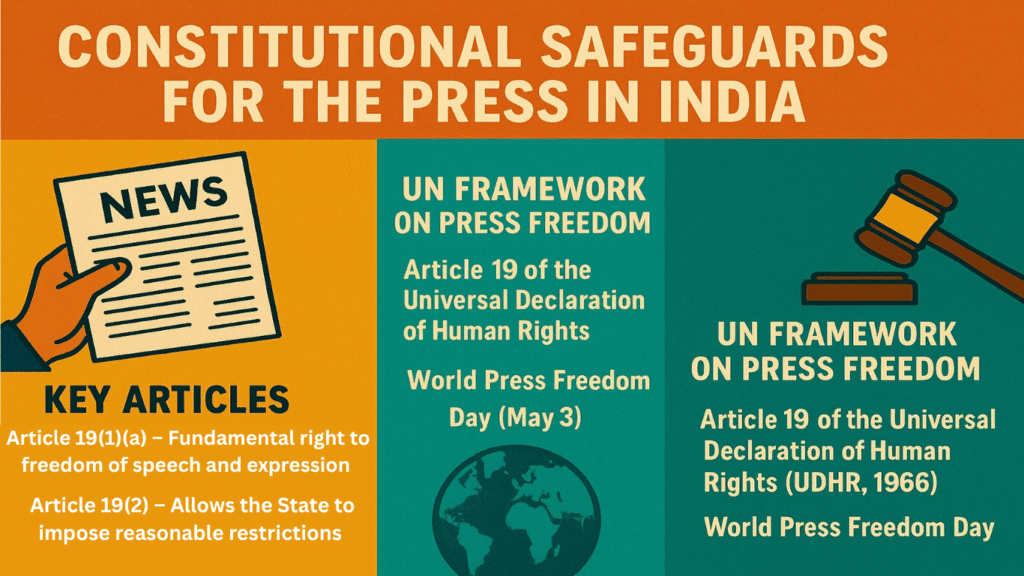
India’s Constitution does not explicitly mention “freedom of the press,” but it is deeply embedded in the Right to Freedom of Speech and Expression. The judiciary has repeatedly affirmed that a free press is essential for democracy.
🔑 Key Articles
- Article 19(1)(a) – the Indian Constitution guarantees all citizens the fundamental right to freedom of speech and expression. Judicial interpretations have consistently held that this right encompasses the freedom of the press as well.
- Article 19(2) – Allows the State to impose reasonable restrictions on this freedom in the interests of:
- Sovereignty and integrity of India
- Security of the State
- Public order, decency, and morality
- Judicial Milestones:
- Romesh Thapar v. State of Madras (1950) – Supreme Court held that freedom of the press is part of Article 19(1)(a).
- Indian Express Newspapers v. Union of India (1985) – Reinforced that press freedom is vital for democracy.
👉 For aspirants: Always link National Press Day and the Press Council of India with Article 19(1)(a) in exam answers.
🌍 UN Framework on Press Freedom
Globally, press freedom is recognized as a fundamental human right under international law. The United Nations has enshrined this in its charters and declarations.
🔑 Key UN Provisions
- Article 19 of the Universal Declaration of Human Rights (UDHR, 1948): “Everyone has the right to freedom of opinion and expression; this right includes freedom to hold opinions without interference.”
- Article 19 of the International Covenant on Civil and Political Rights (ICCPR, 1966): Protects freedom of expression, with restrictions only for respect of rights, reputation, national security, public order, or public health/morals.
- World Press Freedom Day (May 3): Declared by the UN General Assembly in 1993, it highlights global challenges to press freedom.
- UNESCO Initiatives: Promote journalist safety, combat impunity, and encourage nations to align their laws with international standards.
The journey of the Indian press—from its courageous battles during the Emergency to its modern challenges of “Godi Media”—reminds us that journalism is not just about reporting events, but about safeguarding democracy, amplifying truth, and giving voice to the voiceless. National Press Day is more than a commemoration; it is a call to every citizen and aspirant to value the role of a free press in shaping an informed society.
As you prepare for exams like UPSC, SSC, PCS, and Patwari, remember that understanding the press is not only about GK notes—it is about appreciating the courage, ethics, and resilience that keep democracy alive.
📲 For the latest notifications of all our articles directly on your mobile, we encourage you to join our WhatsApp channel.
📚 For more related articles and current affairs, please click here to visit our Current Affairs & Articles section.
Together, let us continue to learn, question, and celebrate the spirit of a free press—because an informed mind is the strongest weapon of change.