Imagine a moment when the world pauses to honor brilliance—not just in science or literature, but in the pursuit of peace, the unraveling of life’s mysteries, and the shaping of economies. That moment arrives each year in October, when the Nobel Prizes are announced. These awards are not just medals or money—they are global affirmations of human potential, perseverance, and purpose.
From the quiet laboratories of physicists to the poetic musings of writers, from the tireless efforts of peace activists to the economic theorists reshaping nations—the Nobel Prize celebrates those who dare to think differently and act boldly. Let’s embark on a journey through the history, categories, processes, and impact of the Nobel Prize.
Table of Contents
🧭 The Origins: Alfred Nobel’s Vision for Humanity
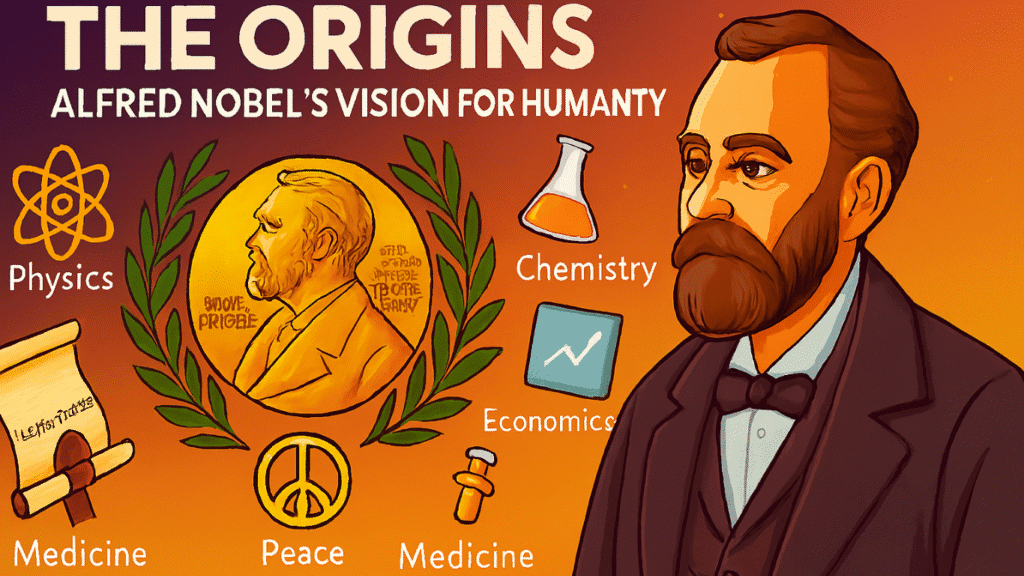
Every great legacy begins with a moment of reflection. For Alfred Nobel, that moment came when he read a premature obituary titled “The Merchant of Death is Dead.” A French newspaper had mistakenly published it after the death of his brother, confusing the two. The headline shocked Nobel—it painted him as a man whose inventions had caused destruction, not progress. This moment became a turning point in his life.
Alfred Nobel was a Swedish chemist, engineer, and inventor born in 1833. He held over 350 patents, the most famous being dynamite, which revolutionized construction and mining. However, its use in warfare deeply troubled him. Nobel was a man of science, but also of conscience. He didn’t want to be remembered for creating tools of violence. Instead, he wanted his name to be associated with peace, knowledge, and the betterment of humankind.
In 1895, a year before his death, Nobel signed a will that would change history. He dedicated 94% of his fortune—about 31 million Swedish kronor at the time (equivalent to over ₹200 crore today)—to establish five prizes: Physics, Chemistry, Physiology or Medicine, Literature, and Peace. His will stated that these prizes should be awarded to those who “have conferred the greatest benefit to mankind.”
This was a radical idea. Nobel’s decision was met with resistance from his family and even legal challenges. But his vision prevailed. The Nobel Foundation was established in 1900 to manage the funds and oversee the prize process. The first Nobel Prizes were awarded in 1901, five years after his death.
- Alfred Nobel’s birth: October 21, 1833, Stockholm, Sweden
- Death: December 10, 1896, San Remo, Italy
- Will signed: November 27, 1895
- Nobel Foundation established: June 29, 1900
- First Nobel Prizes awarded: December 10, 1901
- Original prize categories: Physics, Chemistry, Medicine, Literature, Peace
- Economics added: 1968 by Sveriges Riksbank (Swedish Central Bank)
🧪 The Six Pillars of Excellence: Deep Dive into Nobel Prize Categories
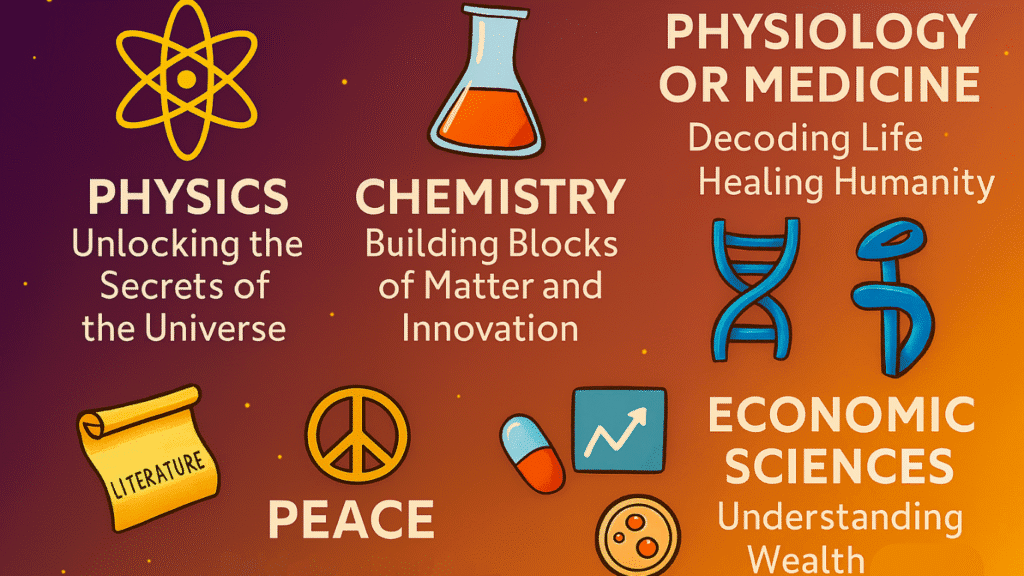
The Nobel Prizes are not just awards—they are global endorsements of human brilliance across six foundational domains. Each category reflects a unique facet of civilization’s progress, and together, they form the backbone of the Nobel legacy. Let’s explore each in more depth, with historical examples and institutional insights that bring these pillars to life.
⚛️ 1. Physics: Unlocking the Secrets of the Universe
Physics was one of the original categories awarded in 1901. It honors discoveries that explain the fundamental laws of nature—from the behavior of particles to the vastness of space.
- Notable Laureates:
- Albert Einstein (1921): For his explanation of the photoelectric effect, which laid the foundation for quantum theory.
- C.V. Raman (1930): First Indian Nobel laureate in Physics, awarded for discovering the Raman Effect.
- Awarding Body: Royal Swedish Academy of Sciences
- Relevance: Physics Nobel Prizes often lead to technological revolutions—lasers, semiconductors, and even GPS systems trace their roots to Nobel-winning research.
⚗️ 2. Chemistry: Building Blocks of Matter and Innovation
The Chemistry Prize celebrates breakthroughs in molecular science, chemical reactions, and materials that shape industries and medicine.
- Notable Laureates:
- Marie Curie (1911): For her discovery of radium and polonium—she remains the only person to win Nobel Prizes in two different sciences.
- Venkatraman Ramakrishnan (2009): Indian-born structural biologist awarded for studies on the ribosome.
- Awarding Body: Royal Swedish Academy of Sciences
- Relevance: Chemistry Nobel Prizes often lead to new drugs, cleaner energy, and safer materials.
🧬 3. Physiology or Medicine: Decoding Life and Healing Humanity
This category honors discoveries that advance our understanding of the human body, diseases, and medical treatments.
- Notable Laureates:
- Alexander Fleming (1945): For discovering penicillin, which revolutionized medicine.
- Tu Youyou (2015): For discovering artemisinin, a life-saving malaria treatment derived from traditional Chinese medicine.
- Awarding Body: Karolinska Institute, Sweden
- Relevance: Medicine Nobel Prizes often lead to public health breakthroughs and life-saving innovations.
📚 4. Literature: The Soul of Civilization
The Literature Prize is awarded to authors whose work enriches humanity through imagination, insight, and linguistic mastery. It’s not just about storytelling—it’s about shaping cultural consciousness.
- Notable Laureates:
- Rabindranath Tagore (1913): First Asian Nobel laureate, honored for his poetic masterpiece “Gitanjali.”
- Gabriel García Márquez (1982): For magical realism that redefined Latin American literature.
- Awarding Body: Swedish Academy
- Relevance: Literature Nobel Prizes elevate voices that challenge norms, preserve heritage, and inspire empathy.
☮️ 5. Peace: Bridging Divides and Building Harmony
The Peace Prize is unique—it’s awarded in Oslo, Norway, not Sweden. It honors individuals and organizations that promote peace, resolve conflicts, and uphold human rights.
- Notable Laureates:
- Mother Teresa (1979): For her humanitarian work with the poor in Kolkata.
- Kailash Satyarthi (2014): For his fight against child labor and exploitation in India.
- Awarding Body: Norwegian Nobel Committee
- Relevance: Peace Nobel Prizes spotlight global efforts toward justice, equality, and reconciliation.
📈 6. Economic Sciences: Understanding Wealth and Welfare
This category was added in 1968 by Sweden’s central bank, Sveriges Riksbank, in memory of Alfred Nobel. It honors contributions to economic theory, policy, and practice.
- Notable Laureates:
- Amartya Sen (1998): Indian economist awarded for his work on welfare economics and poverty.
- Paul Krugman (2008): For his analysis of trade patterns and economic geography.
- Awarding Body: Royal Swedish Academy of Sciences
- Relevance: Economics Nobel Prizes influence global policy, development strategies, and financial systems.
🏛️ Institutions Behind the Prizes
Each Nobel category is managed by a respected institution that ensures rigorous evaluation:
| Category | Awarding Institution | Location |
|---|---|---|
| Physics | Royal Swedish Academy of Sciences | Stockholm, Sweden |
| Chemistry | Royal Swedish Academy of Sciences | Stockholm, Sweden |
| Medicine | Karolinska Institute | Stockholm, Sweden |
| Literature | Swedish Academy | Stockholm, Sweden |
| Peace | Norwegian Nobel Committee | Oslo, Norway |
| Economics | Royal Swedish Academy of Sciences | Stockholm, Sweden |
These institutions invite nominations from qualified individuals worldwide—professors, researchers, previous laureates, and members of academies. The selection process is confidential and can take months of review and deliberation.
📅 The Nobel Calendar: Announcements, Ceremonies & Celebrations
The Nobel Prize is not just a moment—it’s a season of global recognition, intellectual celebration, and cultural prestige. Every year, the Nobel Calendar unfolds with precision and tradition, beginning in early October and culminating on December 10, the anniversary of Alfred Nobel’s passing.
🗓️ October: The Month of Announcements
Each Nobel Prize category is announced on a separate day, typically during the first two weeks of October. The announcements are made by the respective awarding institutions in Sweden and Norway. These events are closely watched by scholars, journalists, and governments worldwide.
| Date Range | Event | Location |
|---|---|---|
| Early October | Nobel Prize Announcements | Stockholm (Sweden) & Oslo (Norway) |
| December 10 | Nobel Prize Award Ceremonies | Stockholm (Sweden) & Oslo (Norway) |
- Peace Prize: Announced and awarded in Oslo, Norway, by the Norwegian Nobel Committee.
- Other Prizes (Physics, Chemistry, Medicine, Literature, Economics): Announced and awarded in Stockholm, Sweden, by their respective Swedish institutions.
🎓 December 10: The Nobel Day
The Nobel Prize ceremonies are held on December 10, marking the death anniversary of Alfred Nobel (1833–1896). This day is the pinnacle of the Nobel season, where laureates receive:
- A gold medal bearing Alfred Nobel’s profile
- A diploma with a citation of their achievement
- A monetary award, currently valued at 11 million Swedish kronor (approx. ₹8.5 crore)
The ceremonies are formal, elegant, and attended by royalty, heads of state, and global dignitaries. The King of Sweden personally presents the awards in Stockholm, while the Chair of the Norwegian Nobel Committee leads the Peace Prize ceremony in Oslo.
🎤 Nobel Week: A Festival of Ideas
Leading up to the award ceremony is Nobel Week, a series of events that showcase the laureates’ contributions:
- Nobel Lectures: Laureates present their research, ideas, and journeys. These talks are archived and considered intellectual treasures.
- Nobel Banquet: A grand dinner held at Stockholm City Hall, featuring traditional Swedish cuisine and cultural performances.
- Concerts & Exhibitions: Celebrating the intersection of science, art, and humanity.
These events are not just ceremonial—they are educational and inspirational, offering insights into the minds that shape our world.
💰 The Prize Money: Wealth of Recognition and Legacy
Beyond prestige and global admiration, the Nobel Prize also carries a substantial financial reward—symbolizing not just recognition, but investment in future innovation. Each year, the Nobel Foundation determines the prize amount based on returns from Alfred Nobel’s original endowment, carefully managed to preserve its long-term sustainability.
💸 Current Value of the Nobel Prize
As of recent years, each Nobel Prize is valued at:
- 11 million Swedish kronor (SEK)
- Equivalent in Indian Rupees: Approximately ₹8.5 Crore
This amount may be shared among co-laureates if the prize is awarded jointly. For example, if three scientists win the Physics Prize together, the amount is divided equally unless otherwise specified.
🏅 What Laureates Receive
In addition to the monetary reward, Nobel laureates are honored with:
- A Nobel Medal:
- Made of 18-carat gold, weighing approximately 175 grams
- Each category has a unique design, with Alfred Nobel’s profile featured prominently
- A Nobel Diploma:
- A beautifully crafted certificate with a personalized citation
- Often includes artwork and calligraphy unique to each laureate
- Global Recognition:
- Media coverage, invitations to speak, and influence in their field
- Nobel status often leads to increased funding, collaborations, and policy impact
🏦 Who Funds the Nobel Prize?
The Nobel Foundation, established in 1900, manages the financial assets left by Alfred Nobel in his will. Nobel allocated 94% of his fortune—then worth over 31 million Swedish kronor—to fund the prizes. The Foundation invests this capital and uses the returns to:
- Fund the prize money
- Organize Nobel Week events
- Maintain the Nobel archives and museum
- Support educational outreach and lectures
The Foundation operates independently and ensures that the prizes remain financially viable and globally respected.
🏆 Nobel Prize 2025: Honoring the Architects of Progress
The 2024 Nobel Prizes once again spotlighted individuals whose work has reshaped science, literature, and society. From decoding the language of genes to redefining artificial intelligence, this year’s laureates exemplify Alfred Nobel’s vision of rewarding those who “have conferred the greatest benefit to humankind.”
Let’s explore the winners and their groundbreaking contributions:
🧬 Physiology or Medicine
Laureates: Mary E. Brunkow, Fred Ramsdell & Shimon Sakaguchi Discovery: Peripheral immune tolerance and its role in regulating the immune system Impact: Their groundbreaking research uncovered how the body prevents its immune system from attacking its own tissues. This discovery transformed immunology by explaining the mechanisms that maintain self-tolerance, paving the way for new treatments in autoimmune diseases, cancer immunotherapy, and organ transplantation.
Awarding Body: Karolinska Institute, Sweden
⚛️ Physics
Laureates: John Clarke, John M. Martinis & Michel H. Devoret Contribution: Groundbreaking research in quantum tunnelling and superconducting circuits Impact: Their pioneering work in the sub-atomic realm of quantum tunnelling has advanced the development of ultra-sensitive quantum devices and superconducting technologies. These innovations are now driving progress in digital communications and quantum computing, laying the foundation for faster, more secure, and energy-efficient systems.
Awarding Body: Royal Swedish Academy of Sciences
🧪 Chemistry
Laureates: Susumu Kitagawa, Richard Robson & Omar M. Yaghi Contribution: Development of Metal-Organic Frameworks (MOFs) Impact: Their pioneering work led to the creation of MOFs—highly porous crystalline materials that can store, separate, and transform gases and molecules. These frameworks have revolutionized applications in clean energy, carbon capture, drug delivery, and catalysis, making them one of the most versatile materials in modern chemistry.
Awarding Body: Royal Swedish Academy of Sciences
📚 Literature
Laureate: László Krasznahorkai Contribution: Experimental and philosophical fiction exploring chaos, solitude, and transcendence Impact: Widely regarded as one of Hungary’s most profound literary voices, Krasznahorkai’s dense, flowing prose challenges conventional narrative forms. His works—such as Satantango and The Melancholy of Resistance—delve into existential themes and societal collapse, earning him global acclaim and the 2015 Man Booker International Prize. His writing continues to influence contemporary literature with its meditative depth and stylistic innovation.
Awarding Body: Swedish Academy
☮️ Peace
Laureate: María Corina Machado Contribution: Unwavering advocacy for democracy, human rights, and civic resistance in the face of authoritarianism Impact: Widely regarded as one of Venezuela’s most courageous political voices, Machado’s steadfast commitment to peaceful democratic restoration has galvanized national and international support. As a former member of Venezuela’s National Assembly and a prominent opposition leader, she has confronted systemic repression with resilience, organizing grassroots movements and amplifying the voices of marginalized citizens. Her leadership during political crises—marked by integrity, strategic nonviolence, and moral clarity—has drawn global recognition, including numerous human rights awards and nominations for the Nobel Peace Prize. Machado’s unwavering stance continues to inspire democratic movements across Latin America and beyond, embodying the transformative power of principled resistance in the pursuit of justice and freedom.
Awarding Body: Norwegian Nobel Committee
📈 Economic Sciences
Laureate: Joel Mokyr, Philippe Aghion, and Peter Howitt Contribution: Foundational insights into the role of technological innovation, creative destruction, and historical context in driving long-term economic growth Impact: Widely regarded as architects of modern endogenous growth theory, their collective work has reshaped how economists understand the engines of prosperity. Joel Mokyr illuminated the cultural and institutional roots of the Industrial Revolution, arguing that the “culture of growth”—a belief in progress, science, and useful knowledge—was as vital as capital or labor in igniting sustained development. Meanwhile, Philippe Aghion and Peter Howitt revolutionized growth theory with their model of creative destruction, demonstrating how innovation by forward-looking firms continuously displaces outdated technologies and firms, fueling dynamic economic advancement. Their framework not only explains persistent growth in market economies but also clarifies the complex relationship between competition, intellectual property, and policy. Together, their scholarship bridges history, theory, and policy, offering profound lessons for navigating 21st-century challenges—from AI-driven transformation to climate innovation. In 2025, as economies grapple with technological disruption and stagnation risks, their insights remain indispensable to crafting policies that foster inclusive, knowledge-based growth.
Awarding Body: Royal Swedish Academy of Sciences
🇮🇳 Indian Connection to the Nobel Prize
India has a proud history of Nobel laureates:
| Name | Category | Year | Contribution |
|---|---|---|---|
| Rabindranath Tagore | Literature | 1913 | Gitanjali |
| C.V. Raman | Physics | 1930 | Raman Effect |
| Mother Teresa | Peace | 1979 | Humanitarian work |
| Amartya Sen | Economics | 1998 | Welfare economics |
| Kailash Satyarthi | Peace | 2014 | Child rights activism |
| Venkatraman Ramakrishnan | Chemistry | 2009 | Ribosome structure (Indian-born, US citizen) |
These laureates have elevated India’s global reputation in science, literature, and humanitarian efforts.
📚 Nobel Prize Facts for Competitive Exams
- Alfred Nobel’s Will: Signed in 1895
- First Prizes Awarded: 1901
- Peace Prize Location: Oslo, Norway
- Other Prizes Location: Stockholm, Sweden
- Economic Sciences Added: 1968
- Prize Money (2024): SEK 11 million ≈ ₹8.5 Crore
- Award Date: December 10 annually
- Indian Nobel Laureates: Tagore, Raman, Sen, Satyarthi, etc.
- Youngest Laureate: Malala Yousafzai (Peace, 2014, age 17)
- Oldest Laureate: Leonid Hurwicz (Economics, age 90)
🧭 Nobel Prize—A Gateway to Knowledge and Preparation
The Nobel Prize stands as a beacon of excellence, honoring individuals whose contributions have transformed science, literature, peace, and economics. For aspirants preparing for competitive exams like UPSC, SSC, Banking, and State PSCs, understanding the Nobel legacy is not just academic—it’s strategic. Nobel Prize facts frequently appear in current affairs, general awareness, and essay writing, making them essential for both prelims and mains.
From Alfred Nobel’s vision to the latest laureates in 2024, this topic offers rich insights into global innovation, ethical leadership, and intellectual history. Indian connections—like C.V. Raman, Mother Teresa, Amartya Sen, and Kailash Satyarthi—add relevance for national exams and interviews.
To deepen your preparation, explore our curated resources:
- 📌 Current Affairs & Editorial Articles – Stay updated with Nobel announcements and global developments
- 🏛️ Punjab (History & Culture) – Understand regional contributions to peace and literature
- 💼 Latest Government Jobs – Find opportunities aligned with your academic interests
- 📚 Previous Years Question Papers – Practice Nobel-related questions from UPSC, SSC, and Banking exams
- 📝 Punjabi Grammar – Strengthen your language skills for regional exams
- 📖 English Grammar – Master essay writing and comprehension for national-level tests
In essence, the Nobel Prize is more than a topic—it’s a lens through which aspirants can understand the world, sharpen their intellect, and prepare for a future of impact. Keep exploring, keep learning, and let excellence guide your journey.