In a world where everyone is dazzled by fame and fortune, there exist some people with a quieter kind of greatness. One that doesn’t make unnecessary noise, but seeks to heal. One that has no intention to conquer others, but to uplift them. There is a name—Ramon Magsaysay. The Ramon Magsaysay Award was born from this very spirit.
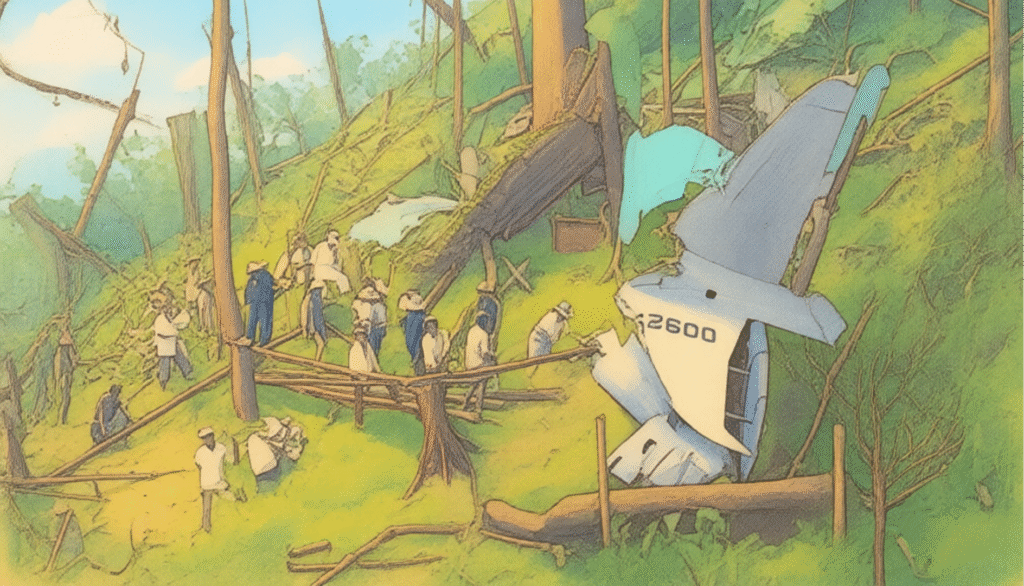
It began not in a palace, but in the heart of a man who walked with the people. President Ramon Magsaysay of the Philippines believed that leadership meant listening, that dignity belonged to every citizen, and that service was sacred. When he died in a tragic plane crash in 1957, Asia didn’t just lose a leader—it lost a light. But from that loss rose a legacy: an award that would go on to honor those who carry the torch of compassion, courage, and integrity.
For Indian aspirants preparing for competitive exams, this is more than a current affairs topic. It is a mirror—reflecting the kind of civil servant, leader, or changemaker one can become. It is a reminder that true greatness lies not in titles, but in tireless service to others.
Table of Contents
📜 History and Origin of the Ramon Magsaysay Award
🌱 Born from Tragedy, Built on Integrity
In the heart of post-war Asia, where nations were rebuilding and people were yearning for honest leadership, a light emerged—Ramon Magsaysay, the 7th President of the Philippines. He was not just a head of state; he was a servant of the people. Known for riding public buses, visiting rural villages, and listening to the unheard, Magsaysay redefined governance as a sacred duty.
But in March 1957, tragedy struck. A plane crash claimed his life, leaving behind a continent in mourning. Yet from that grief rose a legacy so powerful that it continues to inspire generations—the Ramon Magsaysay Award.
🏛️ Foundation of the Award: A Tribute to Leadership with a Soul
To honor his memory and values, the Rockefeller Brothers Fund, in collaboration with the Philippine government, established the award in 1957. It wasn’t meant to glorify fame or fortune—it was designed to recognize those who, like Magsaysay, believed that truth, humility, and service were the highest forms of leadership.
The first award was conferred in 1958, and since then, it has become Asia’s most prestigious recognition for individuals and organizations who uplift society through courage, compassion, and ethical action.
🏢 The Guardian of the Legacy: RMAF
The award is administered by the Ramon Magsaysay Award Foundation (RMAF), headquartered in Manila, Philippines. This foundation carries out a rigorous selection process each year, ensuring that only the most deserving changemakers—those who echo Magsaysay’s spirit—are honored.
🕊️ Fields of Recognition: Where Humanity Meets Action
Recipients are chosen for their impact in areas such as:
- Government Service
- Public Service
- Community Leadership
- Journalism, Literature, and Creative Communication Arts
- Peace and International Understanding
- Emergent Leadership
These categories reflect the award’s commitment to recognizing not just achievement, but moral courage and transformative service.
🌏 Why It’s Called the “Nobel Prize of Asia”
The Ramon Magsaysay Award is often hailed as the “Nobel Prize of Asia”—a title it has earned not through wealth or grandeur, but through its moral gravity and global reverence. While the Nobel Prize honors brilliance in science, literature, and peace, the Magsaysay Award recognizes something equally vital: humanity in motion.
It celebrates those who walk unarmed into injustice, who lift the fallen without cameras, and who serve not for applause, but for the quiet dignity of others. These are the unsung heroes—teachers in remote villages, doctors in conflict zones, activists who risk their lives for truth—whose stories rarely make headlines but whose impact reshapes lives.
In a continent as vast and diverse as Asia, where inequality and hope often coexist, the Magsaysay Award stands as a moral compass. It reminds us that leadership is not about position, but about purpose. That greatness is not measured in power, but in the lives we touch.
For aspirants preparing for UPSC, SSC, PCS, and other competitive exams, this award is more than a GK fact—it is a mirror of the civil servant you aspire to become. One who listens, uplifts, and leads with empathy.
“In honoring the few, the Magsaysay Award inspires the many.”
🏆 Categories of Recognition: Honoring Humanity in Action
The Ramon Magsaysay Award doesn’t reward popularity—it honors purpose. It recognizes those who walk into the shadows of society and bring light. Those who choose service over self, truth over comfort, and action over applause.
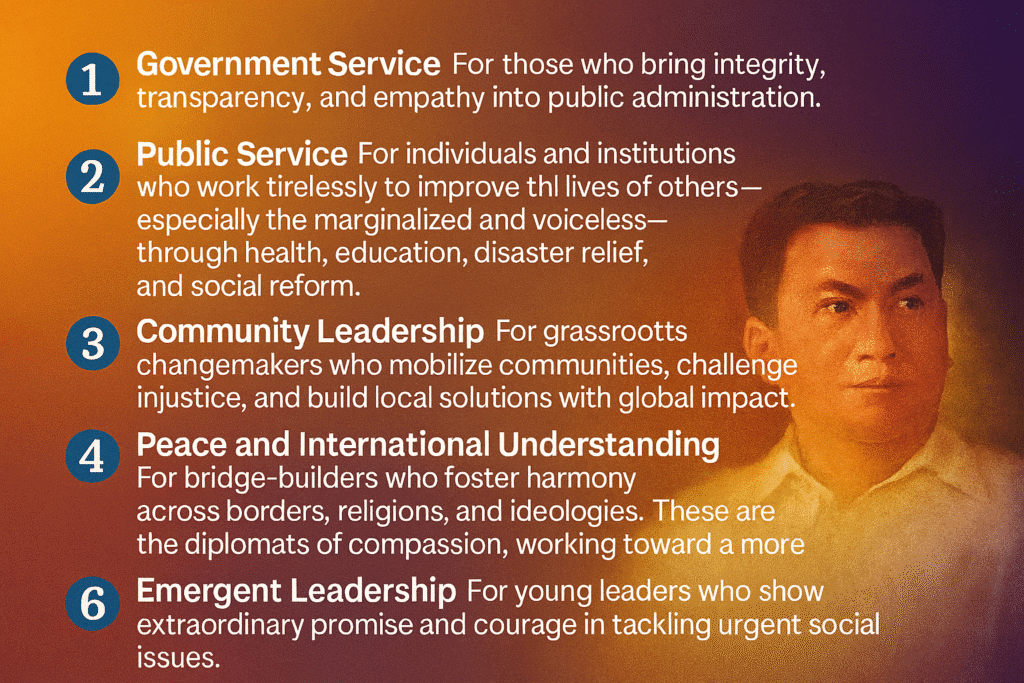
To reflect the diverse ways in which individuals and organizations uplift humanity, the award is conferred in six powerful categories:
1️⃣ Government Service
For those who bring integrity, transparency, and empathy into public administration. These are the civil servants who prove that governance can be a force for good.
2️⃣ Public Service
For individuals and institutions who work tirelessly to improve the lives of others—especially the marginalized and voiceless—through health, education, disaster relief, and social reform.
3️⃣ Community Leadership
For grassroots changemakers who mobilize communities, challenge injustice, and build local solutions with global impact.
4️⃣ Journalism, Literature, and Creative Communication Arts
For storytellers who wield truth as their weapon—journalists, writers, and artists who expose corruption, amplify unheard voices, and inspire change through words and visuals.
5️⃣ Peace and International Understanding
For bridge-builders who foster harmony across borders, religions, and ideologies. These are the diplomats of compassion, working toward a more peaceful world.
6️⃣ Emergent Leadership
For young leaders who show extraordinary promise and courage in tackling urgent social issues. This category celebrates the future of ethical leadership.
🎖️ What Do Recipients Receive?
Each awardee is honored not just with symbols, but with respect and recognition that echoes across Asia:
- 🥇 A medal bearing the image of Ramon Magsaysay, symbolizing the spirit of service
- 📜 A certificate of citation, detailing their contribution and impact
- 💰 A monetary prize, significant enough to support their mission (amount varies)
- 🎉 A ceremonial event in Manila, where winners share their stories of struggle, resilience, and triumph before a global audience
🇮🇳 Indian Luminaries Who Made Us Proud
Turning Compassion into Action, One Changemaker at a Time
India’s journey with the Ramon Magsaysay Award is not just a list of names—it’s a legacy of courage, compassion, and relentless service. These are not celebrities or politicians chasing headlines. They are quiet revolutionaries who chose to serve, uplift, and transform lives.
🇮🇳 Complete List of Indian Ramon Magsaysay Award Recipients (1958–2025)
This list is a tribute to the changemakers who turned compassion into action.
| Year | Recipient(s) | Contribution |
|---|---|---|
| 1958 | Vinoba Bhave | Bhoodan Movement for land redistribution |
| 1959 | C.D. Deshmukh | Public service; first Indian RBI Governor |
| 1963 | Rajendra Singh | Community leadership in water conservation |
| 1965 | K. G. Subramanyan | Creative arts and education |
| 1966 | Verghese Kurien | White Revolution; dairy development |
| 1967 | M.S. Subbulakshmi | Music and cultural diplomacy |
| 1971 | Jayaprakash Narayan | Political reform and social justice |
| 1972 | Satyajit Ray | Film and literature |
| 1974 | Ela Bhatt | SEWA; women empowerment |
| 1975 | Acharya J.B. Kripalani | Public service and Gandhian activism |
| 1977 | Baba Amte | Rehabilitation of leprosy patients |
| 1982 | P. Sainath | Journalism for rural India |
| 1986 | Murlidhar Devidas Amte | Community leadership |
| 1991 | T.M. Krishna | Music and social inclusion |
| 1992 | Aruna Roy | RTI movement and grassroots democracy |
| 1997 | Mahasweta Devi | Literature and tribal rights |
| 2002 | Sandeep Pandey | Peace and education activism |
| 2005 | Shantha Sinha | Child rights and education |
| 2006 | Sanduk Ruit (Nepal-based Indian) | Eye care for the poor |
| 2012 | Kulandei Francis | Rural development and microfinance |
| 2014 | Anshu Gupta | Goonj; dignified disaster relief |
| 2015 | Sanjiv Chaturvedi | Whistleblower and forest officer |
| 2019 | Ravish Kumar | Journalism with integrity |
| 2021 | Kiran Karnik | Public service and digital inclusion |
| 2023 | Bezwada Wilson | Campaign to end manual scavenging |
| 2025 | Safeena Husain (Educate Girls) | Girl child education in rural India |
These recipients span fields from governance and journalism to arts and activism. Each one reminds aspirants that true leadership begins with empathy, and real change starts at the grassroots.
🧭 Selection Process: How Winners Are Chosen
Finding the Quiet Heroes Who Change the World
The Ramon Magsaysay Award is not given to the loudest voices—it is bestowed upon those who listen deeply, act bravely, and serve quietly. Behind every recipient is a story of grit, grace, and ground-level transformation. But how are these changemakers chosen?
🌍 Nominations from Across Asia
Every year, the Ramon Magsaysay Award Foundation (RMAF) invites nominations from across the continent. These nominations come from civil society organizations, academic institutions, journalists, and even past awardees—each one identifying individuals or groups who have made a profound impact in their communities.
🔍 Rigorous Vetting and Field Research
Once nominated, the journey is far from over. The RMAF conducts a thorough vetting process that includes:
- Deep research into the nominee’s work and ethics
- Interviews with colleagues, beneficiaries, and critics
- Field visits to witness the impact firsthand
This ensures that the award is not just based on reputation, but on real, measurable transformation.
🧑⚖️ Final Selection by the Board of Trustees
The final decision rests with the Board of Trustees of RMAF, a panel of distinguished leaders and thinkers. They evaluate each nominee based on:
- Impact: Has their work changed lives?
- Integrity: Do they lead with honesty and humility?
- Alignment with Magsaysay’s Values: Do they embody service, courage, and compassion?
Only those who pass this intense scrutiny are honored—making the award a symbol of moral excellence.
🌺A Legacy That Lights the Way
In a world often clouded by ambition and noise, the Ramon Magsaysay Award reminds us of a quieter kind of greatness—one that listens, uplifts, and transforms. It honors those who walk into forgotten corners of society and leave behind hope, dignity, and change. For Indian aspirants preparing for competitive exams, this award is not just a GK topic—it is a mirror reflecting the kind of leader, civil servant, or changemaker you can become.
Let the stories of Vinoba Bhave, Ela Bhatt, Bezwada Wilson, and Safeena Husain ignite something within you. Let them whisper that service is strength, and that your preparation today can become someone’s liberation tomorrow. Whether you dream of joining the IAS, PCS, or serving your community in any capacity—remember, the path of purpose begins with empathy.
“You don’t need a title to lead. You need a heart that refuses to ignore injustice.”
🔍 For more such rich and fact-packed content, visit our Current Affairs & Articles section and explore the legacy of changemakers who shaped history.
Your journey matters. Your dreams matter. And we’re here to walk with you—every step of the way.