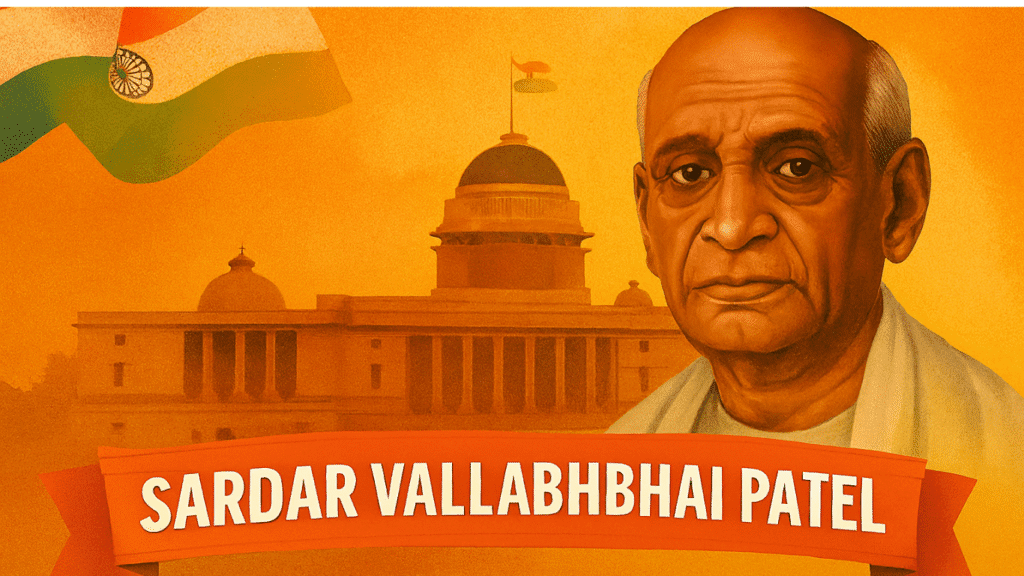
On a quiet morning in Nadiad, Gujarat, 150 years ago, a child was born who would one day weld together the soul of a divided India. That child was Vallabhbhai Patel—now remembered as the Loh Purush, the Iron Man of India.
Today, as we mark his 150th birth anniversary, we do more than celebrate a leader. We revisit a legacy of courage, unity, and nation-building.
Sardar Patel didn’t just fight for freedom. He stitched together a scattered map of princely states into one strong nation. He didn’t just speak of unity—he built it, brick by brick, with diplomacy, firmness, and vision.
This article is your complete guide to understanding Patel’s life, work, and relevance in today’s India.
So take a deep breath. Let’s walk through the life of a man who held India together when it was on the edge of falling apart. Let’s learn from the Iron Man—not just to answer questions, but to build character.
Table of Contents
📖 Birth, Early Life, and Education of Sardar Vallabhbhai Patel
🍼 Birth and Family Background
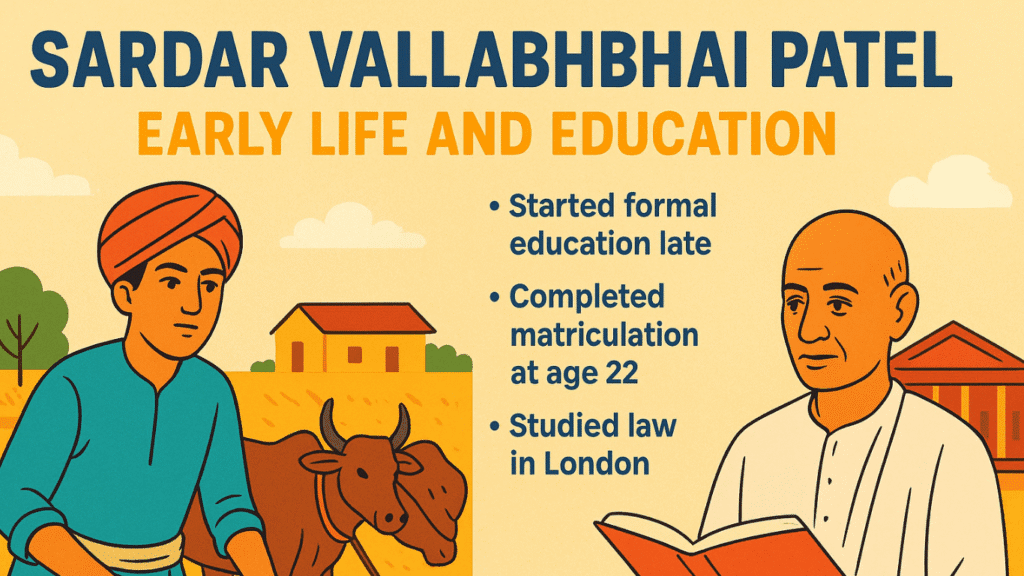
Sardar Vallabhbhai Patel was born on 31st October 1875 in Nadiad, a small town in present-day Gujarat. His family belonged to the Leva Patidar community—known for its agricultural roots, simplicity, and strong social values.
- Father: Jhaverbhai Patel – a farmer with deep respect for hard work and honesty
- Mother: Ladbai – religious, nurturing, and a pillar of moral strength
- Vallabhbhai was the fourth child in a family of six
- His elder brother, Vithalbhai Patel, later became the Speaker of the Central Legislative Assembly
The Patels lived a modest life, rooted in rural traditions and community service. These values shaped Vallabhbhai’s character and leadership style.
🧒 Early Life and Personality
As a child, Vallabhbhai was quiet, observant, and independent. He wasn’t considered academically gifted, but he had a sharp mind and fearless spirit.
- Helped his father in farming and household chores
- Solved problems with logic and confidence
- Known for his calm demeanor and strong will
One of the most famous incidents from his childhood was when he treated a painful boil on his chest using a heated iron rod, refusing to show pain or fear. This act of courage became symbolic of his future role as the “Iron Man of India.”
He was also known for:
- Organizing local events and debates among peers
- Standing up to injustice, even as a teenager
- Refusing to follow blindly, always asking “why” before “how”
🎓 Education Journey
Patel’s academic journey was unconventional but inspiring. He started formal education late but made rapid progress due to his determination and discipline.
- Completed matriculation at age 22, which was considered late at the time
- Initially studied in Petlad, Borsad, and Nadiad
- Took up self-study while working as a clerk and helping his family
- Passed the District Pleader’s exam, allowing him to practice law in Gujarat
In 1910, he went to London to study law at Middle Temple Inn, one of the four prestigious Inns of Court.
- Completed a 36-month course in just 30 months
- Ranked among the top Indian students
- Lived a disciplined and modest life, avoiding distractions
- Focused on civil law, property law, and courtroom ethics
He returned to India in 1913 as a qualified barrister, and began practicing in Ahmedabad, where he quickly rose to prominence.
⚖️ Legal Career in Ahmedabad
Patel’s legal career was marked by clarity, honesty, and courtroom brilliance.
- Known for sharp cross-examinations and precise arguments
- Charged reasonable fees, making him popular among farmers and traders
- Gained respect for never misleading clients
- Became one of the most successful barristers in Gujarat
His legal success laid the foundation for his entry into public service and politics, especially during the Kheda and Bardoli Satyagrahas.
💍 Marriage and Children of Sardar Vallabhbhai Patel
🧑🤝🧑 Marriage and Personal Life
Sardar Vallabhbhai Patel was married to Jhaverba in the year 1891, when he was around 16 years old. Their marriage was arranged, as per the customs of the time, and reflected the values of simplicity, mutual respect, and family responsibility.
- Marriage year: 1891
- Age at marriage: Around 16 years
- Jhaverba was known to be quiet, religious, and supportive
- The couple led a modest and disciplined life, rooted in tradition
- Despite his growing legal and political career, Patel remained deeply connected to his family
Their bond was built on trust and shared values, and Jhaverba’s quiet strength supported Patel through his early struggles.
🧒 Children and Family Responsibilities
Sardar Patel and Jhaverba had two children:
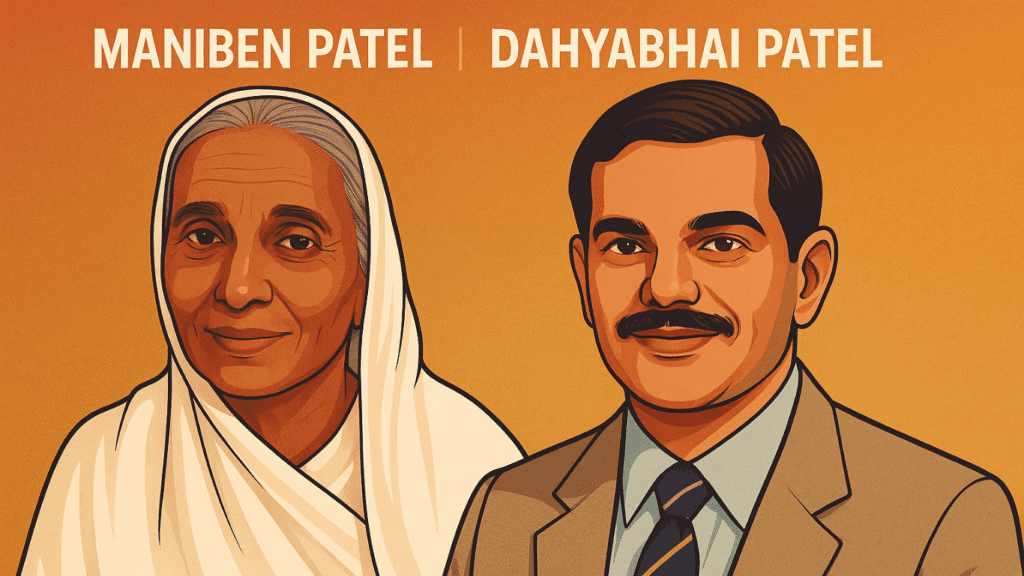
- Maniben Patel – born in 1903
- Dahyabhai Patel – born in 1905
Tragically, Jhaverba passed away in 1909, leaving Patel a widower at the age of 34. He chose not to remarry, and instead devoted himself to raising his children with care, discipline, and emotional strength.
- Maniben became his lifelong companion, managing his correspondence and travel
- She remained unmarried, dedicating her life to social work and her father’s legacy
- Dahyabhai entered public service and became a Member of Parliament
Patel’s parenting style was strict but loving. He believed in:
- Self-reliance – encouraging independence and responsibility
- Honesty – upholding truth in all matters
- Hard work – valuing effort over privilege
His home reflected the same values he brought to national leadership—discipline, simplicity, and service.
✈️ Sardar Vallabhbhai Patel’s Visit to London: Education, Discipline, and Transformation
🎓 Why He Went to London
By the early 1900s, Vallabhbhai Patel had already built a solid reputation as a pleader in Gujarat. But he wasn’t satisfied. He dreamed bigger. He wanted to become a barrister—a title that carried prestige and power in colonial India. In 1910, at the age of 35, he set sail for London, leaving behind his two young children and the memory of his late wife, Jhaverba.
Interestingly, Patel had originally planned to go before his elder brother, Vithalbhai Patel, but when a scholarship opportunity arose, Vallabhbhai insisted that Vithalbhai take it first. This selfless act reflected Patel’s character—always putting others before himself. Later, Vallabhbhai funded his own journey and education entirely through savings from his legal practice, without any government aid or family wealth.
He enrolled at Middle Temple Inn, one of the four prestigious Inns of Court in London, known for training some of the finest legal minds in the British Empire.
📚 Life in London: Discipline and Focus
Patel’s life in London was a masterclass in self-discipline and single-minded focus. He lived in modest lodgings, cooked his own meals, and avoided all distractions. While many students explored the city’s social life, Patel stayed up late studying, often reading legal texts into the early hours of the morning.
- He completed a 36-month course in just 30 months, a rare feat
- Ranked first among Indian students in his batch
- Excelled in civil law, property law, and courtroom ethics
- Adopted a professional Western lifestyle, wearing suits and maintaining punctuality
- Avoided political activism, focusing solely on academics
His professors admired his clarity of thought and legal reasoning. His classmates respected his quiet confidence. Patel didn’t just study law—he mastered it.
🏛️ Middle Temple Inn: A Prestigious Institution
Middle Temple Inn, located in the heart of London’s legal district, was a symbol of elite legal training. For an Indian under British rule, gaining admission was a major achievement. Patel’s success there was not just personal—it was a statement of Indian capability and intellect.
- The curriculum included British common law, legal drafting, and courtroom procedures
- Patel regularly attended live court sessions to observe real trials
- He built a strong foundation in legal ethics and advocacy
His time at Middle Temple not only sharpened his legal skills but also gave him the confidence to challenge colonial injustice upon his return.
🧳 Return to India and Legal Career in Ahmedabad
In 1913, Patel returned to India as a qualified barrister. He chose to practice in Ahmedabad, where he quickly became one of the most respected lawyers in the region.
- Known for sharp cross-examinations and logical arguments
- Charged reasonable fees, making him accessible to farmers and traders
- Maintained strict honesty—he never misled clients or took up false cases
- Built a reputation for clarity, courtroom confidence, and fearlessness
His legal success wasn’t just about winning cases—it was about empowering the common man. He often helped poor farmers fight against unjust landlords or colonial policies. His courtroom became a platform for justice and dignity, not just legal debate.
This phase of his life laid the foundation for his entry into public service. His leadership in the Kheda Satyagraha (1918) and Bardoli Satyagraha (1928) was deeply rooted in the trust and respect he had earned as a barrister.
👨👧 Balancing Duty and Family
Patel’s return was also marked by personal pain. His wife, Jhaverba, had passed away in 1909, while he was still in India preparing for his London journey. He returned as a widower, with two children—Maniben and Dahyabhai—to raise alone.
- He didn’t let grief weaken him. Instead, he turned it into strength and responsibility
- Raised his children with discipline, love, and moral values
- Maniben became his lifelong companion, attending meetings, managing his schedule, and preserving his legacy
- She remained unmarried, dedicating her life to social work and public service
- Dahyabhai entered politics, becoming a Member of Parliament and contributing to India’s democratic journey
Patel’s home was simple, but filled with respect, routine, and resilience. He believed that family discipline was the first step toward national discipline.
🧠 Seeds of Leadership
Though he was not yet in politics, Patel’s legal work laid the foundation for his future leadership.
- Helped farmers and poor families fight unjust cases, especially against exploitative landlords
- Spoke out against British policies in local forums and bar associations
- Built a network of trust and influence across Gujarat through legal service and public engagement
- Advocated for local self-governance, education, and civil rights
People began to see him not just as a lawyer, but as a leader with a spine of steel and a heart of service. His reputation as a man of action and integrity spread far beyond the courtroom.
🇮🇳 Sardar Vallabhbhai Patel’s Role in India’s Freedom Movements
🔥 From Barrister to Freedom Fighter
After returning from London in 1913, Patel built a successful legal career in Ahmedabad. But everything changed when he heard Mahatma Gandhi’s call for non-cooperation. Inspired by Gandhi’s ideals of truth and non-violence, Patel left his legal practice and stepped into the freedom movement—not for fame, but to serve.
He began organizing protests, speaking at public forums, and helping farmers fight unjust colonial policies. His transformation from barrister to activist was driven by deep empathy for the poor and a sharp sense of justice.
📍 Bardoli Satyagraha (1928): The Turning Point
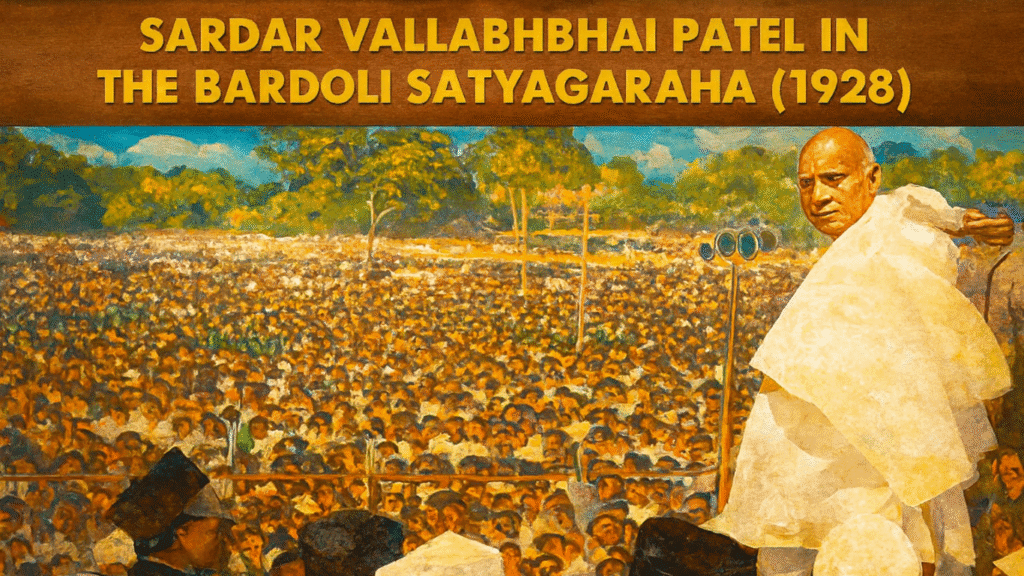
In 1928, the British government imposed a 30% tax hike on farmers in Bardoli taluka, Surat district, Gujarat. The region was already suffering from floods and crop failure. Patel was invited to lead the protest, and he accepted with full responsibility.
- He mobilized farmers to refuse tax payments peacefully
- Formed committees to coordinate resistance and legal support
- Used non-violent methods, inspired by Gandhi’s satyagraha
- The British government confiscated land, but Patel stood firm
- After months of disciplined protest, the government rolled back the tax hike
This victory earned him the title “Sardar”, meaning leader or chief, given by the grateful farmers of Bardoli.
🧱 Role in National Movements
Patel played a key role in Gandhi’s major campaigns:
- Non-Cooperation Movement (1920–22): Urged Indians to boycott British schools, courts, and goods
- Civil Disobedience Movement (1930–34): Supported the Salt Satyagraha, led local protests, and coordinated arrests
- Quit India Movement (1942): Called for British withdrawal, organized underground networks, and faced imprisonment
He was arrested multiple times, spending months in jail. But his resolve never broke. He used every moment to strengthen the movement and inspire unity.
🗣️ Leadership Style and Mass Connect
Patel’s leadership was firm, fearless, and deeply rooted in the people. He didn’t just speak to crowds—he connected with them.
- Gave speeches in Gujarati and Hindi, making ideas accessible
- Traveled across villages to mobilize grassroots support
- Believed in self-reliance, unity, and discipline
- Encouraged local leaders and volunteers to take ownership
He built a movement of trust, where every farmer, worker, and student felt part of the national cause.
🏛️ Sardar Vallabhbhai Patel’s Work in Congress and His Relationship with Mahatma Gandhi
🗳️ Joining the Indian National Congress
Sardar Vallabhbhai Patel joined the Indian National Congress in 1917, during the Kheda Satyagraha, where he worked closely with Mahatma Gandhi to help farmers affected by famine and unjust taxation. This marked the beginning of his political journey.
- Became active in local politics and farmer movements in Gujarat
- Supported Gandhi’s call for non-cooperation and civil disobedience
- Focused on grassroots organization, especially among peasants and workers
Patel was not a fiery orator or a dramatic figure. He was a man of action, known for his discipline, planning, and ability to mobilize people with clarity and purpose.
🤝 Relationship with Mahatma Gandhi
Sardar Patel and Mahatma Gandhi shared a deep bond of trust and mutual respect. Though their personalities were different—Gandhi was spiritual and idealistic, while Patel was practical and firm—they were united by a common goal: India’s freedom through non-violence and unity.
- Gandhi called Patel his “shield”, the one who protected the movement from within
- Patel followed Gandhi’s principles of truth, simplicity, and non-violence
- Supported Gandhi during major movements like the Salt Satyagraha (1930), Quit India Movement (1942), and Bardoli Satyagraha (1928)
- While Gandhi inspired the masses, Patel organized them, managed logistics, and ensured discipline
Their partnership was a perfect balance of vision and execution—Gandhi lit the flame, Patel kept it burning.
🧭 Role in Congress Leadership
Patel’s leadership within the Indian National Congress was marked by efficiency, loyalty, and strategic thinking.
- Became President of the Indian National Congress in 1931 during the Karachi Session, where the party adopted resolutions on fundamental rights and economic justice
- Played key roles in party organization, fundraising, and election strategy
- Was a core member of the Congress Working Committee, shaping major decisions during the freedom struggle
- Managed provincial elections, coordinated Satyagraha campaigns, and resolved internal disputes
He was respected by senior leaders like Jawaharlal Nehru, Rajendra Prasad, and Maulana Azad, even though he sometimes had strong differences in opinion, especially on matters of governance and economic policy.
🧱 Gandhi vs Patel: Differences with Respect
While Patel admired Gandhi deeply, he was also practical and firm in his views. Their differences were not conflicts—they were complementary perspectives.
- Patel believed in strong central governance, industrial development, and administrative efficiency
- Gandhi emphasized village-level autonomy, rural upliftment, and khadi (hand-spun cloth)
- Patel supported the Indian Civil Services, while Gandhi wanted to dismantle colonial administrative structures
Despite these differences, Patel always stood by Gandhi during critical moments, never letting personal views override the larger mission. Their relationship was built on mutual respect, not blind agreement.
Patel once said,
“Gandhiji was the light that showed us the path. I only helped clear the stones.” This quote reflects his humility and his role as the executor of Gandhi’s vision.
🏛️ Sardar Vallabhbhai Patel: The Architect of National Integration
🗺️ The Challenge After Independence
When India gained independence on 15 August 1947, the country faced a massive challenge: 565 princely states were still under the control of local rulers. These states had the option to join India, Pakistan, or remain independent, creating a dangerous possibility of a fragmented subcontinent.
Without integration, India risked becoming a patchwork of kingdoms, vulnerable to internal conflict, foreign influence, and administrative chaos. The dream of a united India stood on shaky ground.
🧭 Patel’s Role as Home Minister
Sardar Vallabhbhai Patel was appointed as India’s first Home Minister and Deputy Prime Minister. Prime Minister Jawaharlal Nehru trusted Patel with the most difficult task—uniting India.
Patel took charge with firmness, diplomacy, and vision. He worked closely with V.P. Menon, a senior civil servant, to create a plan for integration.
- Promised privileges and pensions to cooperative rulers
- Used the Instrument of Accession to legally merge states
- Persuaded rulers with respect and realism
- Warned of consequences if they refused to join
🏰 Major Successes in Integration
While many states joined voluntarily, some posed serious challenges. Patel’s response was decisive and strategic:
🔴 Junagadh
- Muslim ruler wanted to join Pakistan, but majority population was Hindu
- Patel sent troops and held a public referendum in February 1948
- Result: Junagadh joined India
🔴 Hyderabad
- Nizam wanted independence and refused to join India
- Patel launched Operation Polo in September 1948
- Hyderabad was integrated into India within five days
🔴 Kashmir
- Faced invasion from Pakistan-backed tribal forces
- Maharaja signed the Instrument of Accession under emergency
- Patel supported military defense and integration
- These actions showed Patel’s iron will and strategic brilliance, securing India’s territorial integrity.
🧱 Building a Unified India
Patel didn’t just merge territories—he built the administrative backbone of modern India.
- Founded the Indian Administrative Service (IAS) and Indian Police Service (IPS)
- Strengthened central governance and law enforcement
- Promoted national unity, internal security, and civil discipline
His legacy lives on in every district collector, police officer, and civil servant who serves the nation today.
🕊️ Death and the Prime Minister Controversy: The Final Chapter of Sardar Vallabhbhai Patel
🧓 Final Years and Health Decline
After India’s independence in 1947, Sardar Vallabhbhai Patel served as the Deputy Prime Minister and Home Minister. He worked tirelessly to unite the country, strengthen internal security, and lay the foundation of civil services.
But by 1949, his health began to decline. Years of travel, stress, and political responsibility had taken a toll on his body.
- He suffered from chronic heart problems
- Continued working despite medical advice
- Took rest in Mumbai, but remained active in national affairs
On 15 December 1950, Sardar Patel passed away at Birla House, Mumbai, at the age of 75. His death was mourned across the country. Leaders, citizens, and even foreign dignitaries paid tribute to the man who had held India together.
🏛️ The Prime Minister Controversy
One of the most discussed topics in Indian political history is the controversy around Patel not becoming the first Prime Minister of India.
Here’s what happened:
- In 1946, the Congress party had to choose its leader for the interim government
- 12 out of 15 Pradesh Congress Committees supported Sardar Patel for the top post
- However, Mahatma Gandhi favored Jawaharlal Nehru, believing he was better suited for international diplomacy and youth appeal
- Patel respected Gandhi’s decision and withdrew his nomination
This decision led to Jawaharlal Nehru becoming India’s first Prime Minister, while Patel took charge of Home, States, and Information ministries
🤝 Patel’s Response: Duty Over Position
Sardar Patel never expressed bitterness over the decision. He believed in teamwork and national interest above personal ambition.
- He worked closely with Nehru, despite ideological differences
- Focused on internal unity, while Nehru handled foreign affairs
- Their partnership was sometimes tense, but always respectful
Patel once said, “I am not interested in power. I am interested in service.” This shows his selfless character and commitment to India.
🕯️ National Mourning and Legacy
After his death, the nation observed official mourning. His body was cremated in Mumbai, and memorials were built in his honor.
- In 1991, he was awarded the Bharat Ratna posthumously
- In 2018, the Statue of Unity was inaugurated in Gujarat—the tallest statue in the world
🗿 Statue of Unity and National Recognition of Sardar Vallabhbhai Patel
🌟 Honoring the Iron Man of India
Sardar Vallabhbhai Patel’s contribution to India’s unity, governance, and freedom struggle is unmatched. To honor his legacy, the Government of India built the Statue of Unity—a symbol of strength, leadership, and national pride.
This statue is not just a monument. It is a message to every Indian: Unity is our strength, and Patel is its architect.
🗿 The Statue of Unity: World’s Tallest Statue
The Statue of Unity was inaugurated on 31st October 2018, on Patel’s 143rd birth anniversary, by Prime Minister Narendra Modi. It is located near the Sardar Sarovar Dam in Kevadia (now Ekta Nagar), Gujarat.
- Height: 182 meters (597 feet) – Tallest statue in the world
- Material: Bronze-clad structure with steel framework
- Designer: Sculptor Ram V. Sutar
- Construction time: 4 years
- Cost: Approx ₹2,989 crore
The statue faces the Narmada River, symbolizing Patel’s vision of a united India standing tall and firm.
🧭 Features and Attractions
The Statue of Unity is more than a statue—it’s a full tourist and educational complex:
- Museum and Exhibition Hall: Showcasing Patel’s life, speeches, and achievements
- Viewing Gallery: Located at 153 meters, offering panoramic views of the Narmada valley
- Valley of Flowers: A beautiful garden surrounding the statue
- Laser Light Show: Depicts Patel’s journey and India’s integration
- Children’s Nutrition Park and Jungle Safari: For educational tourism
It attracts millions of visitors every year and has become a symbol of national unity and patriotism.
🗓️ Rashtriya Ekta Diwas (National Unity Day)
To honor Patel’s legacy, the Government of India declared 31st October as Rashtriya Ekta Diwas in 2014.
- Celebrated across India with unity runs, parades, and pledges
- Schools, colleges, and government offices organize awareness programs
- Leaders pay tribute at the Statue of Unity
This day reminds every citizen of Patel’s role in integrating India’s princely states and building a strong nation.
🏅 National Recognition and Awards
Sardar Vallabhbhai Patel received several honors, both during his life and posthumously:
- Bharat Ratna: India’s highest civilian award, given posthumously in 1991
- Commemorative Coins and Stamps: Released on major anniversaries
- Educational Institutions: Named after him across India
- Statue of Unity: A global tribute to his leadership
His legacy is taught in school textbooks, celebrated in public speeches, and remembered in competitive exams.
🕊️Learning from the Iron Man of India
Sardar Vallabhbhai Patel was not just a leader. He was a builder of dreams, a protector of unity, and a symbol of fearless service. From the dusty lanes of Nadiad to the halls of London, from courtroom battles to national integration—his journey was one of grit, grace, and greatness.
For aspirants preparing for competitive exams, Patel’s life is more than a chapter in history. It is a mirror of values we must carry:
- Discipline in preparation
- Courage in facing challenges
- Clarity in decision-making
- Unity in purpose
He didn’t chase power. He chose responsibility. He didn’t seek applause. He earned respect. And even when history offered him the highest chair, he bowed to the greater cause of national service.
As you sit with your books, revise your notes, and dream of success—remember Patel’s iron will. Let his story remind you that true strength lies not in titles, but in actions. Not in ambition, but in integrity.
Let every answer you write carry the spirit of unity. Let every goal you chase reflect the courage of a man who healed a divided land.
Because in every aspirant who studies with purpose, Sardar Patel lives on.
📚 Explore More Educational Resources
Looking to boost your exam prep and general knowledge? Dive into our curated articles and study materials designed for competitive exam aspirants:
- 🏞️ Punjab (History and Culture) – Discover the rich heritage, folk traditions, and historical milestones of Punjab.
- 📰 Current Affairs & Articles – Stay updated with weekly digests, national and international news, and exam-relevant insights.
- 💼 Government Jobs & Notifications – Find the latest job alerts, eligibility criteria, and application tips.
- 📄 Previous Year Question Papers – Practice with solved papers from UPSC, SSC, State PSCs, and more.
- 📘 English Grammar – Master tenses, sentence structure, and error spotting with easy-to-follow guides.
- 📗 English Vocabulary – Expand your word power with thematic lists, synonyms, antonyms, and idioms.
- 📙 Punjabi Grammar – Learn essential rules, sentence formation, and vocabulary for regional exams.