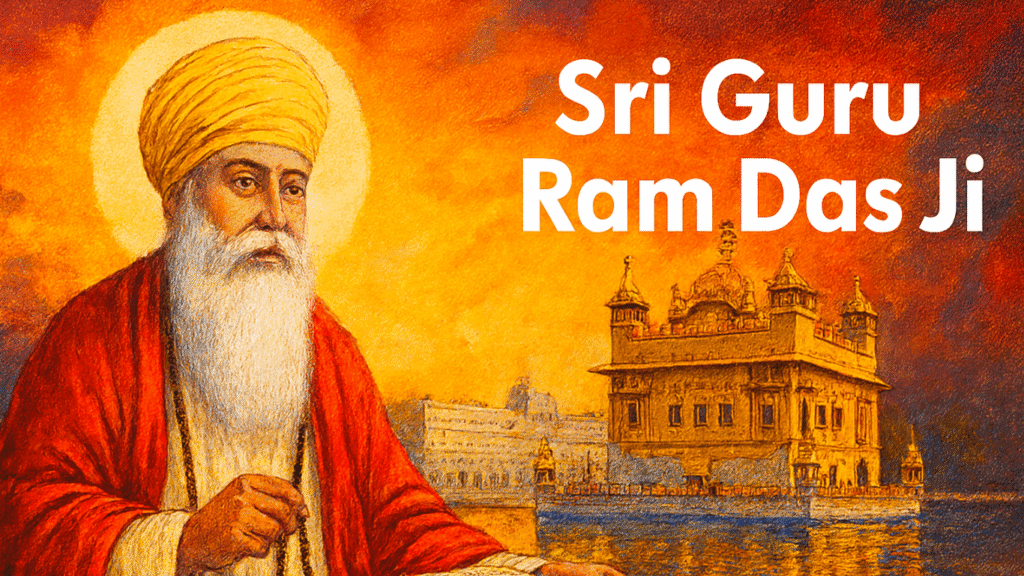
After getting the enlightenment in 1499 A.D., Shri Guru Nanak Dev Ji decided to spread the message of the one God across India and in foreign lands. He spent 21 years traveling to different places to preach about the one God. He started his journeys from Sultanpur Lodhi, and these journeys or travels are famously known as Udasis, which also reflect being unconcerned and unattached to anything during those years, as he left his house, family, and all other worldly things to spread the message of that one God.
Along with these Udasis, he was also accompanied by his childhood friend Bhai Mardana, who was a devoted Muslim and also played the Rabab while performing kirtan.
Objective of the Udasis
The primary objective of Shri Guru Nanak Dev Ji’s Udasis was to remove all misconceptions among the people, as they heavily believed in casteism. These practices were not limited to one religion; in both Hinduism and Islam, people had lost the original essence of their religion and were engaging in empty rituals and superstitions. Casteism was at its peak, and even within one religion, some people made others inferior by caste. The condition of women was even worse, as they faced many restrictions compared to men and suffered under the caste system.
Guru Nanak Dev Ji undertook these Udasis to guide people with the message of one God and tried to restore the essence of spirituality and equality among them.
First Udasi (1499–1511)
Guru Nanak Dev Ji began his first Udasi at the end of 1499 A.D. During this, he traveled for about 12 years across India, especially in the eastern and southern parts of the country. This first Udasi ended in 1511 A.D. with visits to various significant places where he taught people about the message of the One God. Below are the famous cities where Shri Guru Nanak Ji visited during his first Udasi.
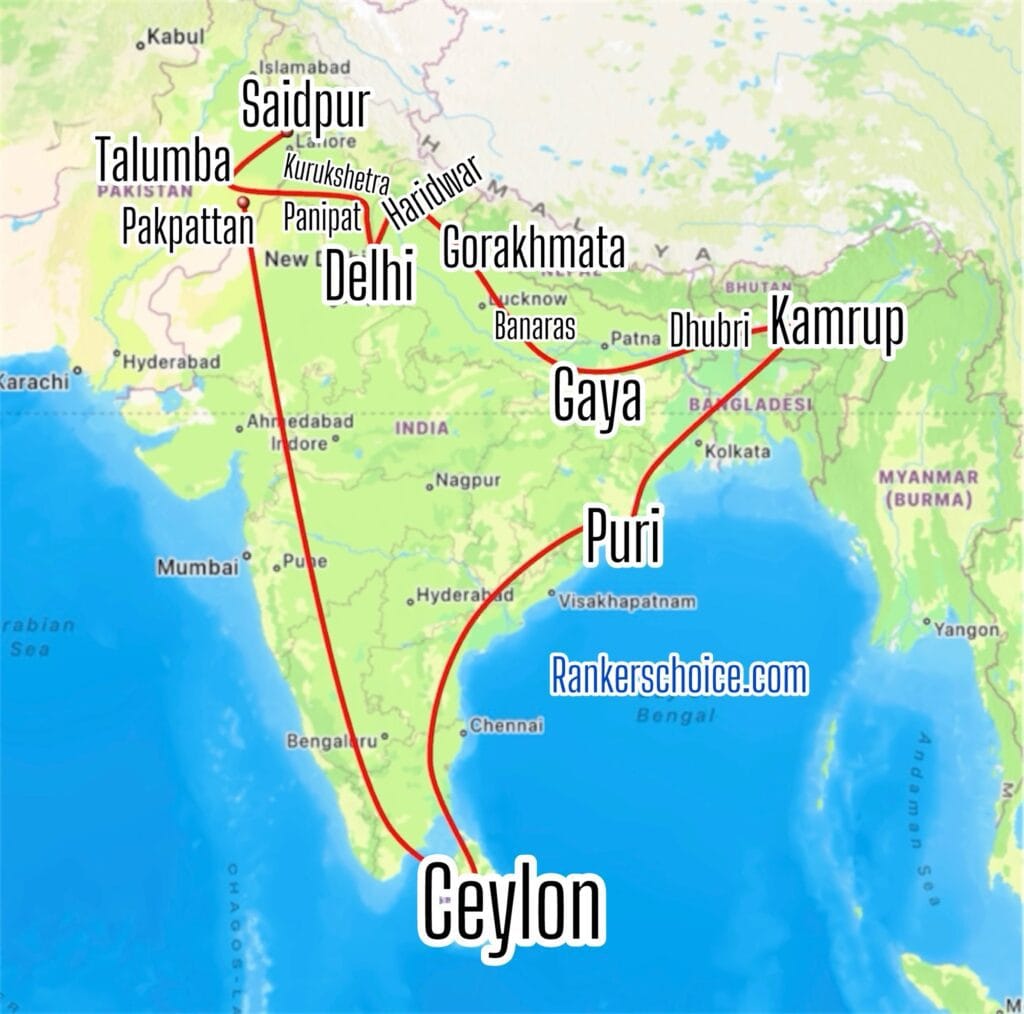
1. Saidpur (Eminabad):
Shri Guru Nanak Dev Ji started his first udasi from Sultanpur Lodhi where he attained his enlightenment and reached Saidpur, which is now also known as Eminabad. When he arrived in Saidpur, a rich landlord of the village, Malik Bhago, invited him to his house for a big feast. But Shri Guru Nanak Dev Ji refused his invitation. Instead of the big feast at Malik Bhago’s, he decided to stay at Bhai Lalo Ji’s place, who was a poor carpenter and worked hard for his living. Upon getting the information of his refusal, Malik Bhago got enraged and demanded a detailed explanation from Guru Ji for rejecting his invitation, which also hurt his pride badly.
Guru Nanak Dev Ji explained to him simply that he did not want to eat food from that person who was exploiting the poor. So, to prove his point, Guru Ji took some food from Malik Bhago in his one hand and a piece of plain bread from Bhai Lalo Ji in his other hand. When he pressed both at that very moment, blood came from Malik Bhago’s food, which showed that it was earned through unfair means and the money he earned by causing pain to others. On the other hand, milk dripped from Bhai Lalo’s bread, which showed that it was pure and hard-earned money through honest work.
Through this act Guru Nanak Dev Ji taught a valuable lesson to everyone that everyone should earn honestly and through hard work only, without harming or cheating anyone.
2. Talumba:
After Saidpur, Shri Guru Nanak Dev Ji reached Talumba where he met a man named Sajja. Although his name was Sajjan, which means a gentleman, actually he was a cheat and a thug. In his house he had built a temple and a mosque for both the Hindu and Muslim travelers who would stay there. During the daytime he would pretend to be very helpful to the people and very kind to them, but at night he used to rob them and sometimes even killed them and threw their bodies into a hidden well.
Sajjan also planned to do the same with Shri Guru Nanak Dev Ji and Bhai Mardana Ji. But that night, as Guru Nanak Dev Ji was reciting the Bani with Bhai Mardana Ji, the words of the Bani deeply touched the heart of Sajjan, and he realized the mistakes he had been committing against noble men. To overcome his regret, he fell at Guru Nanak Dev Ji’s feet and asked for forgiveness for all the wrongs he had done so far.
So in that very moment Guru Nanak Dev Ji forgave him with kindness. After this life-changing incident, Sajjan gave up all the evil things he had been doing with the people. He stopped cheating and harming others and became a true Sajjan, as his name suggests—a gentleman. Afterwards, he spent the rest of his life spreading the teachings of Guru Nanak Dev Ji.
3. Kurukshetra:
Sri Guru Nanak Dev Ji arrived at Kurukshetra during the time of a solar eclipse. On this occasion, thousands of Brahmins and saints had gathered, and Guru Nanak Dev Ji gently spoke to them and explained that we should live a simple and truthful life. He also advised them not to believe in such superstitions related to the solar eclipse, as such beliefs had no real value in themselves.
His words made a powerful impact. Many people were deeply moved by Guru Nanak Dev Ji’s words and instantly became his followers and embraced his teachings of truth, simplicity, and righteousness.
4. Panipat:
At Panipat, Guru Nanak Dev Ji met a Sufi saint named Sheikh Tahir. Sheikh Tahir was inspired by Guru Nanak Dev Ji’s teachings and wisdom. As Guru Nanak Dev Ji was preaching simplicity and truth, Sheikh Tahir became a devoted follower of Guru Nanak Dev Ji.
5. Delhi (Majnu Ka Tila):
When Guru Nanak Dev Ji reached Delhi from Panipat, he decided to stay at a place called ‘Majnu Ka Tila’. Majnu, who was a known and very respected holy man (Faqir), lived there. He had a very strong influence on the people over there. As he met Guru Nanak Dev Ji, he was moved by the teachings of Guru Nanak Dev Ji and became his devoted disciple. So, along with Majnu, his followers also joined him in preaching the message of truth, love, and humanity.
6. Haridwar:
When Guru Nanak Dev Ji reached Haridwar, he saw many Hindus gathered to take a holy bath in the River Ganga. They believed that by bathing in its sacred river ganga and offering water towards the sun, they could wash away their sins and honor their ancestors, which is called Pitars. While seeing this, Guru Nanak Dev Ji also began to throw water towards the west direction.
By seeing this unusual act, many people were surprised and gathered around him and started asking him what he was doing. Guru Ji replied that he was offering water to his fields in Kartarpur. The people started laughing and asked him how water thrown in the west direction could possibly reach his fields, which were about 300 miles away.
Then Guru Nanak Dev Ji replied calmly, “If your water can reach the sun, which is millions of miles away, then why can’t my water reach my fields?” His response made the people think deeply about their rituals and beliefs. They were impressed by his wisdom and realized the importance of all acts over blind traditions.
7. Gorakhmata:
After visiting Haridwar, Sri Guru Nanak Dev Ji reached Gorakhmata. There, he had a discussion with the ‘Sidh Yogis,’ who were ascetics practicing various rituals and austerities. Guru Ji explained to them that salvation cannot be achieved by wearing earrings, applying ash (vibhuti) on the body, blowing horns, carrying sticks, or shaving one’s head. These external practices, he said, do not lead to true spiritual growth or union with God.
The Yogis were deeply moved by Guru Nanak Dev Ji’s teachings, which emphasized inner purity, devotion, and truthful living over mere outward symbols and rituals. So inspired were they that they became his disciples. Since then, the place Gorakhmata came to be known as Nanakmata , in honor of Guru Nanak Dev Ji’s transformative visit.
8. Banaras:
Banaras, a famous Hindu pilgrimage site, was also visited by Sri Guru Nanak Dev Ji. There, he had a long discussion with a learned pandit named Chatur Das about the practice of idol worship. Guru Nanak Dev Ji explained to him that worshiping idols is futile and does not lead to true spiritual connection with God. He emphasized the importance of devotion, truthful living, and remembering God with sincerity, rather than relying on rituals or physical representations.
Chatur Das was deeply impressed by Guru Ji’s wisdom and teachings. Convinced by his words, he embraced the path of Sikhism, along with his Brahmin friends, and became a devoted follower of Guru Nanak Dev Ji.
9. Gaya:
In Gaya, Sri Guru Nanak Dev Ji observed many Hindus performing a ritual of offering food to their ancestors. Guru Ji explained to them that this was a false and meaningless custom. He told the people that just as our physical bodies cannot travel to the other world after death, similarly, material things like food from this world cannot reach the souls in the next world.
Through his teachings, Guru Nanak Dev Ji urged the people to focus on truth, love, and devotion, rather than engaging in empty rituals. His words made the people reflect deeply on their practices and the importance of sincere spiritual efforts.
10. Dhubri (Assam):
At Dhubri in Assam, Sri Guru Nanak Dev Ji met Shankar Dev, a revered saint and reformer. Shankar Dev was deeply moved and inspired by Guru Nanak Dev Ji’s teachings of love, humility, and devotion to one God. Impressed by the simplicity and truth of his message, Shankar Dev became a devoted disciple of Guru Nanak Dev Ji, embracing his spiritual wisdom and spreading the values of unity and faith.
11. Kamrup (Assam):
When Sri Guru Nanak Dev Ji reached Kamrup in Assam, he encountered a famous witch named Nur Shahi. She attempted to cast a spell on Guru Ji using her alluring gestures and enchanting charms. However, her efforts failed as Guru Nanak Dev Ji remained unaffected by her powers.
With his divine wisdom, Guru Ji explained to her the futility of such practices and guided her towards the right path of truth, devotion, and righteous living. Nur Shahi was deeply moved by his teachings and realized the importance of leading a life devoted to God rather than indulging in worldly illusions and harmful practices.
12. Jagannath Puri:
After visiting Assam, Sri Guru Nanak Dev Ji reached Jagannath Puri in Orissa. The priests of the Jagannath Temple requested Guru Ji to pay homage to Lord Jagannath. However, Sri Guru Nanak Dev Ji explained that he did not believe in formal rituals or artificial worship, such as aarti. He said that nature itself is constantly engaged in the true worship of the Almighty God, performing His divine work every moment.
Guru Ji emphasized that there is no need for artificial rituals when the entire creation is already in devotion to God. His words carried deep wisdom and inspired the people to reflect on the essence of true spirituality beyond mere formalities.
13. Ceylon (Sri Lanka):
After visiting South India, Sri Guru Nanak Dev Ji traveled to Ceylon (now known as Sri Lanka). At that time, Shivnath was the ruler of Ceylon. When Guru Ji arrived, Shivnath was deeply impressed by his divine personality and the profound hymns he sang. The ruler found Guru Nanak Dev Ji’s teachings to be full of wisdom and truth.
Inspired by his message of love, equality, and devotion to one God, Shivnath, along with many others, became a follower of Sri Guru Nanak Dev Ji. His visit left a lasting impact on the people of Ceylon, who embraced his teachings with great reverence.
14. Pakpattan:
During his return to the Punjab from Ceylon (Sri Lanka) , Sri Guru Nanak Dev Ji stayed at Pakpattan , a historically and spiritually significant town in present-day Pakistan. At Pakpattan, Guru Nanak Dev Ji met Sheikh Brahm , devoted follower of Sheikh Farid. Sheikh Brahm was deeply impressed by Guru Nanak Dev Ji’s teachings, wisdom, and divine personality.
In turn, Sri Guru Nanak Dev Ji also held Sheikh Brahm in high regard, recognizing his sincerity and devotion. Their meeting became a moment of mutual respect and spiritual connection, reflecting the universal message of love and unity that transcends all boundaries.
Second Udasi (1513–1516)
After spending a short time in Talwandi and Sultanpur, Sri Guru Nanak Dev Ji embarked on his second Udasi (journey) towards the East at the end of 1513 A.D. This journey lasted for three years, during which Guru Ji visited several important places. Some of the key locations he traveled to during this Udasi include:
1. Hilly States:
Sri Guru Nanak Dev Ji traveled through the Punjab region and visited several hilly states, including Mandi, Rawalsar, Jawalamukhi, Kangra, Baijnath, Kullu, and others. During his journey, he shared his divine teachings of love, truth, and devotion to one God with the people living in these areas.
The inhabitants of these hilly regions were deeply moved and inspired by Guru Ji’s wisdom and simplicity. Many of them embraced his teachings and became his devoted followers. Through his visits, Guru Nanak Dev Ji left a lasting spiritual impact on the lives of the people in these regions, spreading the message of unity and righteousness.
2. Kailash Parbat:
Sri Guru Nanak Dev Ji reached Kailash Parbat (also known as Sumer) via Tibet. The Siddhas, who were residing there, were astonished to see Guru Ji’s arrival at such a remote and spiritually significant place. They asked him about the condition of the world.
Guru Nanak Dev Ji replied that truth had vanished from the world, and falsehood and corruption had taken over everywhere. He explained that instead of guiding the people and helping them walk on the path of righteousness, the Yogis and Siddhas had retreated to forests and hills, leaving the world in the darkness of ignorance.
Guru Ji advised them to come out of their isolation and serve humanity, as true spirituality lies in selfless service and uplifting others. His words carried deep wisdom and inspired the Siddhas to reflect on their role in guiding the world toward light and truth.
3. Ladakh:
From Kailash Parbat, Sri Guru Nanak Dev Ji traveled to Ladakh. During his stay there, many people were deeply inspired by his teachings of love, truth, and devotion, and they became his disciples. Even today, the people of Ladakh hold Sri Guru Nanak Dev Ji in high regard, and he is revered in many villages across the region.
Every year, pilgrims from Ladakh visit Harmandir Sahib (Golden Temple) in Amritsar to pay their respects and honor the teachings of Guru Nanak Dev Ji. This enduring connection reflects the profound impact of Guru Ji’s message on the people of Ladakh, who continue to cherish and follow his spiritual legacy.
4. Kashmir:
At Mattan in Kashmir, Sri Guru Nanak Dev Ji held a lengthy and profound religious debate with Pandit Brahm Das, a learned scholar. Guru Ji explained to him that simply reading or reciting the Vedas and the Ramayana does not lead to salvation. True salvation, he emphasized, can only be attained by living a life of righteousness and performing good actions in accordance with the teachings of holy scriptures.
Guru Nanak Dev Ji urged Pandit Brahm Das to focus on practicing truth, humility, and selfless service rather than relying solely on rituals or rote recitation. His words deeply impacted Pandit Brahm Das, who recognized the wisdom in Guru Ji’s teachings and became a devoted follower. This debate highlighted the importance of living a life aligned with spiritual values rather than merely engaging in empty formalities.
5. Hasan Abdal:
On his return journey to Punjab, Sri Guru Nanak Dev Ji stopped at Hasan Abdal. There, he encountered an arrogant Faqir named Wali Kandhari, who lived on a hilltop. When the Faqir became angry with Guru Ji, he rolled a massive stone down the hill, intending to harm or kill him. However, Sri Guru Nanak Dev Ji calmly raised his hand and stopped the rolling stone with his palm.
This miraculous event took place at what is now known as Panja Sahib , a revered site for Sikhs. Today, a magnificent Gurdwara stands at this location, commemorating the divine incident. The sacred spot serves as a place of pilgrimage and inspiration, symbolizing Guru Nanak Dev Ji’s grace, humility, and unwavering devotion to truth.
6. Sialkot:
At Sialkot, Sri Guru Nanak Dev Ji met a Muslim saint named Hamza Ghaus. The saint was extremely angry with the people of the town due to some issue and had resolved to destroy the entire city using his spiritual powers. However, when he met Guru Nanak Dev Ji and listened to his teachings of peace, love, and forgiveness, he was deeply moved. All his anger vanished, and he abandoned his destructive intentions.
This incident left a profound impact on the people of Sialkot. They were greatly inspired by Guru Ji’s wisdom and compassion, and many of them became his devoted followers. Through this event, Guru Nanak Dev Ji once again demonstrated the power of humility and the ability of divine teachings to transform hearts and resolve conflicts.
Third Udasi (1517–1521)
Sri Guru Nanak Dev Ji began his third Udasi at the end of 1517 A.D. This journey lasted for four years, during which Guru Ji, accompanied by Bhai Mardana, traveled to many countries in Western Asia. The purpose of this Udasi was to spread the message of love, equality, and devotion to one God. Guru Ji visited several important places during this journey, including:
1. Multan:
Many Sufi saints resided in Multan. When they heard about the arrival of Sri Guru Nanak Dev Ji, they sent him a bowl filled with milk. This was a symbolic message indicating that Multan was already full of saints and there was no space for any newcomer. Guru Nanak Dev Ji immediately understood the implication of this gesture.
In response, Guru Ji placed a jasmine flower on top of the bowl of milk and sent it back to the Sufi saints. Through this act, he conveyed a profound message: just as the jasmine flower added fragrance to the milk without causing any harm or spillage, his arrival in Multan would bring harmony and spiritual upliftment without disturbing anyone.
During his stay in Multan, Sri Guru Nanak Dev Ji met a renowned Sufi saint, Sheikh Bahauddin. Their meeting turned into a deep spiritual exchange, and Sheikh Bahauddin was deeply impressed by Guru Ji’s teachings of love, humility, and devotion to one God.
2. Mecca:
Mecca, the birthplace of Prophet Muhammad, is one of the holiest cities in Islam. According to Sikh tradition, when Sri Guru Nanak Dev Ji reached Mecca, he lay down to rest with his feet pointing towards the Kaaba, the sacred house of worship in Islam.
When Qazi Rukun-ud-Din noticed this, he became angry and exclaimed, “Who are you, sleeping with your feet towards the abode of Allah?” Guru Nanak Dev Ji, with great calmness and respect, replied, “Please turn my feet in a direction where Allah does not exist.”
The Qazi, thinking this would be simple, turned Guru Ji’s feet to other directions. However, to everyone’s astonishment, the Kaaba itself seemed to move in the same direction as Guru Ji’s feet. This miraculous event left the Qazi and the Muslims present deeply amazed and humbled.
Sri Guru Nanak Dev Ji then explained to them that Allah is omnipresent—present everywhere—and not confined to any single direction or place. His message highlighted the universality of God and the importance of recognizing His presence in all things. This incident left a lasting impression on those who witnessed it, reinforcing the timeless truth of divine oneness.
3. Madina:
From Mecca, Sri Guru Nanak Dev Ji traveled to Medina, another holy city in Islam, where the grave of Prophet Muhammad is located. Here, Guru Ji shared his message of love, unity, and devotion to one God. His teachings resonated deeply with the people, emphasizing the importance of truth and humility in spiritual life.
During his stay in Medina, Guru Nanak Dev Ji had a religious discussion with Imam Azim, a learned Islamic scholar. The Imam was greatly impressed by Guru Ji’s wisdom, profound understanding of spirituality, and universal message of love and equality. Through this dialogue, Imam Azim came to recognize the divine truth in Guru Ji’s words, further strengthening the bond of respect and understanding between them.
This visit reinforced the timeless principle that true spirituality transcends religious boundaries and unites humanity through love and devotion to the One Creator.
4. Baghdad:
In Baghdad, Sri Guru Nanak Dev Ji met Sheikh Behlol, a respected spiritual figure. Sheikh Behlol was deeply moved by the divine Bani (holy verses) of Guru Nanak Dev Ji and the profound wisdom contained in his teachings. So inspired was he that he became a devoted disciple of Guru Ji.
Sri Guru Nanak Dev Ji spent about four months in Baghdad during his travels. During this time, he shared his message of love, equality, and devotion to one God with the people of the city. His teachings left a lasting impression on the residents of Baghdad, who were captivated by his simplicity, truthfulness, and universal spiritual message. Through his words and actions, Guru Ji touched the hearts of many, spreading the light of unity and righteousness.
5. Kandahar and Kabul:
After visiting Baghdad, Sri Guru Nanak Dev Ji traveled to Kandahar and then made his way to Kabul. As was his practice, Guru Ji preached the message of love, equality, and devotion to the One God. His teachings resonated deeply with the people of Kabul, and many embraced his path, becoming his disciples.
Even to this day, Sri Guru Nanak Dev Ji is held in high reverence in Kabul. His visit left an indelible mark on the hearts of the people, and his teachings continue to inspire countless individuals in the region. The respect and admiration for Guru Ji remain alive, reflecting the timeless and universal nature of his spiritual message.
6. Peshawar:
At Peshawar, Sri Guru Nanak Dev Ji engaged in a very long and profound dialogue with the Yogis. These Yogis were deeply engrossed in their own practices and rituals, but Guru Ji explained to them the true essence of religion. He emphasized that true spirituality lies not in external appearances or ascetic practices, but in living a life of truth, humility, compassion, and devotion to one God.
Guru Ji urged them to serve humanity and connect with the Divine through love and righteous actions, rather than focusing on empty rituals or renouncing the world. His words carried great wisdom and clarity, guiding the Yogis toward the path of genuine spirituality.
Through this dialogue, Sri Guru Nanak Dev Ji illuminated their minds and hearts, helping them understand the universal principles of faith and the importance of living a meaningful, truthful life.
7. Saidpur:
When Sri Guru Nanak Dev Ji reached Saidpur at the end of 1520 A.D., the town was attacked by Babar, the Mughal invader, with the intention of capturing it. The Mughal army unleashed a reign of terror, killing thousands of innocent people. The town was heavily looted, houses were set on fire, women were dishonored, and thousands of men, women, and children were taken as prisoners. Sri Guru Nanak Dev Ji was also among those arrested.
However, when Babar learned about the divine presence and saintly nature of Guru Nanak Dev Ji, he personally came to seek his darshan (blessed sight). Deeply moved by Guru Ji’s serene personality and spiritual aura, Babar not only released Guru Nanak Dev Ji but also freed many other prisoners who had been captured during the attack.
Sri Guru Nanak Dev Ji later wrote about the atrocities committed by Babar in what is now known as Babar Vani (Guru Ji’s compositions about Babar’s invasion), found in the Guru Granth Sahib. These writings vividly describe the suffering of the innocent and emphasize the importance of justice and compassion.
After this event, Sri Guru Nanak Dev Ji returned to Rai Bhoi Ki Talwandi (his birthplace). With this, his long journeys, known as the Udasis , concluded in 1521 A.D. These travels had allowed Guru Ji to spread his timeless message of love, equality, and devotion across vast regions, leaving an indelible impact on humanity.
Impact of the Udasis
The Udasis (journeys) of Sri Guru Nanak Dev Ji had a profound and transformative impact on society. Through his travels, he succeeded in dispelling the superstitions and false beliefs that were deeply rooted among the people, igniting a new awakening of spiritual and moral consciousness. His divine wisdom, sweet hymns, and compassionate personality touched the hearts of people from all walks of life.
Great scholars, Yogis, Siddhas, Brahmins, and even thieves, thugs, and criminals were won over by his teachings. Guru Nanak Dev Ji’s message of love, truth, humility, and devotion to one God brought about a complete change in the mindset of these individuals. Many who were once misguided or engaged in wrongful acts transformed their lives after meeting the great Guru.
Thousands of people embraced his teachings and became his devoted followers, deeply inspired by his exemplary character and universal message. Guru Nanak Dev Ji’s teachings transcended barriers of caste, creed, and religion, uniting humanity under the banner of equality and righteousness. His Udasis not only spread his divine wisdom but also laid the foundation for a more just, compassionate, and spiritually awakened society.