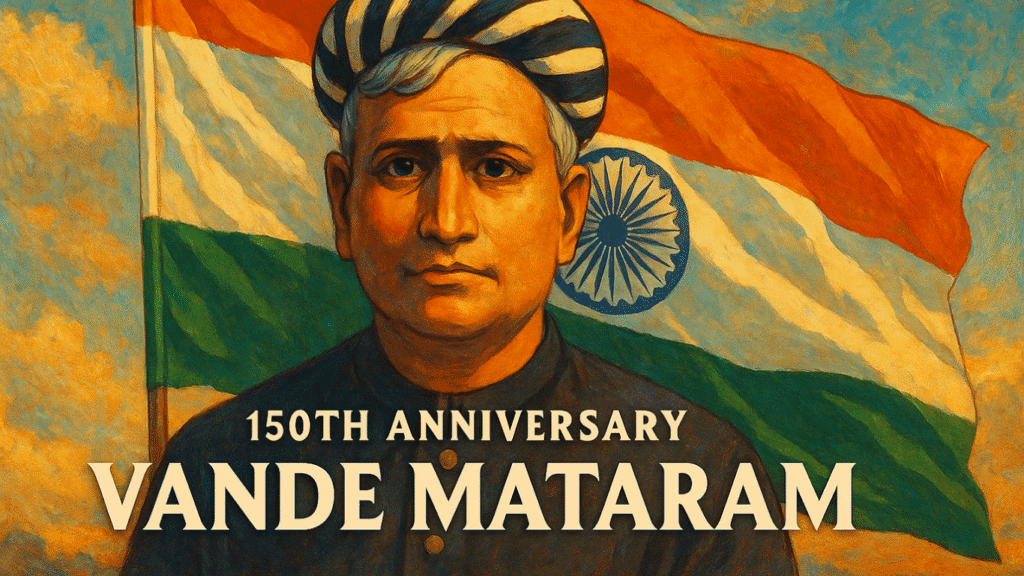
“Vande Mataram” — two words that once echoed through burning jails, silent classrooms, and blood-soaked battlefields — now complete 150 years in 2025. But their power remains undiminished.
On 7th November 1875, Bankim Chandra Chattopadhyay penned these immortal lines in Bangadarshan, unaware that his creation would one day become the heartbeat of India’s freedom struggle. Blending Sanskrit’s spiritual depth with Bengali’s lyrical grace, “Vande Mataram” wasn’t just a song — it was a revolution wrapped in poetry.
From the Swadeshi Movement to the Quit India Movement, this anthem became the war cry of countless freedom fighters. It was first sung publicly by Rabindranath Tagore at the 1896 Indian National Congress session, and later adopted as the National Song of India in 1950, sharing equal reverence with “Jana Gana Mana.”
Today, as aspirants prepare to serve the nation through UPSC, SSC, PCS, and other exams, “Vande Mataram” reminds us that patriotism isn’t just history — it’s a living legacy. It’s the call to rise, to serve, and to honor the motherland with every breath, every answer, every dream.
Table of Contents
📜 Historical Background: The Birth of a National Song
🖋️ Who Composed “Vande Mataram”?
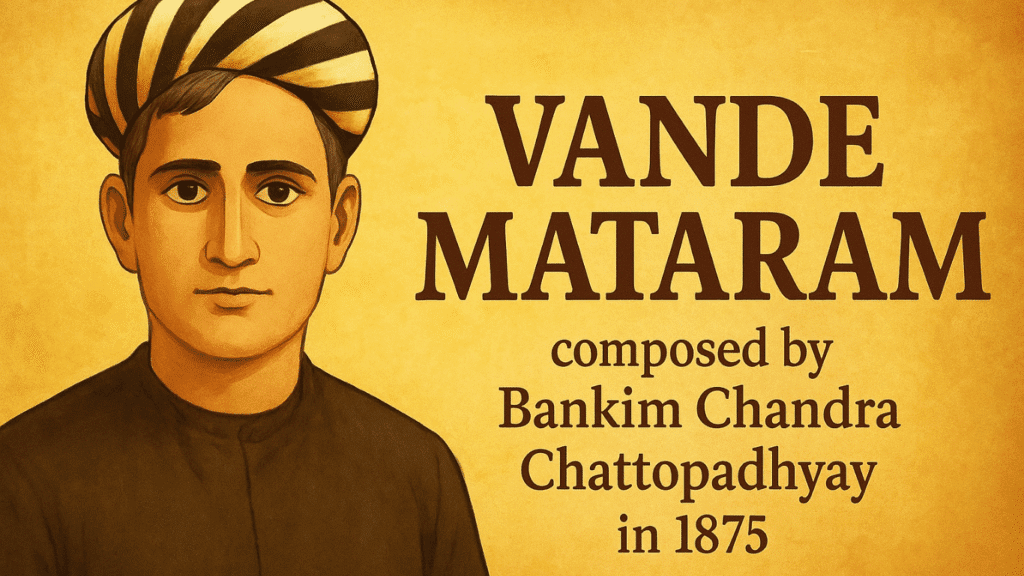
“Vande Mataram” was composed by Bankim Chandra Chattopadhyay in 1875, a towering figure in India’s literary and nationalist awakening. Born in 1838 in West Bengal, Bankim was one of the first graduates of Calcutta University and served as a Deputy Magistrate under British rule. Despite his government post, he was deeply disturbed by colonial oppression and sought to awaken national pride through literature.
- He wrote “Vande Mataram” in Sanskritized Bengali, blending the spiritual elegance of Sanskrit with the emotional rhythm of Bengali.
- The song was first published in his literary magazine Bangadarshan on 7th November 1875, marking its official birthdate.
Bankim’s vision was clear: India needed a unifying symbol — not just of resistance, but of reverence. “Vande Mataram” was his poetic offering to Bharat Mata, the divine embodiment of the motherland.
📚 Novel Connection: Anandamath (1882)
In 1882, Bankim included “Vande Mataram” in his revolutionary novel Anandamath, which portrayed a fictional uprising of sannyasi warriors against British forces in Bengal. The novel was more than fiction — it was a coded call for rebellion.
- The song appears as a spiritual chant sung by monks who worship India as a goddess.
- It became a symbol of armed resistance, cloaked in devotion and sacrifice.
This fusion of nationalism and spirituality made “Vande Mataram” a powerful emotional weapon — one that could stir hearts without violating British censorship directly.
🎶 First Sung: 1896 Indian National Congress Session
The song gained national prominence when Rabindranath Tagore — Nobel laureate and poet — sang it publicly at the Indian National Congress session in Calcutta in 1896.
- Tagore’s rendition was soulful and dignified, introducing the song to leaders and masses alike.
- From that moment, “Vande Mataram” became the anthem of India’s freedom movement, chanted in protests, prisons, and parades.
🇮🇳 Role in the Freedom Movement: A Song That Became a Sword
When the British Raj tightened its grip on India, it wasn’t just weapons or protests that shook their empire — it was a song. “Vande Mataram”, with its divine invocation and lyrical fire, became the heartbeat of India’s resistance.
🔥 Swadeshi Movement: The Song of Defiance
In 1905, when the British partitioned Bengal, the Swadeshi Movement erupted in protest. Streets filled with students, workers, and women chanting “Vande Mataram” — not as a poem, but as a battle cry.
- It unified people across caste, creed, and region under one emotional banner: Mother India must be free.
- The song was sung in public meetings, processions, and underground gatherings, often at great personal risk.
🚫 Banned by the British Raj
The British quickly realized its power. “Vande Mataram” was banned in public spaces, and those who dared to sing it were arrested, beaten, or even killed.
- In 1907, students in Lahore were expelled for singing it in school.
- The ban only amplified its appeal, turning it into a symbol of defiance.
🩸 Fuel for Revolutionaries
For freedom fighters, “Vande Mataram” was more than a song — it was spiritual armor.
- Bhagat Singh carried its verses in his heart as he walked into the gallows.
- Subhas Chandra Bose used it to inspire the Indian National Army (INA), calling it the “soul of the motherland.”
- Lala Lajpat Rai, even while bleeding from police lathis, invoked its spirit in his speeches.
It echoed in the jails of Andaman, in the ghettos of Calcutta, and in the battlefields of Burma. Wherever there was resistance, “Vande Mataram” was the unseen force that held the nation together.
🏛️ Constitutional Status: From Protest to Pride
After decades of struggle, sacrifice, and soul-stirring chants of “Vande Mataram,” India finally achieved independence in 1947. But the song’s journey didn’t end there — it entered the halls of the Constituent Assembly, where the nation’s future was being written.
📜 Adoption as the National Song
On 24th January 1950, just two days before India became a Republic, the Constituent Assembly of India officially adopted “Vande Mataram” as the National Song of India.
- The decision was made to honor its historic role in the freedom movement and its emotional resonance with the people.
This moment marked a symbolic transition — from rebellion to recognition, from underground resistance to constitutional reverence.
⚖️ Equal Status, Distinct Roles
While “Jana Gana Mana” is sung at official state functions, “Vande Mataram” is often used in cultural, educational, and patriotic events, especially on Independence Day, Republic Day, and national commemorations.
- Both songs represent India’s soul — one through unity, the other through devotion.
- “Vande Mataram” continues to be a source of inspiration, especially for youth preparing to serve the nation.
✨ Meaning and Message: A Salutation to the Soul of India
At its heart, “Vande Mataram” means “I bow to thee, Mother” — a simple phrase that carries the weight of centuries of devotion, sacrifice, and love for the motherland. But this “Mother” is no ordinary figure. She is Bharat Mata, the divine embodiment of India — not just as a geographical entity, but as a living, breathing spirit that nurtures, protects, and inspires.
🌾 A Hymn to the Land
वन्दे मातरम् सुजलां सुफलां मलयजशीतलाम् शस्यशामलां मातरम् ।
शुभ्रज्योत्स्नापुलकितयामिनीं फुल्लकुसुमितद्रुमदलशोभिनीं सुहासिनीं सुमधुर भाषिणीं सुखदां वरदां मातरम् ।। १ ।।
वन्दे मातरम् ।
कोटि-कोटि-कण्ठ-कल-कल-निनाद-कराले कोटि-कोटि-भुजैर्धृत-खरकरवाले, अबला केन मा एत बले ।
बहुबलधारिणीं नमामि तारिणीं रिपुदलवारिणीं मातरम् ।। २ ।।
वन्दे मातरम् ।
तुमि विद्या, तुमि धर्म तुमि हृदि, तुमि मर्म त्वं हि प्राणा: शरीरे बाहुते तुमि मा शक्ति, हृदये तुमि मा भक्ति, तोमारई प्रतिमा गडि मन्दिरे-मन्दिरे मातरम् ।। ३ ।।
वन्दे मातरम् ।
त्वं हि दुर्गा दशप्रहरणधारिणी कमला कमलदलविहारिणी वाणी विद्यादायिनी, नमामि त्वाम् नमामि कमलां अमलां अतुलां सुजलां सुफलां मातरम् ।। ४ ।।
वन्दे मातरम् ।
श्यामलां सरलां सुस्मितां भूषितां धरणीं भरणीं मातरम् ।। ५ ।।
वन्दे मातरम् ।।
The verses of “Vande Mataram” are soaked in reverence for India’s natural beauty and abundance:
- The song praises the land’s lush fields, cool winds, sweet waters, and fragrant flowers.
- It celebrates India’s fertility and grace, portraying her as a mother who feeds, shelters, and uplifts her children.
This imagery wasn’t just poetic — it was political. At a time when India was being exploited by colonial powers, Bankim Chandra’s words reminded people of what they were fighting for: not just freedom, but the soul of their sacred land.
💪 Strength in Devotion
Beyond beauty, “Vande Mataram” invokes Shakti — the divine feminine power. The motherland is not passive; she is Durga, the warrior goddess, armed and fearless.
- This duality — of nurture and resistance — made the song a perfect anthem for India’s freedom fighters.
- It gave them not only a cause but a spiritual justification for their struggle.
❤️ A Timeless Emotional Bond
Even today, the song stirs something deep within. For aspirants preparing to serve the nation, “Vande Mataram” is a reminder that service to the country is not just duty — it is devotion.
- It teaches that patriotism is not loud slogans, but quiet reverence, selfless action, and unshakable love for the land that raised us.
- Every time we say “Vande Mataram,” we are not just remembering history — we are renewing a sacred vow.
🎉 150th Anniversary Celebrations (2025): Rekindling the Spirit of Vande Mataram
As the sun rose on 7th November 2025, India didn’t just mark a date — it celebrated 150 years of a song that shaped its destiny. “Vande Mataram,” born in the pages of Bangadarshan in 1875, returned to the national spotlight with a year-long tribute led by the Government of India.
🎶 Mass Singing Events Across India
From schools in Kerala to army cantonments in Ladakh, millions of voices united in singing “Vande Mataram” — not as a ritual, but as a renewal of national devotion.
- Educational institutions held synchronized recitations and competitions to revive the song’s meaning among youth.
- Gurdwaras, temples, mosques, and churches echoed with its verses, symbolizing unity in diversity.
🪙 Commemorative Stamp and Coin
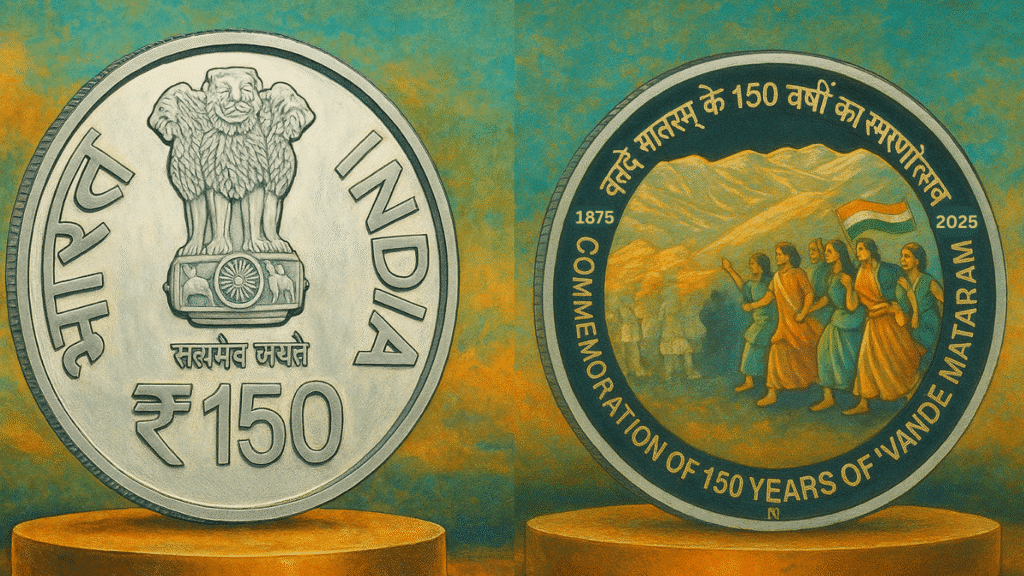
To honor the occasion, Prime Minister Narendra Modi unveiled a special ₹150 coin and a postal stamp featuring:
- Bankim Chandra Chattopadhyay’s portrait
- A symbolic image of Bharat Mata with the tricolor
These collectibles are not just memorabilia — they are educational tools, reminding every aspirant of the song’s legacy.
📚 Patriotic Education and Cultural Revival
The Ministry of Education launched a “Vande Mataram Literacy Campaign”, integrating the song’s history into:
- NCERT textbooks
- Civil services preparation modules
- State board syllabi
Cultural ministries organized Anandamath-themed theatre, folk renditions, and digital exhibitions, bringing the song’s emotional depth to life.
🌈 Theme: Unity, Pride, and Youth Empowerment
The official theme — “Ekta Mein Shakti, Sanskriti Mein Gaurav” — emphasizes:
- Unity in diversity: Celebrating India’s pluralism through a shared anthem.
- Patriotic education: Instilling values of service, sacrifice, and pride.
- Youth engagement: Encouraging aspirants to see nation-building as a sacred duty.
🕊️A Salute from the Heart of Every Aspirant
“Vande Mataram” is not just a song — it is a sacred whisper from the soul of India, echoing through time, reminding us of who we are and what we stand for. It was sung by those who walked into fire for freedom, and now it must be remembered by those who walk into exam halls with dreams of serving the nation.
As you prepare for UPSC, SSC, PCS, Patwari, or any other exam, let “Vande Mataram” be more than a line in your syllabus. Let it be your inner anthem, your moral compass, your reminder that service to the nation is the highest calling.
Because every time you say “Vande Mataram,” you are not just saluting the past — you are pledging your future.
📲 Join our WhatsApp Group to receive regular updates on such inspiring articles, current affairs, and exam-focused content.
📚 For more enriching reads, visit our Current Affairs & Articles Section — your one-stop hub for knowledge that empowers.