In the sacred hall of Parliament, where the echoes of the greatest leaders in the history of Indian democracy still resonate, Congress MP Shri Manish Tewari once again raised an important question through his right as an MP by introducing a Private Member Bill that refuses to be ignored: should elected representatives be bound by the party command, or should they be independent and free to vote according to their own conscience?
Now it is not a political debate; it is a battle for the very soul of democracy, for which our freedom fighters fought. Tewari, with his Private Member’s Bill that sought an amendment to the Tenth Schedule, i.e., the Anti-Defection Law, presented not just a piece of legislation but a call for the dignity of the people’s representatives. He argues that MPs should not simply toe the line of the parties from which they were elected, but instead represent the people who voted for them in the world’s largest democracy.
Now, for the aspirants who are preparing for UPSC, SSC, PCS, Patwari, and other competitive exams, this article is not just news; it is an ideology for those who want to know how the word “democracy” works.
- It directly touches on Constitutional provisions (Tenth Schedule), a favorite topic of examiners in polity questions.
- It highlights Parliamentary procedures, especially the role of Private Member’s Bills, which are often asked in many exams, especially in prelims and mains.
What is Private Member Bill?
A Private member bill as it suggest from the its name is a legislative proposal which can introduced in parliament by any member of parliament who is not a part of the Council of Ministers. This private member bill is different from other bils which are drafted and introduced by the ministers, so Private member bill empowered the individual Member of Parliamentarian to propose new laws or any amendments to exiting laws.
- Independent drafting: The drafting of the Private Member Bill is the full responsibility of the individual MP who is proposing a Private Member Bill in Parliament.
- Purpose of Private Member Bill: To raise issues outside the government’s agenda and also emphasize the notice of other relevant issues that need to be addressed and raised.
- Scope of this bill: It can cover any subject within Parliament’s limits, but Money Bills, which only Ministers can introduce in Parliament, are outside the purview of a Private Member’s Bill.
Constitutional Basis & Procedure
Constitutional Foundation
The framer of the Indian Constitution did not include the term Private Member Bill in the original Constitution of India, and even now the term Private Member Bill does not exist in the Indian Constitution. Yet the framework was laid down in the Constitution that empowers every member of Parliament to introduce a bill or to participate in law making.
Here we look at the constitutional articles that apply to specific bills:
- Article 107: Article 107 grants the right for any bill to be introduced in either House of Parliament, subject only to constitutional limits.
- Article 110: Article 110 defines a Money Bill which can only be introduced exclusively by Ministers and it can be introduced only in the Lok Sabha not in the Rajya Sabha.
- Article 117: Article 117 specifies that any bill involving expenditure from the Consolidated Fund of India requires the President’s recommendation before its introduction in Parliament.
Together, these provisions highlight a crucial balance between the Ministers of the government who propagate the government’s agenda and the Private Members who also have the constitutional authority to propose laws or introduce Private Member Bills on other subjects in Parliament.
Procedural Rules in Parliament
The Rules of Procedure in both Houses of Parliament how a parliamentarian can introduce the Private Member Bills:
- Notice Requirement: MPs need to give at least one month’s notice before introducing a Private Member Bill.
- Dedicated Day: Parliament has decided that each Friday is set aside in both Lok Sabha and Rajya Sabha for discussion of Private Member Bills.
- Process: Like other government bills, a Private Member Bill must secure majority support in both Houses to become law.
Historical Background of Private Member Bills in India
Origins
If we go to the history and the idea of a Private Member Bill (PMB), it comes from the Westminster parliamentary tradition in the United Kingdom, where the non‑ministerial members of Parliament were given the right to introduce legislation. In India our Constitution framers also inherited this practice from the United Kingdom after Independence and adopted it into our own parliamentary system to ensure that law‑making was not limited only to the Executive.
Journey in India
- First Introduction (1952): The practice of Private Member Bills in India began with the First Lok Sabha, giving MPs outside the Council of Ministers an opportunity to propose laws within constitutional limits to cater to the voice of the people they represent.
- Numbers of bills presented: Since 1952, more than 370 Private Member Bills have been presented in the Indian Parliament by MPs.
- Success Rate of bills to passed: Very few have actually become law as Private Member Bills, but their importance lies in the introduction of specific issues and, more importantly, in bringing those issues to the notice of Parliament.
Examples of Passed Private Member Bills which successfully became law
- The Proceedings of Legislature Bill, 1956
- This Bill Ensured protection for the publication of parliamentary proceedings.
- The Hindu Marriage (Amendment) Bill, 1960
- It was Introduced for reforms in Hindu marriage laws, strengthening social justice.
Influence Beyond Passage
Even when not enacted, Private Member Bills often shape the legislative agenda by highlighting neglected issues by the member of the parilament. For example:
- Bills on social reforms and electoral changes have build pressured on the governments to later introduce official legislation.
- They also act as a testing ground for new ideas, allowing Parliament to debate emerging concerns which are not part of the the government’s aganda such as digital rights, environment, or gender equality.
The Tenth Schedule & Anti‑Defection Law
What is the Tenth Schedule?
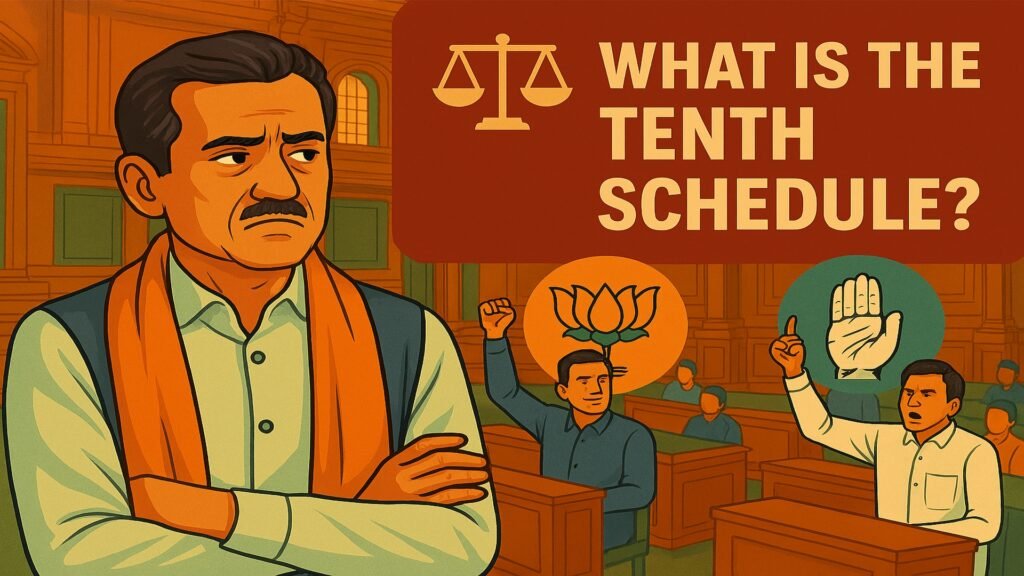
The Tenth Schedule of the Indian Constitution, popularly known as the Anti‑Defection Law, was inserted in the Constitution by the 52nd Constitutional Amendment Act, 1985. The Tenth Schedule was designed to curb the growing menace of political defections, where legislators frequently change their parties for their personal gain, resulting in destabilizing governments and betraying the voters’ mandate and trust.
What Does the Anti‑Defection Law Say?
The law purely lays down the grounds for disqualification of MPs and MLAs who are:
- Voluntary Resignation from Party: If an MP or MLA voluntarily gives up his membership of the specific party.
- Defying Party Whip: If an MP or MLA votes or abstains against the party’s direction without prior permission or went against the party whip.
- Independent Members: An MP or MLA is disqualified from their seat if they change the political party or join another party after their election.
- Nominated Members: Disqualified if he or she joins a party after six months of nomination.
- Decision Authority: The Speaker (Lok Sabha/State Assembly) or Chairman (Rajya Sabha/Legislative Council) decides on which an MP or MLA is disqualified on the grounds of petitions
Why Was It Introduced?
- To ensure stability of governments by preventing frequent collapses or betrayal of the voters’ trust who voted for a particular party.
- To discipline legislators and keep them loyal to the party or toe the party line on whose ticket they were elected.
- To protect the integrity of the electoral mandate, ensuring voters’ trust in the party system they voted for and the member they elected
Criticisms of the Law
- Restricts Freedom: An MP or MLA cannot vote according to their conscience, even on policy matters which they think are right for their people whom they are representing.
- Weakens Debate: Parliament often becomes a numbers game, which limits an MP or MLA’s independent thought.
- Partisan Decisions: Speaker’s authority in disqualification cases can be biased by the influence of the party on the Speaker or Chairman, who are also associated with the particular party.
- Judicial Delays: Court interventions often prolong disputes which lead to loss of voters’ trust
Recent Private Member Bills in Parliament
Manish Tewari’s Bill (Lok Sabha)
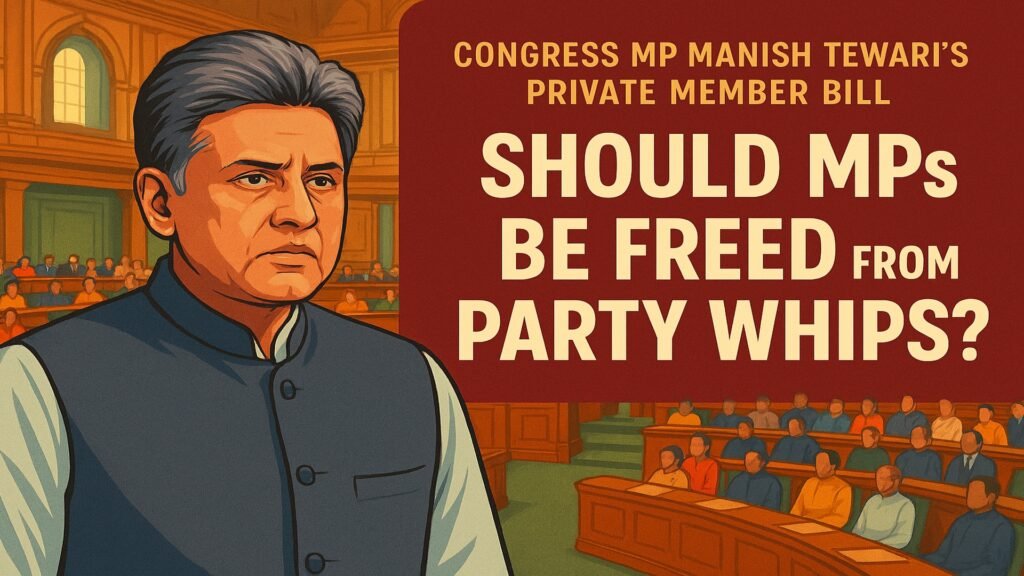
- Introduced by: Congress MP Manish Tewari.
- Objective: To amend the Tenth Schedule (Anti‑Defection Law).
- Key Proposal:
- MPs should be free to vote independently in Parliament on most bills and motions with their own conscience even against the party whip.
- Party whip should be considered only in particular matters which affect government stability and in particular matters where the party has some important motions such as:
- Confidence motions
- No‑confidence motions
- Adjournment motions
- Money bills and financial matters
- Reasoning: Tewari described the current system as “whip‑driven tyranny” and also argued that MPs should represent the voice of the people whom they voted for rather than being limited by party discipline or party ideology.
- Exam Relevance:
- GS‑II Polity: Anti‑Defection Law, Parliamentary procedures (Becomes important when the parliamentary procedure).
- Prelims: Tenth Schedule provisions and its need and history.
- Mains: Questions on “Democracy vs. Party Discipline”
Bhim Singh’s Bill (Rajya Sabha)
- Introduced by: Current BJP Rajya Sabha MP Bhim Singh.
- Objective of the Bill: To remove of the words ‘Secular’ and ‘Socialist’ from the Preamble.
- Key Proposal: He has suggested removing these words ‘Secular’ and ‘Socialist’ from the Preamble which were inserted during the Emergency in a preamble.
- Reasoning:
- He also said that these words were added in 1976 through the 42nd Constitutional Amendment Act by the then Indira Gandhi Government through what he called an “undemocratic” process and should be removed from the Constitution.
- He also claimed that the original Constitution of 1950 did not contain these words and our Constitution makers knew these words would create confusion in society.
- Debate:
- Supporters: Say this restores the “original intent” of the framers of the Constitution who did not think these words were necessary for the Indian society.
- Critics: They argue that secularism and socialism are now part of the basic structure doctrine of constitution and cannot be removed as India also fought against the British for achieving secularism and socialism.
- Exam Relevance:
- Prelims: The most important- Preamble, 42nd Amendment.
- Essay and other topics for the mains examination cover subjects such as ‘Secularism in India’ and ‘The Basic Structure Doctrine’.
So with every Private Member Bill introduced in Parliament it is more than just a proposal, it is a reminder that democracy thrives when every voice is heard and whether it is Manish Tewari’s call to free MPs from party whip‑driven control over their MPs or Bhim Singh’s proposal to amend the Preamble of the Constitution, these bills ignite debates in the Parliament that shape the future of our Constitution.
Dear aspirants, just remember that questions on Private Member Bills, the Tenth Schedule, and constitutional amendments are not just exam topics for you, they are the living heartbeat of India’s democracy which was earned by the sweat and blood of our freedom fighters. By mastering them, you are not only preparing for your exams but also you are preparing to become informed citizens of this beautiful country who understand the foundations of governance.
For more related articles and detailed explanations, please click here to explore our Polity Section and continue strengthening your preparation.