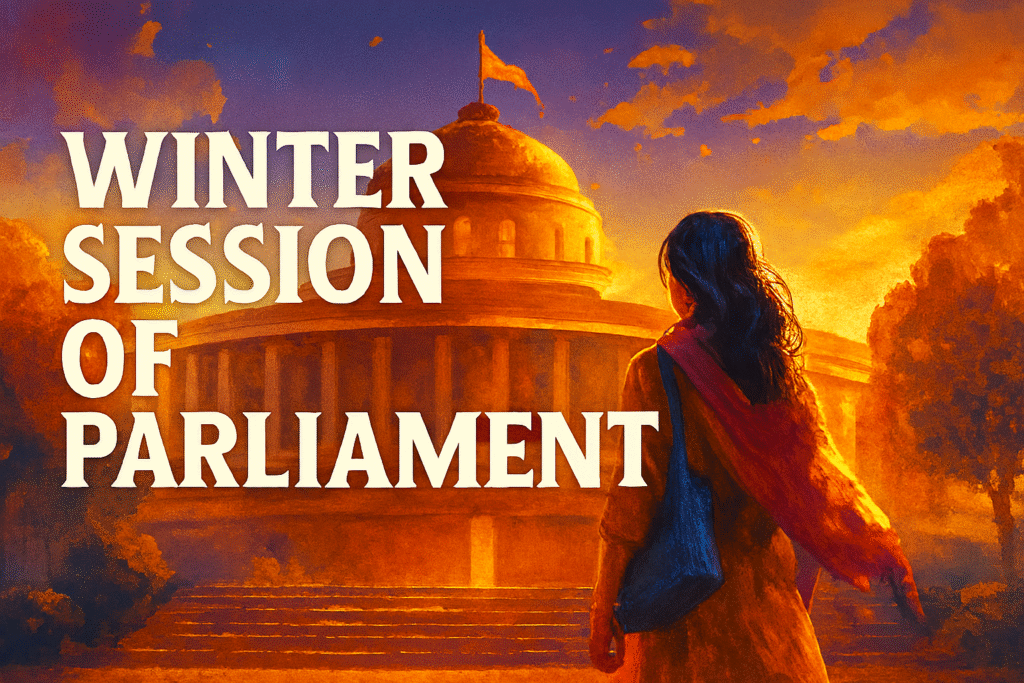
As the chill of December settles over the nation, something warmer stirs within the heart of New Delhi—a pulse, a promise, a Parliament in motion. The Winter Session isn’t just a gathering of lawmakers; it’s a gathering of dreams, debates, and destinies. For every aspirant preparing for UPSC, SSC, PCS, or Patwari exams, this session is more than a topic—it’s a living classroom of governance, a mirror of India’s democratic heartbeat.
Imagine this: behind the sandstone walls of the Sansad Bhavan, voices rise—not in chaos, but in conviction. Bills are born, policies are shaped, and questions are asked that echo the concerns of every citizen. It’s here that the future is drafted—not just in ink, but in intent. And you, dear aspirant, are not just a spectator. You are a future contributor to this very dialogue.
This Winter Session, like every session before it, carries the weight of history and the urgency of tomorrow. It’s a reminder that democracy doesn’t hibernate—it debates, it decides, it delivers. And as you prepare for your exams, know this: every article you read, every polity concept you master, every current affair you revise—is a step closer to becoming the voice that one day may rise in that very hall.
Let’s walk through its legacy, its structure, and its significance—not just with facts, but with feeling. Because to understand Parliament is to understand India. And to understand India is to prepare not just for an exam, but for a lifetime of service.
Table of Contents
🏛️ What Is the Winter Session of Parliament?
A Classroom of Democracy Beneath the Winter Sky
As the year winds down and the air turns crisp, the Indian Parliament awakens for one final legislative sprint—the Winter Session. It’s not just a constitutional formality; it’s a moment of urgency, reflection, and democratic resolve. For aspirants, this session is a living textbook—where governance meets grit, and policy meets purpose.
🌅 How Does the Winter Session Happen?
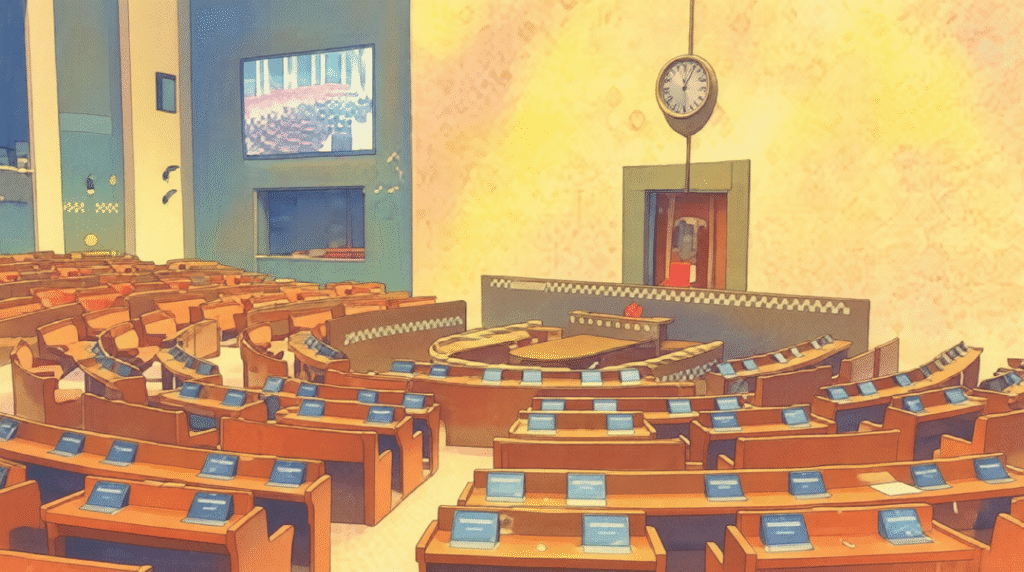
The Winter Session is convened by the President of India, under Article 85 of the Constitution, which empowers the President to summon each House of Parliament from time to time. The Ministry of Parliamentary Affairs proposes the dates, and the President gives formal approval.
- Timing: Usually held between mid-November and late December
- Duration: Shortest of the three sessions, typically 15–20 sittings
- Purpose: To pass urgent bills, review governance, and prepare for the upcoming Budget Session
This session often reflects the political mood post-state elections and is crucial for pushing through last-minute legislation before the year ends.
🗓️ The Three Sessions of Parliament: A Year in Governance
India’s Parliament doesn’t operate year-round—it pulses through three distinct sessions, each with its own rhythm and relevance:
| Session Name | Usual Timeframe | Key Features & Exam Relevance |
|---|---|---|
| Budget Session | February to May | Longest session; Union Budget presented; detailed debates on finance and policy |
| Monsoon Session | July to August | Post-budget legislative work; often includes bills on education, health, and reforms |
| Winter Session | November to December | Shortest session; urgent bills, electoral reforms, and year-end reviews |
📜 Colonial Foundations of the Indian Parliament
From Imperial Control to Democratic Aspiration
Before India’s Parliament became the “temple of democracy,” it was a distant dream—shaped slowly through colonial reforms, nationalist resistance, and constitutional evolution. For aspirants, understanding this journey is not just about history—it’s about grasping how governance, representation, and federalism were born from struggle.
🔹 1861: The First Crack in the Wall
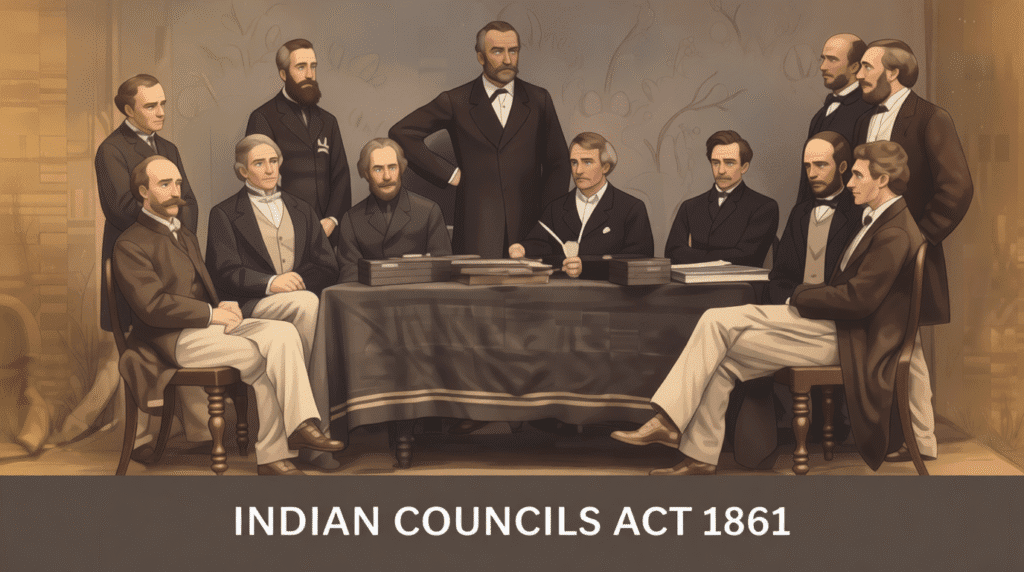
The Indian Councils Act of 1861 was the British Empire’s first reluctant nod to Indian participation in governance. For the first time, a few Indians—designated as non-official members—were nominated to legislative councils. They had no real power, no vote, and no authority—but they had presence. And in a system built to exclude, presence was resistance. It was the first time Indians sat in a room where laws were made, even if only to listen. This symbolic inclusion came in 1862, when Viceroy Lord Canning, in the aftermath of the First War of Independence (1857), appointed three distinguished Indians to the newly constituted legislative council:
- Maharaja Sir Narendra Singh, the ruler of Patiala
- Raja Deo Narain Singh, the Maharaja of Benaras
- Sir Dinker Rao, a respected statesman from Gwalior
Though their roles were limited, their presence marked a quiet but powerful shift—from rebellion to representation, from exclusion to engagement. For aspirants, this moment is a reminder: even the smallest seat at the table can be the start of a revolution. It teaches us that every voice matters, and that the journey to full democracy begins with the courage to show up—even when the system isn’t ready to listen.
🔹 1919: The Birth of Bicameralism
The Government of India Act 1919 was a turning point in India’s constitutional journey—a moment when the British administration, under pressure from rising nationalist voices, offered a glimpse of structured governance. For the first time, India saw the emergence of a bicameral legislature at the center: the Central Legislative Assembly and the Council of State. Though these Houses were far from democratic in composition or power, they were the early shadows of what would one day become our Lok Sabha and Rajya Sabha.
But the Act’s most defining feature was the introduction of diarchy in provinces—a dual system of governance that split subjects into two categories: reserved (controlled by British officials) and transferred (handled by Indian ministers). It was an imperfect compromise, but it gave Indian leaders their first real taste of administrative responsibility. They could now legislate on education, health, agriculture, and local governance—areas that touched the lives of ordinary citizens.
And it was in these provincial councils and central chambers that a new generation of Indian leaders began to rise—not just as freedom fighters, but as parliamentarians. They learned how to question authority, how to draft laws, how to speak for the voiceless. The art of debate, dissent, and decision-making was no longer confined to protest—it was now practiced within the very halls of power.
🔹 1935: The Blueprint of a Nation
The Government of India Act 1935 wasn’t just a law—it was the most ambitious attempt by the British Empire to reshape India’s governance. In its pages lay the blueprint of a nation still fighting for freedom, yet already dreaming of federalism, autonomy, and responsible rule. For aspirants, this Act is not just a chapter in polity—it’s the DNA of the very system they hope to serve.
This Act expanded provincial autonomy like never before. For the first time, provinces were granted the power to form responsible governments, where Indian ministers could truly govern—answerable to elected legislatures, not colonial administrators. It was a bold shift, a recognition that Indians were ready to lead, not just advise. Though the British still held control over defense and foreign affairs, the provinces became laboratories of self-rule, where future leaders learned the craft of governance.
The Act also proposed an All-India Federation, a visionary idea that would unite British provinces and princely states under one constitutional roof. Though this federation never materialized—many princely states refused to join—the idea itself planted the seeds of India’s federal structure. The division of powers between the center and provinces, the role of Governors, the bicameral legislatures—all these features were carried forward into the Constitution of 1950, refined and reimagined by the framers of independent India.
For aspirants, the 1935 Act is more than a polity topic—it’s a reminder that India’s democracy was not born overnight. It was built, clause by clause, through compromise, courage, and constitutional imagination. Every law you study, every article you memorize, every mock test you take—is a step closer to understanding the system that this Act helped shape.
Let this Act remind you: the journey from colonial control to constitutional command was long, but purposeful. And today, as you prepare to enter that system—not as subjects, but as servants of the people—you carry forward the legacy of those who first dared to govern.
🧱 Birth of the Indian Parliament
From Constitution to Conviction: The Dawn of Democratic India
🔹 1946: The Constituent Assembly Is Born
Even before independence, India took a bold step toward self-governance. In 1946, the Constituent Assembly was formed—not by the British, but by Indians, for Indians. Its mission was monumental: to draft a Constitution that could hold together a nation of immense diversity. But this Assembly wasn’t just a drafting body—it functioned as India’s first sovereign legislature, debating laws and laying the foundation for a democratic future. For aspirants, this marks the beginning of India’s constitutional soul.
🔹 26 January 1950: India Becomes a Republic
On this historic day, the Constitution of India came into force, and the nation officially became a Republic. The Constituent Assembly was renamed the Provisional Parliament, continuing to legislate until the first general elections. This transition was more than symbolic—it was the moment when ideals turned into institutions. For aspirants, it’s a reminder that democracy is not just declared—it is practiced, refined, and protected.
🔹 1951–52: The First General Elections
India’s first general elections were held between October 1951 and March 1952, under the principle of universal adult suffrage. Over 170 million citizens were eligible to vote—a revolutionary act in a newly independent nation. Despite logistical challenges, the elections were conducted with dignity and discipline. This was not just a vote—it was a vow to democracy. For aspirants, it’s proof that India’s democratic foundation was built on the trust and participation of its people.
🔹 13 May 1952: The First Lok Sabha and Rajya Sabha Convene
On this day, the Parliament of India was formally born. The First Lok Sabha and Rajya Sabha convened, and the halls of Parliament echoed with the voices of elected representatives. President Rajendra Prasad inaugurated the session, marking the beginning of India’s legislative journey. It was the moment India truly became a democracy—not just in law, but in life. For aspirants, this is the origin of the very institution they dream of serving.
🏛️ Structure and Constitutional Mandate
Where the People’s Voice Finds Form and Power
The Indian Parliament is not just a building of stone and columns—it is the living structure of our democracy, where the will of the people is transformed into law. Its design is both symbolic and functional, rooted in the Constitution and shaped by the dreams of a newly independent nation. For aspirants, understanding this structure is not just about clearing exams—it’s about understanding the very system they hope to serve.
🔹 Bicameral Legislature: Two Houses, One Nation
India’s Parliament is bicameral, meaning it has two Houses:
- The Lok Sabha (House of the People)—directly elected by the citizens, it reflects the voice of the people.
- The Rajya Sabha (Council of States)—represents the states of the Union, ensuring federal balance.
Together, they form the legislative backbone of the country, with the President of India as an integral part of Parliament. Every law passed, every debate held, every question raised—flows through this triad of democratic power.
🧠 Aspirant Insight: Lok Sabha = People’s mandate. Rajya Sabha = State representation. President = Constitutional authority.
🔹 Article 79: The Constitutional Blueprint
Article 79 of the Indian Constitution lays down the composition of Parliament: the President, the Lok Sabha, and the Rajya Sabha. This article is the architectural line that defines the very existence of our legislative system. It reminds us that Parliament is not just about elected representatives—it is a constitutional body where executive, federal, and popular elements converge.
🔹 Article 85: The Pulse of Parliamentary Life
Article 85 empowers the President to summon each House of Parliament from time to time, ensuring that there is no gap of more than six months between two sessions. This article is what keeps the heart of democracy beating—ensuring that the government remains answerable, and that the people’s voice is never silenced for too long.
🧠 Aspirant Tip: Article 85 = Session Summoning Power. It’s the reason we have Budget, Monsoon, and Winter Sessions every year.
🔑 Key Historical Moments in the Journey of Indian Parliament
Where Democracy Was Tested, Strengthened, and Reimagined
India’s Parliament is not just a legislative body—it is a living witness to the trials, triumphs, and transformations of our democracy. Each milestone in its history tells a story of resilience, reform, and renewal. For aspirants, these moments are more than facts—they are lessons in leadership, law, and legacy.
🔹 1952: The First Parliament Session
On 13 May 1952, the newly elected Lok Sabha and Rajya Sabha convened for the first time, marking the formal birth of the Parliament of India. President Rajendra Prasad inaugurated the session, and the halls of Parliament echoed with the voices of elected representatives—many of whom had once fought for freedom. It was a moment of transformation: from colonial councils to sovereign chambers. For aspirants, this is the origin story of the very institution they dream of serving.
🔹 1971: The 24th Constitutional Amendment
In 1971, the 24th Amendment was passed, reaffirming Parliament’s authority to amend any part of the Constitution, including Fundamental Rights. This came in response to judicial challenges that had questioned Parliament’s power. The amendment restored legislative confidence and clarified the balance between the judiciary and legislature. For aspirants, it’s a reminder that constitutional interpretation is not static—it evolves through debate, dissent, and democratic will.
🔹 1975–77: The Emergency Era
The Emergency period was one of the darkest chapters in India’s parliamentary history. Declared in 1975, it suspended civil liberties, curtailed press freedom, and tested the independence of Parliament itself. For nearly two years, the institution that was meant to represent the people became a tool of executive control. Yet, it was also a moment of awakening. When democracy returned in 1977, it came back stronger, with deeper public awareness and institutional safeguards. For aspirants, this is a lesson in vigilance—democracy must be defended, not just practiced.
🔹 2003: The 91st Amendment and Ministerial Accountability
The 91st Amendment Act of 2003 introduced a crucial reform: it limited the size of the Council of Ministers to 15% of the strength of the Lok Sabha. This was aimed at curbing political patronage and ensuring efficiency in governance. It also disqualified defectors from holding ministerial positions, reinforcing the spirit of accountability. For aspirants, this amendment is a case study in how constitutional tools can be used to strengthen ethical governance.
🔹 2023: A New Building, A New Chapter
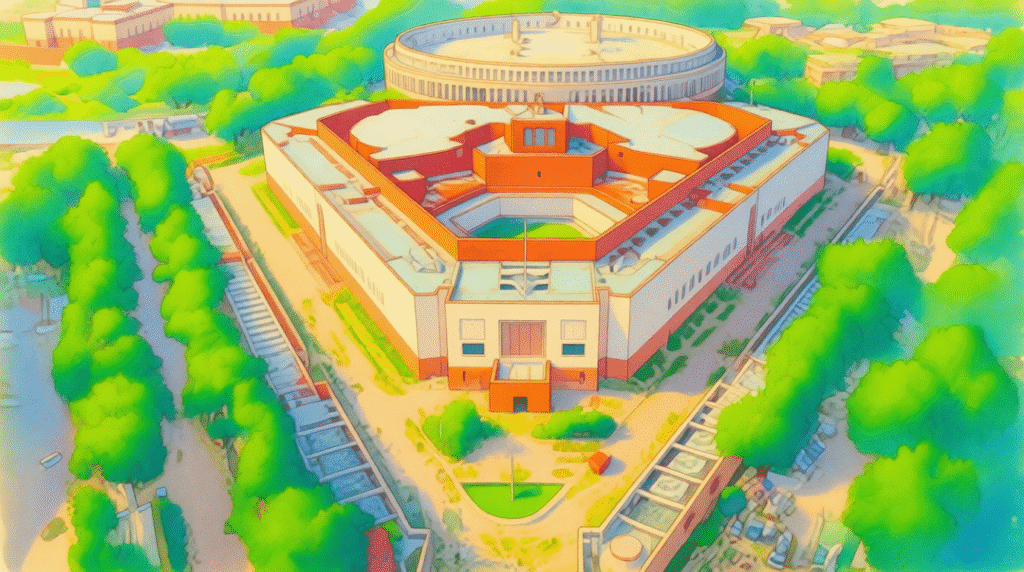
In 2023, India’s Parliament moved to a new building as part of the Central Vista Project. Sleek, modern, and technologically advanced, the new structure symbolizes a new chapter in India’s democratic journey. But while the walls may be new, the spirit remains timeless. It is still the place where laws are shaped, voices are heard, and the future is debated. For aspirants, this transition is symbolic—it reminds us that democracy must evolve with time, but its soul must remain rooted in representation.
🌟Where Aspirations Meet Democracy
The journey of India’s Parliament—from colonial councils to sovereign chambers—is not just a tale of governance. It’s a testament to the power of voices that refused to be silenced, of dreams that demanded representation, and of a nation that chose debate over decree. For every aspirant preparing for UPSC, SSC, PCS, Patwari, or any competitive exam, this story is your inheritance. You are not just studying polity—you are preparing to protect it, shape it, and live it.
Each session of Parliament, each amendment, each moment of resilience is a reminder that democracy is not built in silence—it is built in participation. And one day, it may be your question that sparks a reform, your signature that shapes a bill, your voice that echoes in the halls of power.
So keep preparing—not just with books, but with belief. Because the Parliament of India is not just a place for leaders. It is a place for learners who dare to lead.
📲 Join our WhatsApp group to receive regular updates, motivation, and exam-ready content that keeps your preparation aligned with the pulse of the nation.
📚 For more such articles and current affairs capsules, please visit our Current Affairs & Articles section by clicking here.
Your journey matters. Your voice matters. And your preparation is the first step toward becoming the change India needs.