Hello aspirants! History can be very interesting if we read it like a story. Maharaja Ranjit Singh was a great conqueror. When he became the king, he was just the leader (Sardar) of a small group called the Sukarchakia misl. But because of his bravery and smart thinking, he turned his small state into a huge empire with many conquests.
Let us read the detailed story of his main conquests
Conquest of Lahore (1799 A.D.)
Lahore was the oldest and biggest city in Punjab, and it had been the capital for a long time. At that time, three Bhangi leaders—Sahib Singh, Mohar Singh, and Chet Singh—ruled it. They were cruel, and the people were very tired of their bad rule.
The ruler of Afghanistan, Shah Zaman, wanted to capture Punjab. He attacked Punjab four times between 1793 A.D. and 1798 A.D. In November 1798, he easily took Lahore. But he had to go back to Kabul because of a rebellion there. The Bhangi leaders took control of Lahore again. Because the people were already unhappy with them, they invited Maharaja Ranjit Singh to take over.
Ranjit Singh was waiting for this perfect chance. He attacked Lahore on 6th July 1799 A.D. with the help of his mother-in-law, Sada Kaur. When they heard about the attack, Sahib Singh and Mohar Singh ran away. Chet Singh fought for a little while but then gave up. Ranjit Singh took control of Lahore on 7th July 1799 A.D.
Conquest of Amritsar (1805 A.D.)
Amritsar was very important for Sikhs. It was their religious center (like their Mecca) and the biggest trade city in Punjab. To become the true king of Punjab, Ranjit Singh needed to control it.
At that time, Mai Sukhan (the widow of Gulab Singh Bhangi) was ruling Amritsar for her young son, Gurdit Singh. In 1805 A.D., Ranjit Singh asked her to give him the Lohgarh fort and the famous Zamzama gun. Mai Sukhan said no. So, Ranjit Singh attacked Amritsar. After some fighting, Mai Sukhan accepted defeat.
Conquest of Kangra (1809 A.D.)
In 1809 A.D., the Gorkhas from Nepal attacked and surrounded the Kangra fort. The ruler of Kangra, Sansar Chand Katoch, asked Ranjit Singh for help. He promised to give the fort to Ranjit Singh in return. Ranjit Singh agreed. His army forced the Gorkhas to go back.
But then, Sansar Chand changed his mind and refused to give the fort. Ranjit Singh was smart. He caught Sansar Chand’s son, Anurodh, and kept him. Sansar Chand had no choice but to give the fort to Ranjit Singh.
Conquest of Gujarat (1809 A.D.)
Gujarat was a very rich city. Its ruler, Sahib Singh Bhangi, was secretly planning against Ranjit Singh. Ranjit Singh was busy with other things at first. But in 1809 A.D., he sent an army led by Faqir Aziz-ud-Din. Faqir Aziz-ud-Din defeated Sahib Singh Bhangi and took control of Gujarat.
Conquest of Attock (1813 A.D.)
The fort of Attock was in a very important location. It was ruled by an Afghan governor named Jahandad Khan. He only pretended to follow the Kabul government; he was actually independent.
In 1813 A.D., the Kabul minister (Wazir), Fateh Khan, attacked Kashmir and defeated his brother Ata Mohammad Khan. Jahandad Khan got scared. He thought Fateh Khan would attack Attock next. So, he made a deal with Ranjit Singh. He said he would give the fort to Ranjit Singh if he got a large land grant (Jagir) that gave 1 lakh rupees every year.
When Fateh Khan heard about this, he got very angry. He marched his army to take Attock. On 13th July 1813 A.D., a big and fierce battle was fought at a place called Hazro or Haidru. Ranjit Singh completely defeated Fateh Khan.
Conquest of Multan (1818 A.D.)
Multan was a very rich and important city. It was ruled by an Afghan governor, Nawab Muzaffar Khan. From 1802 A.D. to 1817 A.D., Ranjit Singh sent six armies to Multan. Every time, Nawab Muzaffar Khan avoided a fight by giving him some gift money (Nazrana).
In 1818 A.D., Ranjit Singh decided to take Multan by force. In January 1818, he sent his famous general, Misar Diwan Chand, with an army of 20,000 soldiers. Nawab Muzaffar Khan declared a holy war (Jihad) against the Sikhs. The Sikh army surrounded the fort for four months but could not get in.
Finally, on 2nd June 1818 A.D., the Akali leader Sadhu Singh broke into the fort with some of his friends. The Sikh army followed him. Nawab Muzaffar Khan and his sons fought bravely. In the end, Muzaffar Khan and five of his sons were killed. His sixth son was hurt, and the other two sons asked for mercy. The Sikh army took over Multan.
Conquest of Kashmir (1819 A.D.)
Kashmir is famous for its beauty, tasty fruits, and good trade. Ranjit Singh wanted it. He sent two armies in 1813 and 1814 A.D., but both failed.
After winning Multan in 1818, he got new energy. In 1819 A.D., he sent a huge army to Kashmir, again led by the victorious Misar Diwan Chand. Diwan Chand defeated the Afghan governor of Kashmir, Jabbar Khan.
Conquest of Peshawar (1834 A.D.)
Peshawar was a very important area. In his first attack in 1818 A.D., Ranjit Singh defeated Yar Mohammad Khan and Dost Mohammad Khan, but he decided not to add Peshawar to his empire at that time.
In 1823 A.D., an Afghan minister named Azim Khan took control of Peshawar. Ranjit Singh defeated him in a big battle at Naushera. Finally, in 1834 A.D., he officially added Peshawar to his empire.
How Big Was His Empire?
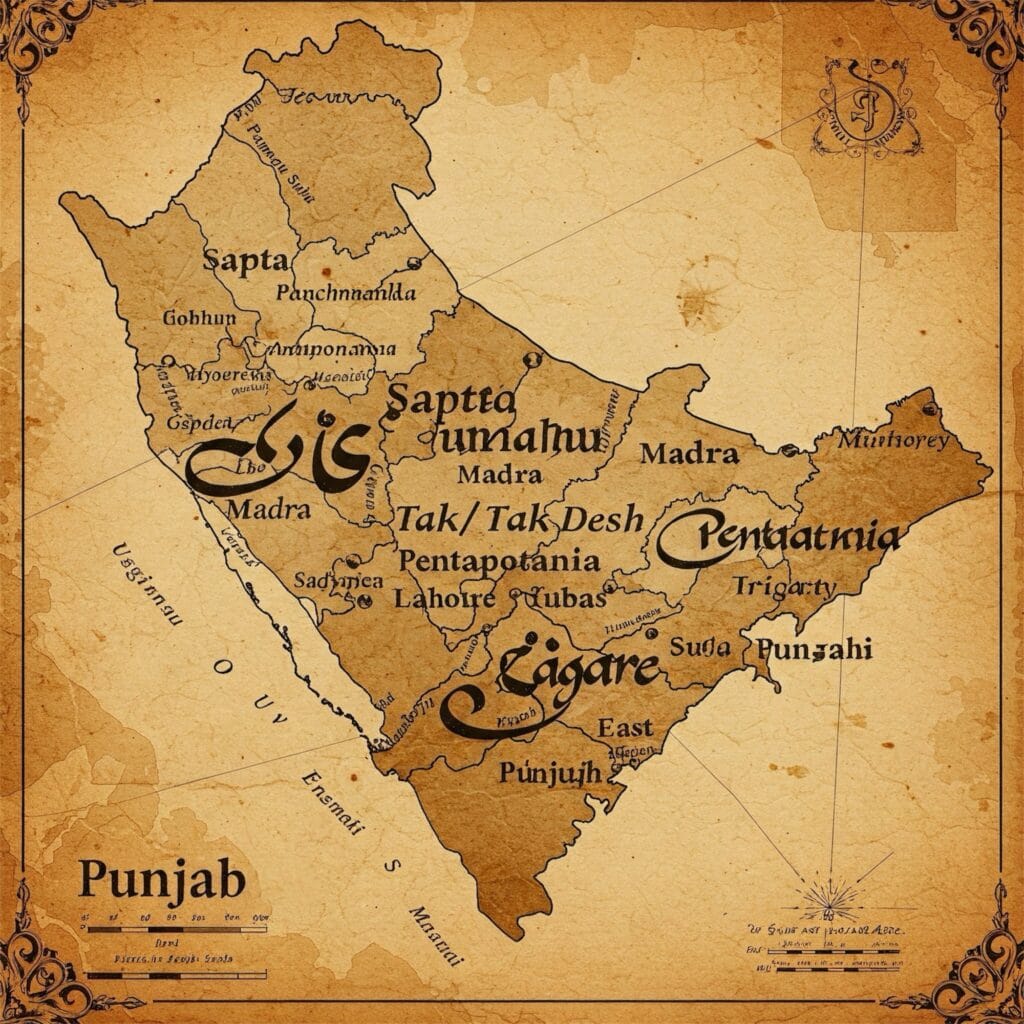
Maharaja Ranjit Singh built a very large empire.
- North: Ladakh
- South: Shikarpur
- East: River Sutlej
- West: Peshawar
His Smart Policy for Conquered Areas
Maharaja Ranjit Singh did not just win lands; he knew how to rule them well. His rules for administration were very smart:
- Equal Treatment: His policy was the same for everyone. He treated Sikh, Hindu, and Muslim rulers equally.
- Peaceful Surrender: If a ruler accepted his rule without a fight, Ranjit Singh gave their land back to them.
- Taking Over by Force: If he had to take a ruler’s land by fighting, he did not punish the ruler. Instead, he gave them a good job in his court or gave them land to live on.
- Strict Punishment: Only those who fought against him and caused trouble were punished strictly.
- Using Local Officers: He kept the local officers in their jobs. This helped keep peace in the area and allowed him to use the skills of smart local people to run the administration smoothly.