Maharaja Ranjit Singh was one of the most important rulers in the history of Punjab. He belonged to the Sukarchakia misl and gradually transformed his small territory into a large and powerful empire. His bravery, leadership qualities and military skills helped him establish the Sikh Empire.
Maharaja Ranjit Singh was born in 1780 A.D. in the family of Mahan Singh, the Chief of the Sukarchakia misl. Although he could not read or write, he was highly skilled in swordsmanship, horse-riding and warfare. He showed great courage from an early age.
When Maharaja Ranjit Singh took control of the Sukarchakia misl in 1797 A.D., Punjab was passing through a period of political instability. Through his ability, courage and determination, he gradually established a powerful empire.
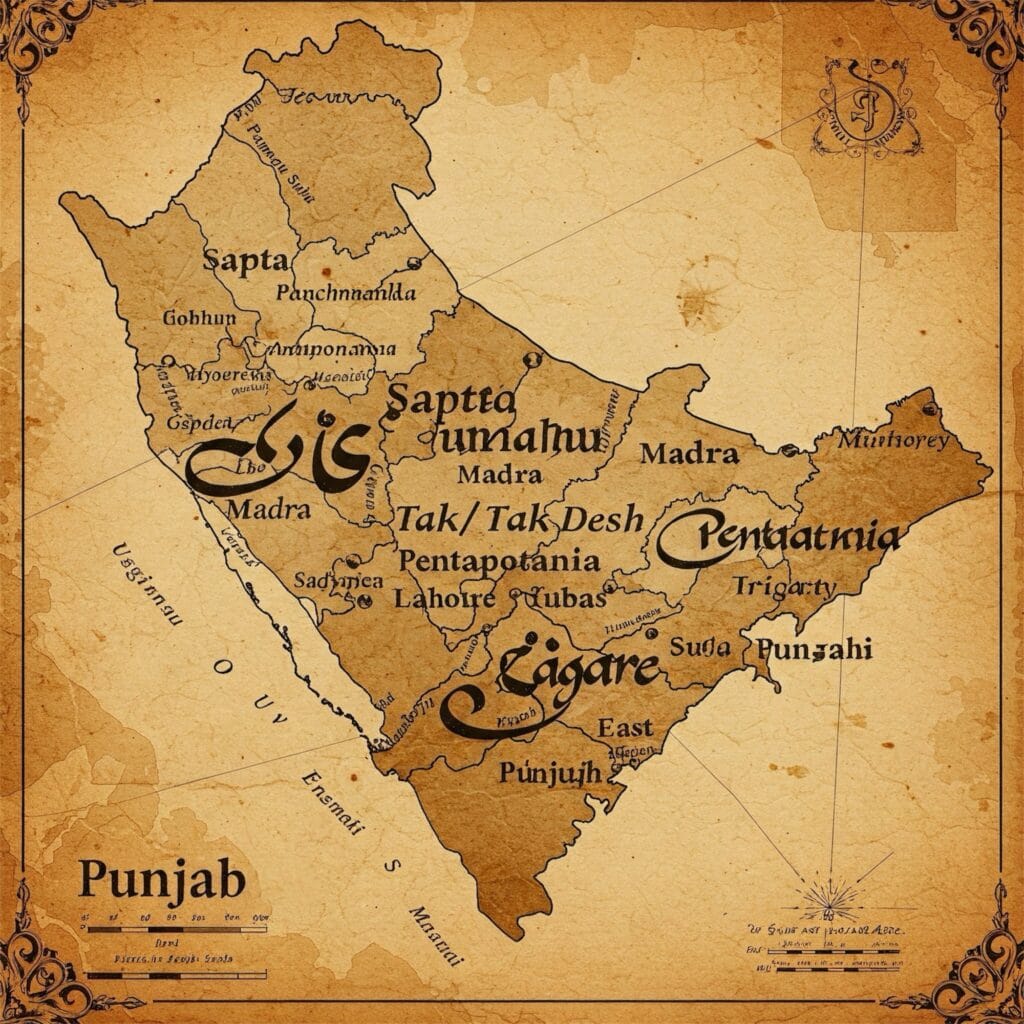
At its height, the boundaries of his empire extended from Ladakh in the north to Shikarpur in the south, from the River Sutlej in the east to Peshawar in the west. This was one of the greatest achievements of Maharaja Ranjit Singh.
Early Life and Career of Maharaja Ranjit Singh
Birth and Parentage of Maharaja Ranjit Singh
Maharaja Ranjit Singh was born in 1780 A.D. His father, Mahan Singh, was the Chief of the Sukarchakia misl. His mother’s name was Raj Kaur, who was the daughter of Gajpat Singh, a Phulkian Sardar of Jind. Since Raj Kaur belonged to the Malwa region of Punjab, people popularly called her Mai Malwain.
The childhood name of Maharaja Ranjit Singh was Buddh Singh.
Controversy Regarding His Date of Birth
There is a difference of opinion among historians regarding the exact date of birth of Maharaja Ranjit Singh. Two different dates are mentioned in historical accounts.
First View: 2 November 1780 A.D.
- Historians such as Osborne, Griffin, McGregor, Latif, Shahmat Ali and Kanahiya Lal considered 2 November 1780 A.D. to be his date of birth.
- Modern historians Dr. B.J. Hasrat, Dr. G.S. Chhabra and K.K. Khullar also supported this date.
- Their opinion was based on the words engraved outside a room in the Haveli of Mahan Singh.
Second View: 13 November 1780 A.D.
- On the other hand, Sohan Lal Suri, the court historian of Ranjit Singh, and Diwan Amar Nath, a contemporary historian, mentioned 13 November 1780 A.D. as his date of birth.
- Modern historians Dr. N.K. Sinha, Dr. Fauja Singh, Dr. Bhagat Singh, Khushwant Singh and S.S. Johar also considered 13 November to be the correct date.
- These historians questioned the reliability of the inscription outside Mahan Singh’s Haveli. According to them, the inscription was written in English, Urdu and Punjabi. If Mahan Singh himself had ordered it to be engraved, it should have been written only in Punjabi. They believed that the British had added the inscription after annexing Punjab and had not properly considered the historical facts.
Controversy Regarding His Birthplace
Historians also have different opinions about the birthplace of Maharaja Ranjit Singh.
- Gujranwala: Some historians believe that he was born at Gujranwala.
- Badrukhan: Others believe that he was born at his maternal grandparents’ house in Badrukhan, in Jind State.
However, modern historians generally accept Gujranwala as his birthplace.
Childhood and Education of Maharaja Ranjit Singh
There is very little specific information available about the childhood of Maharaja Ranjit Singh in contemporary historical sources. He was the only son of his parents and was brought up with great care and comfort. When Ranjit Singh was approximately four years old, he suffered from smallpox. Fortunately, he recovered from the disease, but it left permanent marks on his face. He also lost the sight of his left eye.
At the age of five, he was sent to Bhag Singh’s Dharmshala at Gujranwala for education. However, he had little interest in studies and remained illiterate throughout his life.
In those days, the families of Sardars gave more importance to military training and warfare than to formal education. Ranjit Singh also spent much of his childhood playing and developing his physical skills.
He developed a deep interest in:
- Horse-riding
- Swordsmanship
- Shooting
With regular practice, he became an excellent horse-rider, a skilled bowman and an expert swordsman. His father, Mahan Singh, was impressed by his son’s courage and abilities. He once predicted:
- “The state of Gujranwala will not be a sufficient place for my brave son Ranjit Singh. He would become a great warrior.”
This statement reflected the high expectations Mahan Singh had from his son.
Acts of Bravery of Maharaja Ranjit Singh
Maharaja Ranjit Singh showed signs of courage and bravery from his childhood. He got his first opportunity to participate in a battle when he was approximately 12 years old.
Battle Against Sahib Singh Bhangi
Mahan Singh wanted Sahib Singh Bhangi to hand over Gujarat to him. However, Sahib Singh refused to accept his demand. As a result, Mahan Singh attacked the Sodhran Fort. He also took his young son, Ranjit Singh, along with him during this military campaign.
During the battle, Mahan Singh suddenly became seriously ill and had to return from the battlefield. Before leaving, he handed over the command of the army to Ranjit Singh. Despite his young age, Ranjit Singh handled the situation bravely. He defeated his enemies and captured their ammunition.
Mahan Singh was extremely happy with his son’s victory. To celebrate this achievement, he changed his son’s name from Buddh Singh to Ranjit Singh. The name Ranjit Singh means the person who wins a battle or emerges victorious in battle. After some time, Mahan Singh passed away in 1792 A.D.
Incident Involving Hashmat Khan (1793 A.D.)
Another important incident of Ranjit Singh’s bravery took place in 1793 A.D. Once, while hunting alone, Ranjit Singh reached near Ladowali village. His companions had fallen far behind him. Hashmat Khan, the Chief of the Chatha clan, wanted to take revenge for his earlier defeat at the hands of Mahan Singh. When he saw Ranjit Singh alone, he hid behind a bush and waited for an opportunity to attack him.
As Ranjit Singh passed near the bush, Hashmat Khan suddenly attacked him with his sword. However, Ranjit Singh escaped the attack and immediately counter-attacked. He killed Hashmat Khan by beheading him.
Marriages of Maharaja Ranjit Singh
Marriage played an important role in the political life of Maharaja Ranjit Singh. His marriage alliances helped him develop important political relationships.
First Marriage with Mehtab Kaur (1796 A.D.)
When Ranjit Singh was approximately six years old, he was engaged to Mehtab Kaur. Mehtab Kaur was the daughter of Gurbaksh Singh and the granddaughter of Sardar Jai Singh, the Chief of the Kanhaiya Misl.
In 1796 A.D., when Ranjit Singh was approximately 16 years old, he married Mehtab Kaur with great celebration and ceremony. This marriage proved politically beneficial for Ranjit Singh. His mother-in-law, Sada Kaur, played a significant role in the growth of his political power.
Second Marriage with Raj Kaur (1798 A.D.)
In 1798 A.D., Ranjit Singh entered into his second marriage with Raj Kaur, the daughter of Khazan Singh of the Nakkai Misl.
The Triune Regency (1792–1797 A.D.)
Before becoming the direct ruler of the Sukarchakia misl, Ranjit Singh’s administration remained under the control of three important personalities.
In 1792 A.D., when Ranjit Singh was approximately 12 years old, his father Mahan Singh died. Since Ranjit Singh was still a minor, he could not immediately take complete responsibility for the administration. Therefore, the responsibility of managing the state initially passed into the hands of his mother, Raj Kaur.
However, Raj Kaur did not have sufficient administrative experience. Consequently, she transferred the responsibility of administration to her favourite, Diwan Lakhpat Rai. Later, in 1796 A.D., when Ranjit Singh married Mehtab Kaur, his mother-in-law, Sada Kaur, also began taking an active interest in the administration.
In this way, from 1792 A.D. to 1797 A.D., the administration of the Sukarchakia misl remained under the influence of three individuals:
- Raj Kaur – Mother of Ranjit Singh.
- Diwan Lakhpat Rai – Administrator appointed by Raj Kaur.
- Sada Kaur – Mother-in-law of Ranjit Singh.
This period is known as the Triune Regency. The word ‘Triune’ means a combination of three, while ‘Regency’ refers to the administration of a state on behalf of a ruler who is too young to govern independently.
Thus, the Triune Regency refers to the administration of the Sukarchakia misl by these three individuals during the early years of Ranjit Singh’s life.
End of the Triune Regency (1797 A.D.)
As Ranjit Singh grew older, he became capable of managing the affairs of his state independently. When he reached approximately 17 years of age, he took direct control of the administration and decided to end the Triune Regency.
This marked an important turning point in his political career. From this point onwards, Ranjit Singh began taking responsibility for the administration and future development of the Sukarchakia misl.
What was the childhood name of Maharaja Ranjit Singh?
Buddh Singh
Who was Maharaja Ranjit Singh’s father?
Mahan Singh
Who was Maharaja Ranjit Singh’s mother?
Raj Kaur (Mai Malwain)
To which Misl did Ranjit Singh belong?
What was Maharaja Ranjit Singh’s birthplace according to modern historians?
Gujranwala
What were the two dates associated with Maharaja Ranjit Singh’s birth controversy?
2 November and 13 November 1780
Where was Maharaja Ranjit Singh sent for education?
Bhag Singh’s Dharmshala, Gujranwala
Which disease affected Maharaja Ranjit Singh during childhood?
Smallpox
Which eye did Maharaja Ranjit Singh lose?
Left eye
Who was Sahib Singh Bhangi?
Maharaja Ranjit Singh’s opponent in the Gujarat-Sodhran campaign
What was the name of the fort attacked by Mahan Singh?
Sodhran Fort
When did Mahan Singh die?
1792 A.D.
Who was Hashmat Khan?
Chief of the Chatha clan
Who was Ranjit Singh’s first wife?
Mehtab Kaur
When did Ranjit Singh marry Mehtab Kaur?
1796 A.D.
Who was Ranjit Singh’s second wife?
Raj Kaur
When Ranjit Singh he marry Raj Kaur?
1798 A.D.
Who was Sada Kaur?
Mother-in-law of Ranjit Singh
What was the period of Triune Regency?
1792–1797 A.D.
Who were the three members of the Triune Regency?
Raj Kaur, Diwan Lakhpat Rai and Sada Kaur
When did Ranjit Singh end the Triune Regency?
1797 A.D.