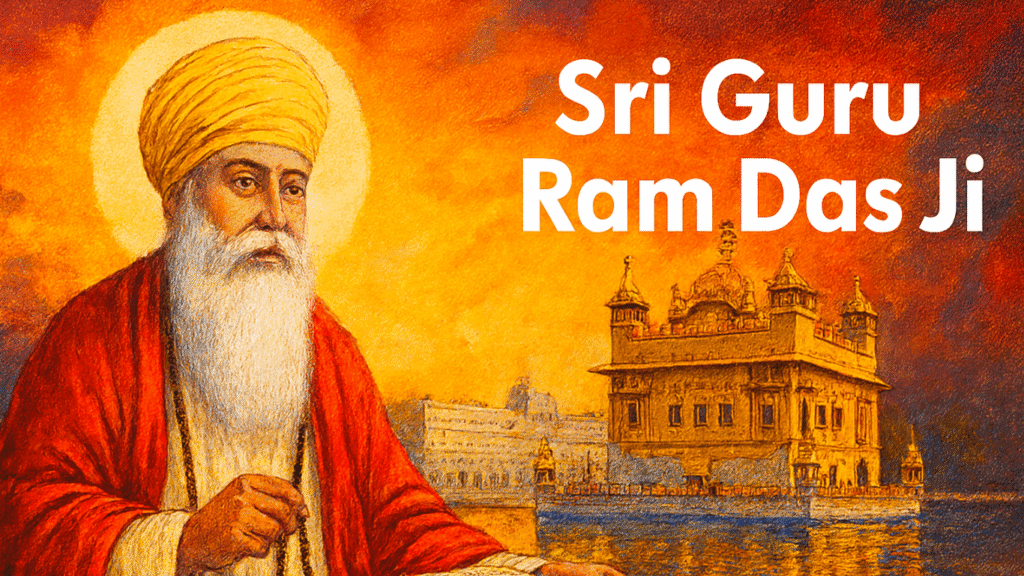
Sri Guru Gobind Singh Ji was one of the greatest personalities in history, not only of India but of the entire world. He became the tenth Guru of the Sikhs in 1675 A.D. at the age of just 9 years, after the martyrdom of his father, Sri Guru Tegh Bahadur Ji.
At that time, India was under the cruel rule of Mughal emperor Aurangzeb, who tried to force Hindus to convert to Islam. Guru Gobind Singh Ji’s leadership brought hope and courage to the people. He was a born leader, fearless warrior, visionary commander, social reformer, religious guide, and literary genius. His greatest contribution was the creation of the Khalsa in 1699, which transformed Sikhs into a powerful community of saint‑soldiers.
Early Life and Career
Birth and Parentage of Sri Guru Gobind Singh Ji
Sri Guru Gobind Singh Ji, the tenth Guru of Sikhism, was born on 22 December 1666 A.D. at Patna Sahib, a city that later became one of the most sacred Sikh shrines. He was the only son of Sri Guru Tegh Bahadur Ji, the ninth Guru, and Mata Gujari Ji, a deeply devoted and noble mother.
At the time of his birth, Guru Tegh Bahadur Ji was away in Dhaka (present‑day Bangladesh), engaged in spreading the message of Sikhism. This meant that Mata Gujari Ji and her family nurtured the infant Guru in Patna during his earliest years.
A remarkable event occurred at his birth. A respected Muslim saint, Bhikhan Shah, tested the spiritual aura of the newborn child. According to tradition, he placed two bowls before the infant — one representing Hindus and the other Muslims. The child reached out to both, symbolizing his future mission of protecting all faiths and standing for universal justice. Bhikhan Shah then declared:
“This child will grow into a great leader and guide the people.”
This prophecy proved true, as Guru Gobind Singh Ji later became the fearless protector of the oppressed and the creator of the Khalsa Panth.
Childhood of Sri Guru Gobind Singh Ji
From the very beginning, Sri Guru Gobind Singh Ji (then known as Gobind Rai) displayed qualities that set him apart as a future leader. Unlike other children of his age, he was not interested in ordinary toys. Instead, he chose bows, arrows, and small weapons as his playthings. This reflected his natural inclination towards courage and discipline.
He often gathered his companions, divided them into groups, and organized mock battles. These playful exercises were not mere games — they were early signs of his ability to lead, strategize, and inspire others. Even in childhood, he acted as a judge among his friends, settling disputes fairly and earning their respect.
One famous incident highlights his fearless nature. While playing with his companions in Patna, the Nawab of the city passed by. An arrogant official ordered young Gobind Rai to bow before the Nawab. The child refused, saying he would not bow before pride and arrogance. Instead, he encouraged his friends to make faces at the Nawab and run away laughing. This bold act showed that even as a child, he would never submit to unjust authority.
During these years, his maternal uncle Kirpal Chand acted as his guardian, ensuring his upbringing was guided with care and discipline.
Education of Sri Guru Gobind Singh Ji
After spending his early childhood in Patna, Guru Gobind Singh Ji moved with his family to Chak Nanaki (Sri Anandpur Sahib) in 1672 A.D. It was here that his father, Guru Tegh Bahadur Ji, made special arrangements for his son’s education. From the very beginning, Guru Ji’s education was designed to prepare him for both spiritual leadership and martial responsibility.
Formal Studies
- Gurmukhi: Taught by Bhai Sahib Chand, this gave Guru Ji direct access to Sikh scriptures and the teachings of the Gurus.
- Sanskrit: Learned from Pandit Harjas, which opened the door to classical Indian philosophy, literature, and spiritual texts.
- Persian and Arabic: Taught by Qazi Pir Mohammad, these languages were essential for understanding Mughal administration, Islamic texts, and diplomacy.
This multilingual education allowed Guru Ji to engage with diverse communities and broaden his intellectual horizons.
Martial Training
Alongside his studies, Guru Ji received rigorous training in martial skills.
- Horse‑riding and weaponry: Under the guidance of Bajjar Singh, a Rajput warrior, Guru Ji mastered the art of riding, archery, swordsmanship, and musketry.
- He practiced daily, combining physical strength with discipline and strategy.
Assumption of Guruship
In 1675 A.D., a turning point came in Sikh history. The Mughal emperor Aurangzeb had unleashed severe religious persecution across India. His officials forced Hindus to convert to Islam, demolished temples, and punished those who resisted. Among the victims were the Kashmiri Pandits, who faced unbearable atrocities.
Seeking protection, a group of Kashmiri Pandits approached Guru Tegh Bahadur Ji, the ninth Guru, at Sri Anandpur Sahib. They pleaded for help to save their faith. Guru Tegh Bahadur Ji, deeply moved by their suffering, declared that only the sacrifice of a holy and revered person could awaken the conscience of the emperor and protect religious freedom.
At that very moment, his young son Gobind Rai, just nine years old, entered the gathering. With innocence yet profound wisdom, he asked his father: “Who could be a holier person than you?”
These words struck Guru Tegh Bahadur Ji with divine clarity. He resolved to sacrifice his own life for the protection of Dharma. Before leaving for Delhi to face martyrdom, Guru Tegh Bahadur Ji bestowed the Guruship upon his son Gobind Rai.
Thus, at the tender age of nine, Gobind Rai became the tenth Guru of the Sikhs. His leadership marked the beginning of a new era. Later, in 1699 A.D., with the creation of the Khalsa, he came to be known as Guru Gobind Singh Ji. He held the Guruship until 1708 A.D., guiding the Sikhs through some of the most challenging times in history.
Difficulties Faced by Sri Guru Gobind Singh Ji
When Sri Guru Gobind Singh Ji ascended the Gurgaddi (spiritual throne) in 1675 A.D., he was only nine years old. Despite his tender age, he inherited enormous responsibilities at a time of crisis. The Sikh community was surrounded by both external threats and internal challenges, making his task extremely difficult.
1. Mughal Tyranny under Aurangzeb
The Mughal emperor Aurangzeb was a religious fanatic who sought to convert the entire country to Islam. He demolished temples, imposed the hated Jaziya tax, and punished those who resisted conversion. His cruelty had already led to the martyrdom of Guru Tegh Bahadur Ji, and now Guru Gobind Singh Ji had to continue the struggle against this oppression.
2. Hostility of the Hill Chiefs
The local Hill Chiefs of the Shivalik region opposed Guru Ji due to their vested interests. They feared his growing influence and military organization. Instead of supporting him against the Mughals, they often conspired against him, creating constant political and military challenges.
3. Conspiracies of Rival Sects
Groups like the Dhirmaliyas and Ramrayyias, who had failed to gain the Guruship, plotted against Guru Ji. They spread false propaganda and tried to weaken his authority. Their conspiracies added to the instability within the Sikh community.
4. Corruption in the Masand System
The Masand system, originally created to collect offerings and guide Sikhs, had become corrupt. Many Masands exploited their position, looted Sikhs, and even defied Guru Ji’s authority. This corruption weakened the unity of the Sikh Panth and demanded urgent reform.
5. Decline in Hindu Morale
Centuries of slavery under foreign rule had left the Hindu society demoralized and spiritless. Fear and hopelessness had spread widely. Guru Gobind Singh Ji recognized that it was vital to reorganize and uplift society, instilling courage and self‑confidence among the people.