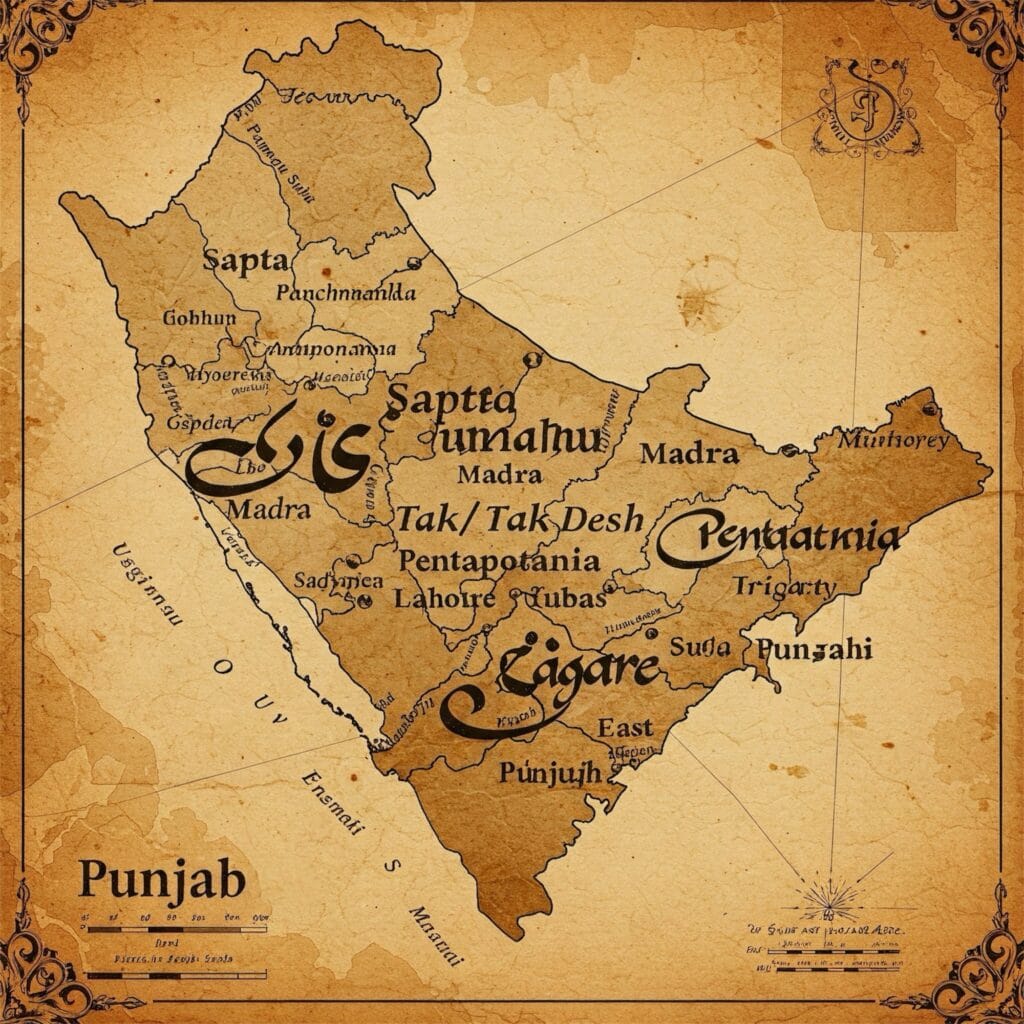
The Karorsinghia Misl was one of the most powerful Sikh confederacies (Misls) in the 18th century. It started as a small group under the guidance of Kapur Singh Singhpuria and later became a major military and administrative force in Punjab and Delhi.
Important Leaders of the Karorsinghia Misl
Sham Singh (The Founder)
Imagine being so unhappy at home that you leave everything behind to join a rebel camp. That is exactly what a young Sandhu Jat named Sham Singh did. Dissatisfied with his parents, he left his village and joined the camp of Kapur Singh Singhpuria.
In the beginning, Sham Singh had nothing. He didn’t even have proper weapons. He took baptism from Kapur Singh and managed to get only an old sword and a small horse. But his dedication was unmatched. Starting with just 10 to 15 men, he soon gathered about 300 brave horsemen.
Sham Singh was not just a warrior; he was a deeply devoted and kind man. He believed in true equality. He would never eat his community meal (langar) until everyone else had eaten. He purposely sat and ate with non-Sikhs and untouchables to prove that all humans are equal. He died without children in 1739, but his legacy lived on.
Karam Singh (The Second Leader)
When Sham Singh passed away, his nephew Karam Singh stepped up to lead. Karam Singh was a fierce warrior who took his duties very seriously.
During this time, the Mughal governor of Lahore had forcibly converted many of their relatives to Islam. Karam Singh could not accept this injustice. Along with his companion Barbara Singh, he punished the guilty men and successfully brought his relatives back into the Sikh faith.
Karam Singh also proved his bravery on the battlefield. In a fight at Jalandhar, he bravely cut off the head of the enemy commander, Khair Shah. This fearless act made him a respected and feared warrior among his enemies.
Karora Singh (The Namesake Leader)
Now enters the man who gave the Misl its official name: Karora Singh. He was a smart and influential leader from village Barki. Under his brilliant leadership, the Karorsinghia Misl grew rapidly.
Karora Singh expanded their territories to include Hariana and Sham Churasi. He built a massive and powerful army of 7,000 to 8,000 horsemen. He was so powerful that he helped the Maharaja of Bharatpur win battles, and he even defeated an Afghan commander named Buland Khan, distributing the captured wealth among his soldiers.
Tragically, Karora Singh died without children in 1761. History tells us a sad story about his death: he was either shot by a local farmer over a simple misunderstanding regarding horse fodder, or he was killed fighting the Nawab of Kunjpura.
Baghel Singh (The Most Famous Leader)
After Karora Singh’s death, a man named Baghel Singh took over. Baghel Singh had actually started as a simple attendant for Karora Singh! But his intelligence and bravery quickly made him the leader.
Baghel Singh was a master of both war and diplomacy. He made the town of Chhalondi his headquarters and commanded a huge army of 12,000 horsemen. He was so clever that he once built a fortress in the town of Tatwan just by asking the local chief for permission, eventually taking one-fourth of the town’s revenue!
He also handled the powerful Raja of Patiala brilliantly. When the Raja tried to take Baghel Singh’s villages, Baghel Singh attacked back. Realizing he was outmatched, the Raja sued for peace, got his son baptized by Baghel Singh, and became his friend.
The Grand Conquest of Delhi
Now, let’s talk about Baghel Singh’s most famous achievement: his conquest of Delhi! He attacked Delhi multiple times, but his 1783 campaign is legendary.
In February 1783, Baghel Singh marched towards Delhi with a massive army of 60,000 troops. They captured towns, collected wealth, and sent a huge sum of one lakh rupees as a religious tax to the Harmandir Sahib in Amritsar.
By March 1783, Baghel Singh entered Delhi with 40,000 troops. The Mughal Emperor was terrified. To save the city, the Emperor called upon a brilliant and brave woman named Begum Samru to negotiate peace.
Treaty of 1783
Begum Samru was a master negotiator. She visited Baghel Singh’s camp and successfully settled a peace treaty. Here is what they agreed upon:
The main Sikh army would return home, but Baghel Singh would stay in Delhi with 4,000 troops to maintain peace. In return, the Emperor allowed him to build seven historical Gurdwaras in the city. To pay for his troops and the construction, Baghel Singh was allowed to keep 37.5% of the city’s daily tax (octroi) collection. He managed the city so well that perfect peace was established!
Seven Gurdwaras
This is the most emotional and beautiful part of Baghel Singh’s story. He built seven Gurdwaras in Delhi to honor the Sikh Gurus.
He built Gurdwara Bangla Sahib where Sri Guru Har Krishan Ji stayed, and Gurdwara Teliwara for the Guru’s wives. But the stories behind Gurdwara Rikabganj and Gurdwara Sisganj are truly special.
For Rikabganj, a mosque was built over the sacred site. Baghel Singh cleverly convinced the local clerics and got written permission to dismantle it. For Sisganj, the exact martyrdom site of Sri Guru Tegh Bahadur, an old Muslim water-carrier woman named Sakhan Mai helped Baghel Singh trace the exact spot. Baghel Singh assured the locals that their mosque would be safe, and beautifully built the Gurdwara right inside the compound.
- Teliwara: Where Mata Sundari and Mata Sahib Devan stayed.
- Jaisinghpura: Now known as Gurdwara Bangla Sahib (where Sri Guru Har Krishan Ji stayed).
- Yamuna Bank: Cremation site of Sri Guru Har Krishan Ji, Mata Sundari, and Mata Sahib Devan.
- Rikabganj: Where Sri Guru Tegh Bahadur’s headless body was secretly cremated.
- Sisganj: The site of Sri Guru Tegh Bahadur’s martyrdom (built with the help of a Muslim woman named Sakhan Mai).
- Majnu ka Tila: Where Sri Guru Nanak Dev Ji and Guru Hargobind Singh Ji stayed.
- Moti Bagh: Where Sri Guru Gobind Singh Ji stayed.
A Unique Meeting with the Emperor
Before leaving Delhi, Baghel Singh did something unprecedented. He agreed to meet the Mughal Emperor, Shah Alam II, but on his own strict terms. He refused to bow down, brought a fully armed escort, and asked the streets to be cleared.
The Emperor was so impressed by his dignity that he gifted him an elephant, a horse, and a pearl necklace. The Emperor even jokingly asked to see the Sikhs “plundering.” Baghel Singh arranged a harmless, funny demonstration in a sugar-cane field, which left the Emperor highly amused and respectful.
Decline of the Karorsinghia Misl
Every great story has an ending. Baghel Singh died in 1802 without a son, which created a power vacuum. His two widows, Ram Kaur and Rattan Kaur, bravely took over the administration of their respective territories.
However, internal rebellions slowly weakened the Misal. A former follower named Sukhu Singh rebelled and declared himself the leader, causing a bitter split. Eventually, the powerful Maharaja Ranjit Singh and the British began taking over their lands.
The final chapter closed in 1848 when the British took over the last widow’s wealth. By May 1948, the remaining territories officially merged into the Patiala and East Punjab States Union (PEPSU), bringing the glorious era of the Karorsinghia Misl to a close.